





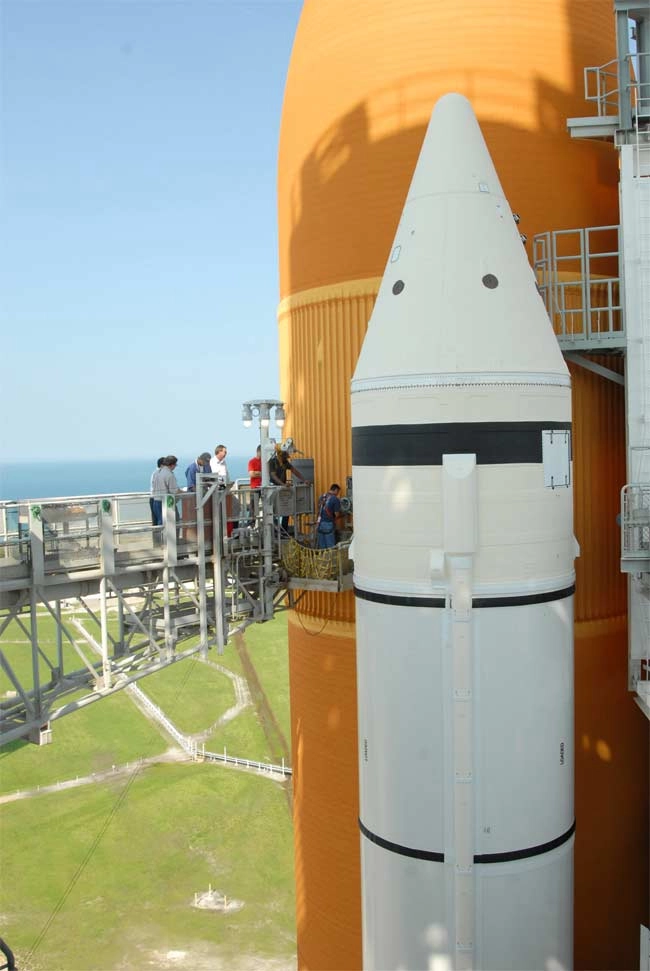
NASA willtry to launch the space shuttle Endeavour on July 11, nearlya month late, after plugging a potentially dangerous hydrogen gas leak, topmission managers said Wednesday.
Endeavour successfullypassed a leak check during a fueling test at its seaside Florida launch pad today,settingthe stage for a planned 7:39 p.m. EDT (2339 GMT) liftoff toward theInternational Space Station on July 11, said Mike Moses, who leads the shuttle?smission management team.
NASAinitially tried to launch Endeavour on June 13, then again on June 17, but the hydrogengas leak in the shuttle?s external fuel tank thwartedboth attempts.
Engineers pinpointedthe leak in a misaligned ground umbilical carrier plate (GUCP) on the tank. Theplate connects to a vent line that siphons excess hydrogen gas safely away fromthe shuttle during fueling.
?This one Ifeel really good about, that we?ve got that problem licked and we?re not goingto see another GUCP leak again on the next launch attempt,? Moses toldreporters.
Leak fix a success
Engineers replaceda Teflon seal and realigned the problematic plate using special washers to plugthe leak, which did not reappear during today?s fueling test at the Kennedy Space Centerin Cape Canaveral, Fla.
?Looks like the tank performed well,? said Endeavour?scommander Mark Polansky via his Twitter page.
Polansky is leading a seven-astronaut crew tasked withdelivering the last piece of Japan?s massiveKibo laboratory to the International Space Station during a marathon 16-daymission. It is NASA?s third shuttle flight of the year, but the first to thestation since the outpost doubledits crew size to six people last month.
NASA has strictrules on the amount of hydrogen gas that can be near a space shuttle at launchtime because the extremely flammable gas can pose an explosion risk to the shuttleand its astronaut crew.
Duringfueling, the space shuttle?s external tank is loaded with about 526,000 gallonsof super-cold liquid hydrogen and liquid oxygen. Some of that hydrogen boilsinto gas over time and must be safely vented away from the shuttle and beharmlessly burned off elsewhere.
Endeavour?srepaired tank passed today?s test with flying colors, mission managers said.
"Therewere absolutely no leak indications whatsoever noted on the two leakdetectors," said NASA launch director Pete Nickolenko. "We'llcontinue to look at the data, and our next step is to move toward launch."
The Endeavour astronauts are slated to go into quarantine thisweekend and return to their Florida spaceport on Tuesday, Polansky said. The countdownto Endeavour?s July 11 launch will begin next Wednesday night, NASA officials said.
Atlantis window work
While oneteam of engineers prepares Endeavour for launch, another is tacklinga window issue on the shuttle Atlantis.
During theshuttle?s May flight to the Hubble Space Telescope, a work light knob jammed upagainst a flight deck window pane and dashboard panel. Initially the knob wasstuck fast, but engineers managed to remove it on Tuesday by pressurizingAtlantis? cabin and applying dry ice on the knob.
Moses said techniciansplan to take a mold of the window to see if the knob has caused damage thatwould require replacing the inner window, a potentially lengthy repair that couldsideline Atlantis for up to eight months.
The shuttleis currently slated to launch supplies and parts to the International SpaceStation on Nov. 12.
?It couldtake a very long time, it sounds very scary,? Moses said of any serious repair.?But then again, I?ve learned this team is really good at re-sequencing andcoming up with some creative ways to do some work in parallel.?
- New Video - Space Station to Get Japanese Porch
- New Video - Meet the STS-127 Shuttle Astronauts
- Video Show - The ISS: Foothold on Forever
