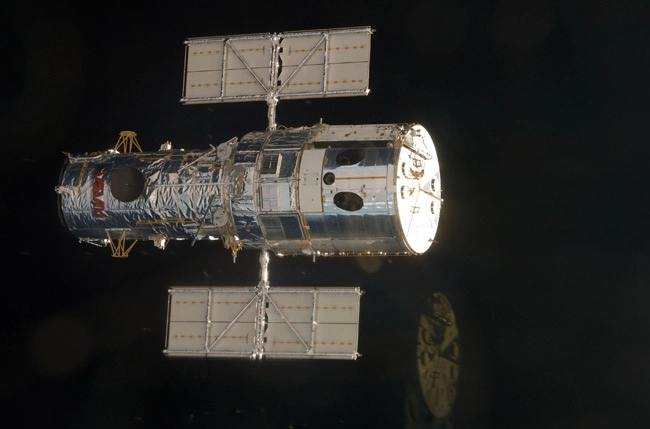
HOUSTON - The vital heat shield on the shuttle Atlantis appears to be in good shape after nearly a week linked with the Hubble Space Telescope, which circles the Earth in a region known to be littered with more junk than NASA's usual orbital haunts.
After repairing the 19-year-old Hubble, Atlantis astronauts fired their shuttle's engines on Tuesday to lower part of their orbit out of the space telescope's 350-mile (563-km) high neighborhood as a precaution against debris hits.
They also took a second look at their shuttle's heat shield to make sure the protective panels lining its wing edges and nose cap were free of any new damage from space debris or micrometeorites. The survey is a now-standard late inspection, but NASA isn't expecting any surprises.

"There wasn't anything specific that anybody was worried about," said Tony Ceccacci, lead flight director for the mission, in a news briefing here at NASA's Johnson Space Center.
Analysis under way
Engineers on Earth are expected to complete their analysis of today's inspection late Wednesday.
Atlantis is due to land Friday to end an 11-day mission to overhaul the Hubble Space Telescope for the fifth and final time. The astronauts performed five challenging spacewalks to install two new instruments, perform vital maintenance and repair two broken instruments that were never designed to be fixed in space.
The astronauts left Hubble more powerful than ever when they redeployed the space telescope earlier today.
NASA has said Atlantis faced a higher than usual risk of damage from space debris -about a 1-in-229 chance — at Hubble's height. The International Space Station orbits Earth at about 220 miles (354 km), where it and visiting shuttles face a 1-in-300 chance of a serious debris strike.
Because of their different altitudes and orbits, Atlantis cannot reach the safe haven of the space station if in the unlikely event it is damaged beyond repair. In an unprecedented precaution, NASA has a second shuttle — Endeavour — standing by on a Florida launch pad ready to fly a rescue mission in case one is needed.
Healthy shuttle
NASA has kept a close watch on shuttle heat shield health since the 2003 Columbia tragedy, where a piece of launch debris damaged that shuttle's heat shield and led to the loss of the vehicle and its seven-astronaut crew. Now, shuttle crews scan their heat shield twice every mission to check for damage.
Earlier in the Hubble flight, NASA gave Atlantis a clean bill of health with respect to launch debris. That's not to say the shuttle reached this point completely unscathed.
During the shuttle's May 11 launch, a small piece of debris popped free from Atlantis' attached external tank and left a series of shallow nicks in four of the black, heat-resistant tiles on the spacecraft's starboard side edge.
The damage is minimal — just small, shallow dings in thick tiles just forward of where Atlantis' fuselage meets its starboard side wing.
LeRoy Cain, NASA's deputy shuttle program manager, said image analysts found that the damage posed no risk to Atlantis or its crew.
Wing-mounted sensors also detected a small impact to a heat shield panel on Atlantis' starboard wing while the shuttle was in Hubble's high orbit. But the hit was too weak to cause any damage, Cain added.
At one point, a piece of debris created during a Chinese anti-satellite test in 2007 flew relatively close by the shuttle, but not close enough to require astronauts to move out of the way.
Even at the lower orbit, Ceccacci said Mission Control will not relent on their watch for space debris and the health of Atlantis.
"The only sigh of relief you're going to get from me is when the wheels are on the ground," Ceccacci said. "Until we get them home, you still have that anxiety in your heart."
SPACE.com is providing continuous coverage of NASA's last mission to the Hubble Space Telescope with senior editor Tariq Malik at Cape Canaveral and reporter Clara Moskowitz in New York. Click here for mission updates and SPACE.com's live NASA TV video feed.
