This storywas updated at 6:29 p.m. EDT.
HOUSTON - Spaceshuttle Discovery returned to Earth on Saturday, ending a successful 13-daymission that completed the International Space Station?s backbone and broughtthe outpost to full power and symmetry with the addition of two final solararray wings.
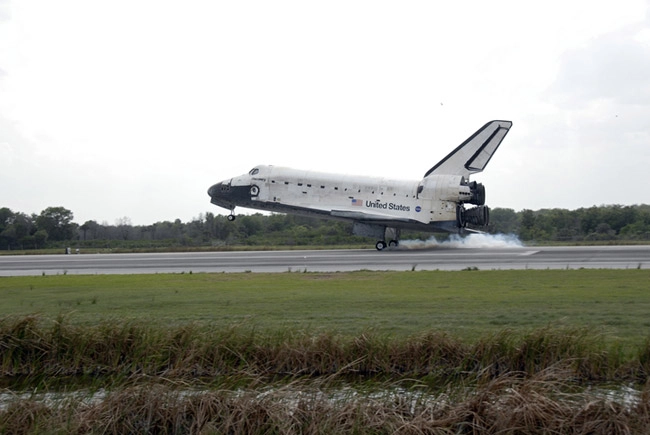
Discovery?sSTS-119 commander Lee Archambault piloted NASA?s oldest orbiter toa safe touchdown at 3:13:17 p.m. EDT (1913:17 GMT) on Runway 15 at theKennedy Space Center?s Shuttle Landing Facility in Cape Canaveral, Florida. Thereturn was delayed by one orbit to provide time for clouds and gustingcrosswinds to clear from the vicinity of the landing strip.
"Welcomehome Discovery after a great mission to bring the International Space Stationto full power," astronaut George Zamka told the crew from Mission Controlhere.
"Thank youvery much, it is good to be back home," Archambault replied.
Returning withArchambault and Antonelli on Discovery were mission specialist John Phillips,lead spacewalker Steven Swanson, educator astronauts Joseph Acaba and RichardArnold II, and Sandra Magnus, who was returningfrom the space station after 134 days in orbit. She traded places with Japan?sfirst long-duration crew member, Koichi Wakata, who launched with to thestation with the STS-119 crew.
?I'm lookingforward to being home and seeing everyone today, hopefully," Magnus saidearly Saturday.
Spacestation at full power
The STS-119crew launched on March 15, bringing the 30,000-pound (13,607-kg) Starboard 6,or S6, truss segment, a 45-foot (13.7-meter) long girder tipped with two115-foot (35-meter) solarwings to the space station.
Swanson andArnold bolted the truss segment to its adjoining piece on the right edge of thestation during the mission?s first spacewalk, completing the station?s 356-foot(108-meter) backbone. Two subsequent spacewalks by Swanson, Arnold and Acabaworked on configuring the outpost?s outside equipment for future shuttlemissions, as well as the arrival of Japan?s first unmanned cargo craft, theHTV.
With the S6truss installed, the astronauts deployed the segment?s solar arrays, nearlydoubling the available power to the station. With all eight wings extended, thestation - now symmetrical in appearance - generates enough electricity to power42 average-size homes. It is now about 81 percent complete.
?This is reallyan amazing time and an amazing mission,? said NASA space operations chief WilliamGerstenmaier after Discovery landed.
Gerstenmaiersaid he was awestruck at the first images of the space station with itscomplete power grid, which astronauts beamed down Wednesday after undocking.
?That?sprobably the most amazing image that you can ever imagine,? he said.
Discovery alsodelivered a replacement distillation unit for the station?s malfunctioningurine processing assembly, part of a water recovery system that will be used torecycle the crew?s waste into potable water. After some initial trouble thatrequired the replacement of filters, space station commander Michael Fincke wasable to get the recycler toprocess urine,and samples of the resulting water were brought back to Earth on Discovery tobe tested.
The addition ofthe solar arrays and the installation of the water recovery system wasnecessary before the space station could increase its crew compliment fromthree to six residents.
With bothaccomplished, the orbiting lab was ready forthe arrivalof the Russian Soyuz TMA-14 spacecraft at 9:06 a.m. EDT (1306 GMT) Saturday,just a few hours before Discovery landed, delivering the station?s nextincrement crew and American billionaire Charles Simonyi, the world?s firstrepeat space tourist. The Expedition 19 astronauts will continue to ready theoutpost before helping to form the first six-person crew in May.
Tripping theboundary
WhileDiscovery?s heat shield received a clean bill of health with respect to launchand orbital debris, mission managers were still expecting the shuttle to ?trip the boundary layer?early as a part of an experiment designed to improve engineers? understandingof how spacecraft re-enter the atmosphere.
Engineers addeda slight protuberance, or ?speed bump,? to one of the thousands of heat shieldtile on the spacecraft?s underbelly to disturb the hypersonic airflowsurrounding the orbiter, creating turbulence that, in turn, should result inincreased heating downstream of the specially-fabricated tile?s position nearthe rear of the left wing. The bump posed no risk to the shuttle or its crew,mission managers said.
?Obviously theshuttle is one of a kind, it?s a winged vehicle flying at these very high Machnumbers, and that boundary layer transition [test] will allow us to collectsome very good heating data,? entry flight director Richard Jones Friday hereat the Johnson Space Center.
The bump shouldhave its effect as the orbiter travel Mach 15, or 15 times the speed of sound.In addition to sensors installed under and around the tile, a U.S. Navyaircraft will fly under Discovery?s path, recording infrared imagery of theorbiter?s belly as it trips the boundary.
The results ofthis test may help NASA create a better heat shield for its next generationcrew exploration vehicle, Orion, being designed to take astronauts to and from thespace station, as well as return humans to the Moon.
Other than thatintentional protuberance, Jones said that the shuttle was safe for reentry.?This mission has just been exceptionally clean, Discovery and her crew havebeen performing just flawlessly,? he commented.
Discovery?smission marked the 125th for NASA?s space shuttle program and the 36th flown bythe orbiter. NASA plans to launch up to eight more shuttle missions by 2010 to completestation construction and one more - set to launch May 12 - to overhaul theHubble Space Telescope one last time.
The mission wasalso the 100th flight since the loss of space shuttle Challenger in January1986, which was highlighted by the delivery of the 100th bouquet of flowers toMission Control by the Shelton family of Texas. Space enthusiasts Mark, Terryand their daughter MacKenzie Shelton have been sending the roses - one for eachspace shuttle crew member and a white rose for those lost in flight - for everyshuttle flight over the last 21 years.
?They representmany families out there that are looking at NASA and are appreciative of thework that we hope we are doing for everyone out there,? said Jones.
- New Video - President Obama Talks With Shuttle, ISS Crews
- New Video - See the Space Station from Earth
- New Show - Inside the International Space Station