


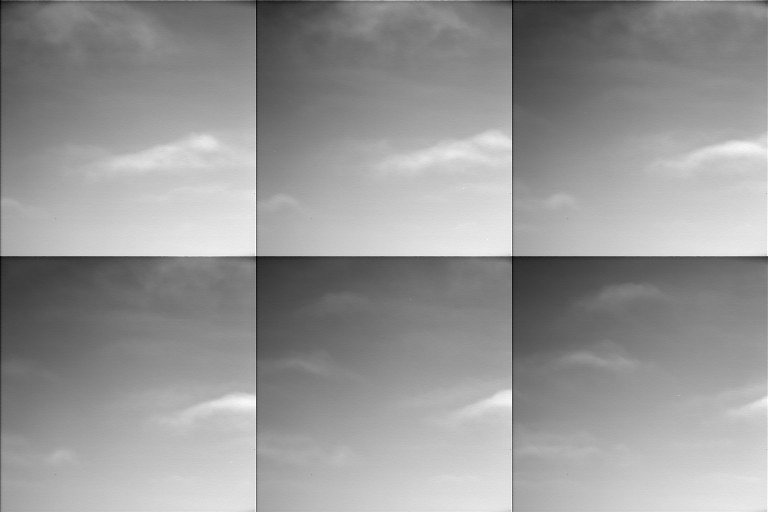
There's a new Martian movie, though it's not quite feature-length.
A series of still images taken by the Phoenix Mars Lander of water-ice clouds sailing overhead on the red planet has been turned into a short animation by NASA mission scientists.
"The images were taken as part of a campaign to see clouds and track wind. These are clearly ice clouds," said Mark Lemmon of Texas A&M University and the lead scientist for the lander's surface stereo imager, which snapped the pictures of the clouds during a 10-minute period on Aug. 29. The resulting animation is just a few seconds long.
Phoenix, which landed on Mars on May 25, has also begun to analyze a sample of Martian dirt take from the deepest trench dug so far by the lander.
On Sunday, Phoenix's robotic arm sprinkled a small fraction of the estimated 3 cubic inches (50 cubic centimeters) of dirt that was scooped out of the informally-named "Stone Soup" trench on Saturday.
The $420 million mission, which began its 30-day extended mission on Aug. 27, is analyzing the Martian regolith for signs of potential past habitability.
This latest sample will be analyzed by the lander's wet chemistry lab, which dissolves samples in water brought from Earth to see what soluble minerals might be in the dirt.
The Stone Soup trench, where the sample was taken from, lies between two of the polygon-shaped hummocks that cover the vast arctic plains where Phoenix landed. Mission scientists are interested to see whether the material in this sample will be different from earlier samples, which were taken from trenches near the center of a polygon.
Images of the sample material taken inside the scoop on Sunday showed that the dirt was clumping differently than it had in previous samples.
"This is pretty exciting stuff and we are anxious to find out what makes this deeper soil cloddier than the other samples," said Doug Ming, a Phoenix science team member from NASA's Johnson Space Center in Houston.
A series of images of fresh dirt dug and discarded from Stone Soup have given the team some clues as to the composition of the sample. Observations of the spectrum of the regolith don't show any signs of water-ice binding the particles together, but bigger clumps of dirt have a texture that could indicate a high concentration of salts. The wet chemistry lab would be able to identify any soluble salts in the sample.
