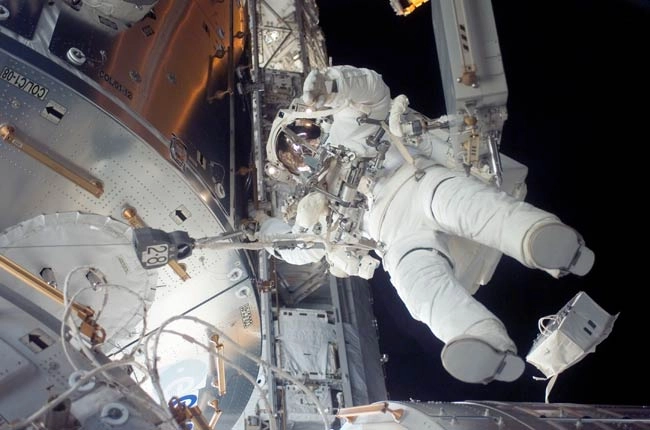
HOUSTON — Two astronauts will venture outside the International Space Station (ISS) to catch an orbital baton of sorts on Saturday when they help attach the shuttle Endeavour's inspection boom to the high-flying laboratory.
Astronauts Robert Behnken and Mike Foreman are set to begin the spacewalk at 5:23 p.m. EDT (2123 GMT) to move the sensor-tipped boom to the ISS to aid a future shuttle mission, though the chore requires intricate choreography between spacewalkers and the crane-like robotic arms of Endeavour and the station.
"It might seem like a kind of routine maneuver, but it's really not," said Endeavour shuttle pilot Gregory H. Johnson, who will wield the station's Canadarm2 robotic arm, before flight. "This particular task keeps me up at night a bit."

Not only are astronauts handing off the 50-foot (15-meter) long boom between two robotic cranes, but they must also maneuver it within inches of the space station's main truss so spacewalkers can grab it, then attach a lifeline-like heater cable to keep its laser and camera sensors from freezing. The entire activity has a 90-minute deadline, Johnson said.
"We have a very tricky set of hand-offs," lead shuttle flight director Mike Moses said of the boom's move late Friday.
Shuttle astronauts used the inspection boom Friday afternoon to check Endeavour's wing edges and nose cap — which experience the hottest temperatures during reentry — for damage by orbital debris or micrometeorites. It is being left outside the ISS for NASA's shuttle Discovery, which cannot carry its own boom when it launches May 25 because its cargo — the space station's tour bus-sized Japanese Kibo laboratory — takes up too much room in the payload bay.
The fuel tank that will feed Discovery's launch in late May departed NASA's New Orleans-based manufacturing plant this week for the agency's Kennedy Space Center spaceport in Cape Canaveral, Fla. Delays in constructing additional shuttle fuel tanks may lead to a slip for NASA's planned Aug. 28 launch of the Atlantis orbiter on the final mission to overhaul the Hubble Space Telescope.
Today's spacewalk will mark the fifth for Endeavour's planned 16-day mission, a new record for shuttle astronauts visiting the space station. Before today, the only shuttle flights to feature five spacewalks were Hubble service calls, mission managers have said.
Balky station joint beckons
After moving Endeavour's inspection boom to the station, the spacewalkers will renew NASA's scrutiny of an ailing rotary joint designed to turn the station's two starboard solar wings like a paddlewheel.
The survey is the latest in a series of hunts for the exact cause of damage that contaminated the 10-foot (3-meter) wide joint with metallic grit, crippling its ability to maximize power production by continuously tracking the sun. A spacewalker discovered the grit in October.
"We still haven't found the root cause of where this debris came from," Moses said.
Astronauts have searched beneath most of the joint's 22 protective covers for signs of damage in previous spacewalks, and found one potential divot that Foreman will revisit during today's excursion. He will also check under the few remaining covers for dings.
"If it is a pockmark, that might give us a hint toward our smoking gun," Moses said of the potential ding.
The station's starboard gear is built to rotate outboard U.S. solar arrays sunward in order to generate as much power as possible for the growing orbiting lab. A similar gear on the station's portside is working fine, mission managers have said.
Engineers on Earth are hoping to pinpoint the exact source of the contamination in order to decide how best to repair it, though any fix would likely require multiple spacewalks to switch to a backup gear ring. Despite the addition of new modules this year, as well as a massive Japanese lab due to arrive in late May, the station's power supply should be sufficient to support additional construction through the fall, mission managers have said.
"It's a huge assembly," Moses said. "It just takes awhile to go look at it and make sure you've covered every piece of it."
Experiment showdown
While Foreman works on the joint, Behnken will tackle a stubborn materials exposure experiment that refused to latch into place outside the station's European Columbus lab during a Thursday spacewalk because of locking pins that were too large. The spacewalkers will try to wedge the experiment in place, or else secure it with smaller pins and then lash it down with wire ties for good measure.
Mission Control radioed up intricate instructions on exactly how to manhandle the experiment into submission with the shuttle crew's morning mail Friday as NASA engineers analyzed an odd glitch in one of the shoulder joints of the station's new Canadian-built maintenance robot Dextre. The $209-million robot is unable to pinpoint what position the joint is in, though engineers are drawing up a potential software patch, ISS flight director Ginger Kerrick said early Friday.
"There's still more work to be done on that, but [it's] no impact to the mission," she added.
Commanded by veteran shuttle flyer Dominic Gorie, Endeavour's STS-123 mission is nearing the home stretch. To date, shuttle astronauts have swapped out one ISS crewmember, delivered the Dextre robot and installed a storage closet for Japan's Kibo lab.
The shuttle is due to undock from the space station late Monday and return to Earth Wednesday evening.
NASA is broadcasting Endeavour's STS-123 mission live on NASA TV. Click here for SPACE.com's shuttle mission coverage and NASA TV feed.
