





This story was updated at12:30 p.m. ET.
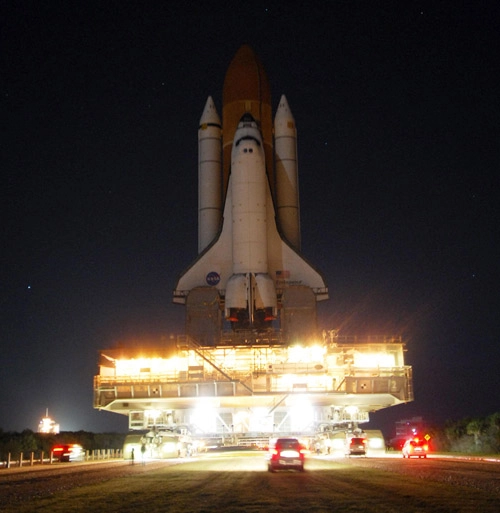
CAPE CANAVERAL, Fla.— NASA mission managers gave space shuttle Endeavour and itsseven-astronaut crew a green light for a predawn launch attempt on Tuesday asfair weather continues to grace the Florida space coast.
Headed by commander DominicGorie, the STS-123 space station construction mission will deliver a monstroustwo-armed Canadian robot, Japan's first permanent room in space and a suite ofmedical, biological and physics experiments to the International Space Station(ISS). Gorie andhis crew are slated to lift off from Pad 39A here at Kennedy Space Center at 2:28 a.m. EDT (0628 GMT) on Tuesday.
"It's great to be hereon the verge of this truly international mission," Scott Higginbotham,STS-123 payload manager, said this morning. "This has been a long campaignfor us, but both my team and our international partners are excited for theopportunity to finally see ourhardware do its thing in space."
Shuttle weather officer Lt.Col. Patrick Barrett said it should be clear skies across Florida throughTuesday — ideal conditions for the highly anticipated night launch ofEndeavour.
"We're expectingfavorable conditions all the way through tanking into launch time,"Barrett said, noting that weather has no chance to hold up fueling of the100-ton orbiter's 15-story fuel tank and only a 10 percent chance of scrubbingthe space shot.
Glove check
LeRoy Cain, chair of NASA'smission management team, said the agency has found no launch-hindering issues,but did note that a close watch will be kept on troublesome spacesuit glovesduring no less than five spacewalks planned for the STS-123 mission.
"We did find that wehad a small tear in one of the [extravehicular activity] gloves that was usedin a previous shuttle docked mission," Cain said of Atlantis' STS-122mission. He explained that the damage wasn't discovered until the orbiterreturned to Earth last month, when technicians examined the gloves.
Although unlikely, NASA is concernedthat tears or holes in the Vectran-coated gloves could breach an astronaut'spressurized spacewalking gear, and the problem has prompted glove redesignefforts, Cain said. STS-118 astronaut Rick Mastracchio detected damage during aspacewalk in August 2007, prematurely ending the outing.
"We've been lookingvery closely at causes," Cain said, noting that dings from tiny pieces of spacedebris in handrails the astronauts grab is likely the culprit. "It'sthings like that that we're looking for."
Night walkers
STS-123 spacewalkers RickLinnehan, Robert Behnken, Mike Foreman and Garrett Reisman — an ISScrewmember replacement — will frequently check their gloves for damageduring the mission, Cain said. Also set to launch aboard Endeavour with the spacewalkersand commander Gorie is pilot Gregory H. Johnson and JAXA astronaut Takao Doi.
To prepare for theovernight hours of their 16-day mission, hailed as the longest station-boundshuttle flight NASA has ever attempted, the astronauts went to sleep around8:30 a.m. EDT (1230 GMT) Sunday morning.
The crew has shifted theirsleep schedule to opposite that of a normal work day because the space station,traveling at more than 17,500 mph (28,200 kph), is in a fixed orbit that offersEndeavour only a 10-minute opportunity each day to chase it down.
From Earth to thestation
As NASA gears up for itsown launch, test director Jeff Spaulding congratulated the European SpaceAgency (ESA) on their successfullaunch of the automated cargo spaceship Jules Verne, now bound for thespace station.
"We're very happy tohave that in orbit," Spaulding said of the double-decker bus-sizedspacecraft, which can ferry three times as many supplies than Russian Progressspacecraft.
Spaulding also noted that launchpreparation crews at KSC haven't missed a beat in preparing Endeavour just onemonth after shuttle Atlantis launched with the ESA's giant Columbus laboratoryon board.
"All of our systems atthis point are in great shape, our teams are ready to go," Spaulding said."They're very excited to be back again in this posture where we'll be ableto launch just over a month or so from our last launch."
- NEWVIDEO: Danger on the Pad: Shuttle Astronauts Practice Escape Drill
- VIDEO:ESA's New Science Laboratory
- VIDEO:Part 1: Europe's First ISS Cargo Ship, Part2