





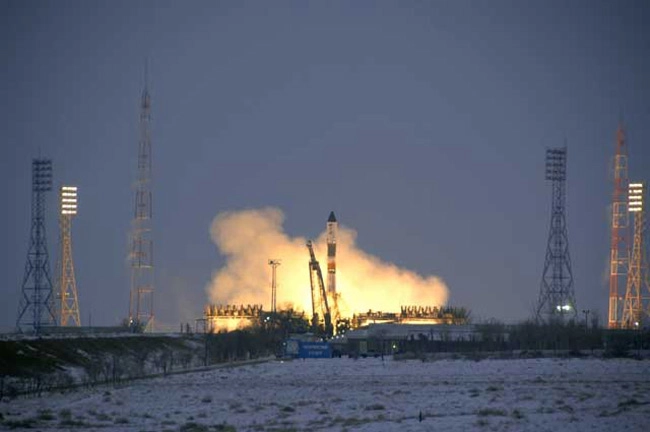
An unmannedRussian cargo ship rocketed toward the International Space Station (ISS) Tuesdayto deliver fresh supplies for the orbiting laboratory?s astronaut crew.
The Progress28 freighter launchedinto orbit at 8:03 a.m. EST (1303 GMT) atop a Russian-built Soyuz rocketfrom the Central Asian spaceport of Baikonur Cosmodrome, beginning a three-dayrun toward the ISS.
Tuckedaboard the automated cargo ship are more than 2.5 tons of food, air, water andother vital supplies for the station and its three-astronaut Expedition 16 crew.The spacecraft is due to arrive at the station?s Russian Pirs dockingcompartment on Thursday at 9:38 a.m. EST (1438 GMT), just a few hours beforeNASA?s space shuttle Atlantis is scheduled to launch its own mission to theISS.
Russia?s disposable Progress spacecraftare similar in appearance to its astronaut-carrying Soyuz vehicles, but areoutfitted to make periodic deliveries of fresh supplies, equipment and vitalrocket propellant to the space station.
Progress 28is carrying about 100 pounds (45 kg) of oxygen, 925 pounds (420 kg) of waterand some 2,925 pounds (1,327 kg) of dry supplies like food, clothing andequipment. About 1,165 pounds (528 kg) of propellant is stored in thespacecraft?s tanks.
The newsupply ship is the first of a seriesof visiting spacecraft bound for the ISS over the next few months. Itspredecessor, Progress 27, departed the space station early Monday with a loadof trash and unneeded items for fiery disposal by burning up in the Earth?satmosphere.
Following Progress28?s arrival on Thursday, NASAhopes to launch the Atlantis shuttle and its STS-122 crew to the spacestation, where astronauts will deliver the EuropeanSpace Agency?s Columbus laboratory. Atlantis is slated to dock at the ISSon Saturday.
Progress28, meanwhile, is scheduled to leave the station on Feb. 15, NASA officialssaid. A new European Space Agency cargo ship, the Automated Transfer VehicleJules Verne, will follow with a launch as early as Feb. 22 and dock as early asMarch 15, ESA officials have said.
Two more visitingshuttle missions and a Soyuz spacecraft carrying a new Expedition 17 crew arealso expected to arrive at the station by the end of April.
- SPACE.com Video Interplayer: NASA's STS-122: Columbus Sets Sail for ISS
- The Great Space Quiz: Space Shuttle Countdown
- VIDEO: ISS Commander Peggy Whitson Takes Charge
