


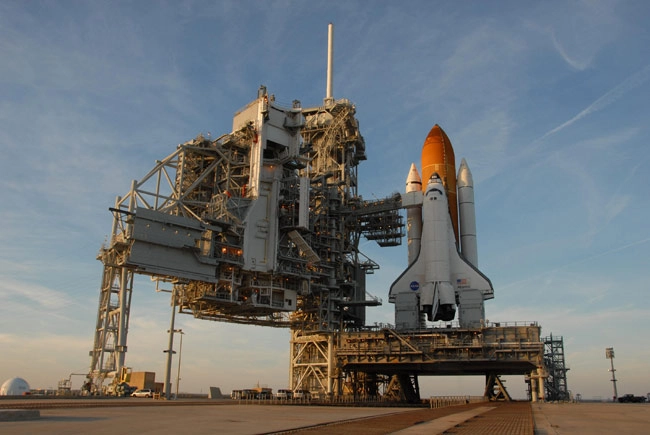
NASA?s shuttleAtlantis is on target for a Feb. 7 launch so long as a kinked radiator hose doesn?tput a crimp in the agency?s plans.
Top missionmanagers officially gave Atlantis? and its crew approval Wednesday to press aheadwith next week?s planned launch toward the International Space Station (ISS),where astronauts will deliver a newEuropean lab to the International Space Station (ISS). But, they added, engineersmust determine whether a bent radiator hose in the orbiter?s payload bay issafe to fly or should be replaced.
?This hoseon Atlantis is not leaking. It?s just bent the wrong way,? NASA?s shuttleprogram manager Wayne Hale told reporters in a Wednesday briefing.
Engineersdiscovered the kinked metal hose late Tuesday during an inspection prompted by asimilar find last month aboard Atlantis? sister ship Discovery. Missionmanagers want to be sure the hose?s atypical position is not a sign that itcould leak during flight, though Atlantis is equipped with a backup coolingsystem even if that were to occur, Hale added.
?The$64,000 question is: Can we really straighten this hose out and live with it ormaybe not even straighten it and live with it, or do we have to replace it,?Hale said. ?I think we?ll have a good answer by Saturday.?
While replacing the hose, if such a fix is needed at all, could delay Atlantis? flight, Hale said he is confident engineers will find theright solution.
?If it?s notsafe to fly, we won?t fly,? he said.
In themeantime, Atlantis remains on track for an afternoon liftoff on Feb. 7 aftertwo months of delays spawned by fuel gauge sensor glitches that prevented two launchattempts last month. The fuel gauges, known as engine cutoff sensors, are partof a backup system to shut down an orbiter?s three main engines before its fueltank runs dry.
Engineerstracked the glitch to an electrical connector near the bottom of the shuttle?s15-story external fuel tank. The connector, they found, was prone to open circuitswhen Atlantis? fuel tank was filled with its super-cold liquid hydrogen andliquid oxygen propellant.
Since then,tank engineers have redesigned the connector to form a permanent bond betweenits exterior plug and interior wires. The fix, NASA officials said, preventsice or water from seeping into the connector and freezing to create opencircuits.
?They?vegot a good fix in place,? said William Gerstenmaier, NASA?s associateadministrator for space operations. ?The failure will not reoccur again.?
Commandedby veteran spaceflyer Stephen Frick, Atlantis? seven astronauts are chargedwith delivering the European Space Agency?s Columbus lab to the ISS andswapping out one member of the outpost?s Expedition 16 crew.
Stationcommander Peggy Whitson and flight engineer Dan Tani performed a seven-hourspacewalk earlier Wednesday to replace a broken solar array motor. The fixprimes the station for the arrival of Atlantis and up to four more visitingshuttle crews to continue ISS construction this year.
?Right now,the crew is trained,? Hale said of Frick and his team. ?They?re ready to go.?
- SPACE.com Video Interplayer: NASA's STS-122: Columbus Sets Sail for ISS
- The Great Space Quiz: Space Shuttle Countdown
- VIDEO: ISS Commander Peggy Whitson Takes Charge
