





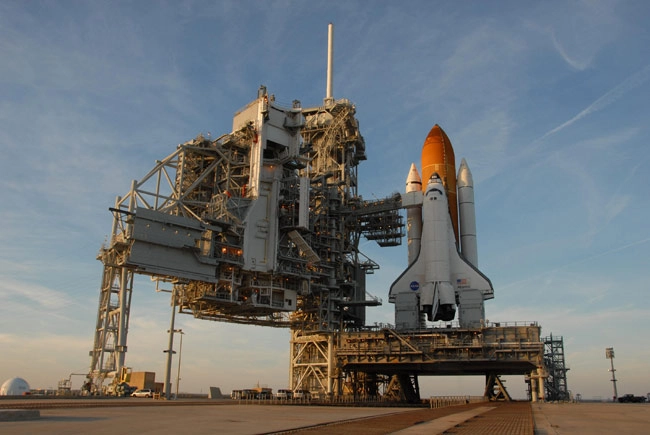
CAPECANAVERAL, Fla. - After one false start, NASA’s shuttle Atlantis and seven astronautswill again attempt to launch toward the International Space Station (ISS) todaydespite suspect fuel tank sensors that have delayed the mission for days.
Shuttle commander Stephen Frick and his STS-122 crewmatesare poised tolaunch spaceward at 3:20:59 p.m. EST ((2020:59 GMT) to haul the space station’s new Columbus laboratory into orbit for the European Space Agency (ESA). But the space shot will only blast off if a set of erratic fuel tank sensors perform properly.
“The team is in great spirits,” Doug Lyons, shuttle launchdirector for Atlantis’ STS-122 mission. “They’ve got the padand the vehicle ready to go make an attempt [Sunday] and we’re lookingforward to getting off the pad and starting the mission.”
Mission managers called off a plannedThursday launch for Atlantis and its crew after two of the four enginecut-off sensors in the liquid hydrogen portion of the shuttle’s15-story fuel tank failed a countdown check. A third sensor also returnederroneous readings after the tank was drained.
NASA flightrules call for at least three of the four sensors to be in working order forlaunch, though mission managers tightened them to require all four of thesensors and their monitoring equipment to be online before liftoff.
“Ifeverything works perfectly, as we would expect from our past history, we’llgo fly,” said Wayne Hale, NASA’s shuttle program manager, toldreporters Saturday. “If we have any other anomalies, or a repeat anomaly,then we think it would be worthwhile to stand down and troubleshoot.”
Atlantisalso has a one-minute launch window, instead of the traditional five-minutetarget, to launch. The shorter window will allow the shuttle to conserveprecious fuel during liftoff as an extra safety measure to assure that itsexternal tank still has propellant in case the engine cut-off sensors failduring launch.
NASA haswrestled with intermittentfuel tank sensor glitches since 2005, when it resumed shuttle flightsfollowing the Columbiatragedy. Then, shuttle flight rules also called for all four sensors to workbefore a planned launch, but loosened the restriction to three of four after monthsof failing to isolate the problem’s source.
After twodays of analysis, mission managers opted to reinstitute the four-sensor rulefor Atlantis’ current mission only. Current weather forecasts predict an80 percent chance of good weather at launch time.
The STS-122astronauts are slated to install the ESA’s 1.4billion Euro ($2 billion) Columbus lab to the ISS during at least threespacewalks planned for their 11-day mission. If the shuttle’s powersupply holds out, NASA could extend the flight by two days to allow an extraspacewalk to inspect a balky solar array joint on the station’s starboardside.
Set tolaunch spaceward with Frick are shuttle pilot Alan Poindexter; missionspecialists Leland Melvin, Rex Walheim, Stanley Love and ESA astronauts HansSchlegel and Leopold Eyharts. A veteran French astronaut, Eyharts will replace U.S. astronaut Dan Tani as a space stationflight engineer and help christen Europe’s Columbus lab during the STS-122 mission.
NASA has aslim window that closes on Thursday, with a possible one-day extension, inwhich to launch Atlantis before sun angles become unfavorable for the shuttle’smission.
The shuttle’slaunch would mark NASA’s fourth shuttle flight of 2007 and the secondthis year carrying a new orbital room bound for the space station.
NASA isbroadcasting Atlantis' STS-122 mission’s Sunday launch live on NASA TVbeginning at 6:00 a.m. EST (1100 GMT). Click here for SPACE.com's shuttle mission coverage and NASA TV feed.
- SPACE.com Video Interplayer: NASA's STS-122: Columbus Sets Sail for ISS
- Test Your Smarts: Space Shuttle Countdown Quiz
- VIDEO: ISS Commander Peggy Whitson Takes Charge
