


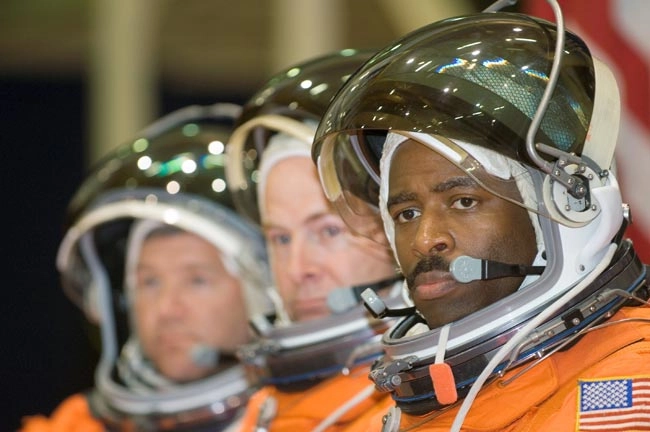
A formerNFL wide receiver and two NASA spacewalkers are ready to tackle a toughconstruction job at the International Space Station (ISS) once their shuttleAtlantis launches into orbit on Thursday.
NASAastronaut Leland Melvin, a professional athlete-turned-astronaut, will make hisspaceflight debut alongside spacewalkers Rex Walheim, Stanley Love and fourcrewmates when Atlantis rockets spaceward to deliver a Europeanlab to the ISS.
?I?veplayed on some very dynamic teams in the past and this is one of the mostdynamic,? said Melvin, who was drafted by the Detroit Lions in 1986 beforeinjuries prematurely ended his NFL career. ?Everyone has each other?s back andwe work together.?
Melvin andLove will make their first trips into space whenAtlantis lifts off at 4:31 p.m. EST (2131 GMT) tomorrow on an 11-daymission to install the European Space Agency?s (ESA) Columbus laboratory at theISS. Walheim, meanwhile, is returning to orbit on what will be his secondspaceflight.
?It isreally exciting to get a chance to go into space again,? Walheim said Mondayafter arriving here at NASA?s Kennedy Space Center (KSC) spaceport.
Tacklingspaceflight
Melvin, 43,credits a mix of sports and education for placing him on the path toward space.His ability to catch a football while growing up in Lynchburg, Va., led to a scholarship to the University of Richmond, where he obtained a bachelor?sdegree in chemistry.
?So I wasplaying ball and I was doing chemical research,? Melvin said in a NASAinterview. ?It was a very exciting time.?
But Melvindidn?t initially plan to become an astronaut. After graduation, he was draftedin the 11th round by the Lions, but pulled a hamstring in the preseason and waslater released. He studied materials science engineering at the University of Virginia while training with the Dallas Cowboys, but another hamstring injuryled him back into life as a research scientist.
?So thatwas pretty much the end of my NFL career,? said Melvin, who has also stressedthe importance of education to students as co-manager of NASA?s educatorastronaut program. ?But I already had this backup plan already in work.?
Melvinjoined NASA?s Langley Research Center in 1989 to help develop nondestructiveways of examining spacecraft and later led the Vehicle Health Monitoring teamfor the agency?s X-33 reusable launch vehicle program. After a friend suggestedhe apply to NASA?s astronaut corps, Melvin obliged and was selected in 1998.
?I thinkplaying pro football, or playing any sport where you have to work together as ateam, helps you become a better astronaut,? he said, adding that the samenon-verbal communication skills on the field can be used on a shuttle flightdeck.
DuringSTS-122, Melvin will serve as Mission Specialist-1 and the prime operator forthe space station?s robotic arm, which he will wield to install Europe?s Columbus lab to the ISS.
?That?sgoing to be another exciting time,? he said. ?We will have grown the station byanother module and have brought our international partners from Europe on board to be part of this huge, expansive station.?
Spacewalkchief
As the onlyveteran spacewalker on Atlantis? STS-122 crew, Walheim will participate in allthree of the mission?s planned spacewalks to install the ESA?s Columbus lab and add new equipment to the station?s exterior.
?I thinkthe main thing is I want to develop really good timelines that are executable,?Walheim, 45, said in an interview. ?We try to make sure that our fellowspacewalkers have the experience that they need.?
A native of San Carlos, Calif., Walheim is a U.S. Air Force colonel who obtained degreesin mechanical and industrial engineering before serving as space shuttle flightcontroller at NASA?s Johnson Space Center in Houston. He trained as a flighttest engineer and was serving as a USAF test pilot instructor when he wasselected to join NASA?s astronaut ranks in 1996.
?I didn?treally think it was that much of an attainable goal, but I kept it at the backof my mind and I did want to shoot for it,? said Walheim who is married to wifeMargie and has two children.
He firstreached orbit in April 2002 on NASA?s STS-110 mission, where he flew alongsidecrewmate Stephen Frick, who is commanding the current STS-122 spaceflight.Aboard Atlantis, Walheim will serve as Mission Specialist-2.
Despitespending 10 days in space during his first spaceflight, Walheim said there isone thing he missed that he hopes to revisit on STS-122.
?You knowyour memories fade fast,? he told reporters ?And it bugs me that I can?tremember seeing a big city in space at night, and so [that?s] one thing I wantto make sure I do.?
Anastronomer astronaut
UnlikeMelvin and Walheim, Love?s commitment to all things space took root in hisyouth and has only grown since.
?I devouredscience fiction novels as a kid,? he said in a NASA interview. ?My make-believegames were like ?Star Wars? and ?Star Trek,? and I?ve always loved exploring.?
Hailingfrom Eugene, Ore., Love holds a bachelor's degree in physics, as well as amaster's and Ph.D. in astronomy. He worked at NASA?s Jet Propulsion Laboratoryin Pasadena, Calif., in 1997 as a staff engineer before being selected for theagency?s astronaut corps a year later after multiple applications and no lessthan three interviews.
?I havetried to treat the astronaut career as a lottery ticket,? said Love, 42, who ismarried and has two sons, ages 8 and 11. ?I really like science and space, andas long as what I really like and what I?m doing are consistent with being anastronaut, I will send in an application and maybe I?ll win the lottery.??
As MissionSpecialist-4 for the STS-122 flight, Love is the primary shuttle robotic armoperator and will participate in one spacewalk to retrieve a broken ISSgyroscope and outfit the station?s Columbus module with two experiments.
?I?m verypleased to be able to add laboratory space and two big instruments to theoutside of Columbus as well,? Love said in an interview, adding that he?slooking forward to the view from the end of the station?s Canadarm2 roboticarm. ?I?ve got a camera. I?m going to take lots of pictures.?
Theinternational cooperation at work on the ISS, and human spaceflight in generalhave a more lasting impact on humanity than some of the selfish or even violentthings nations can invest time, money and other resources in, Love said.
?Explorationis something that we can throw ourselves into and feel like we?re doingsomething worthwhile,? he added. ?It?s a noble cause and I?m very, very excitedto be a part of it.?
NASAwill broadcast Atlantis' STS-122 mission live on NASA TV. Click here for SPACE.com's shuttle mission coverage and NASATV feed.
- SPACE.com Video Interplayer: NASA?s STS-122: Columbus Sets Sail for ISS
- IMAGES: Discovery's STS-120 Mission in Pictures
- VIDEO: ISS Commander Peggy Whitson Takes Charge
