


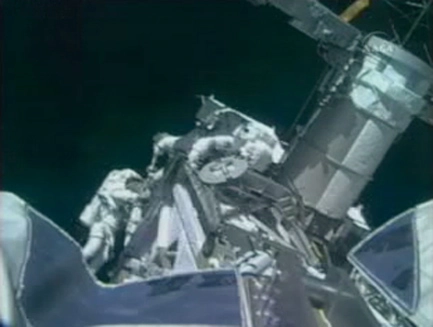
HOUSTON– Two spacewalking astronauts added a new piece to the growingInternational Space Station (ISS) Saturday while engineers on Earthanalyzed a U.S computer glitch and damage to the shuttle Endeavour.
STS-118mission specialists Rick Mastracchio and Dave Williams bolted a new Starboard 5(S5) spacer truss to the end of the space station's metallic backbone, amongother construction tasks, during their six-hour-and-17-minute spacewalk.
"Youguys were awesome," shuttle commander Scott Kelly told the twospacewalkers after they finished their work.
Knownaffectionately as "Stubby," the S5 truss makes way for a new solararray on the growing orbital laboratory. Addition of the 4,010-pound(1,818-kilogram) block gives the ISS an end-to-end length of 246 feet (75meters) and a weight of about 513,000 pounds (233,000 kilograms).
About theonly hitch while Mastracchio and Williams toiled outside the orbital laboratoryoccurred inside the station's U.S. segment.
At about3:52 p.m. EDT (1952 GMT), the station's primary U.S. command and controlcomputer shut down inside NASA's Destiny laboratory, forcing two backups totake over as designed. The six-year-old computer's shutoff had no effect onSaturday's spacewalk, but engineers are studying the problem to track the failure'ssource.
Computerfailures plagued the station's last visiting shuttle mission in June, whencomputers governing the station's Russian navigation and control systemscrashed. The space station's current Expedition 15 crew revived the ailingmachines by installing jumper cables to bypass faulty components. More repairsfor those computer systems are slated to begin Sunday while Endeavour is dockedto the ISS.
Thecomputer failure occurred just one day after NASA engineers discovered damageto the heat-resistant belly of Endeavour, prompting mission managers' concernsfor safe reentry to Earth.
Engineersthink a spray of ice chiseled out pieces of heat-resistant tiles just under aminute after Endeavour's launch on Wednesday evening, but need more informationto fully assess the extent of damage. STS-118 crewmembers hope to scan the damagein detail using the space shuttle's sensor-tipped extension boom on Sunday atabout 12:06 p.m. EDT (1606 GMT).
Growinglaboratory
Whilehooking up the S5 truss to the space station, astronauts had a nearlyunobstructed view of the blue planet 214 miles (344 kilometers) beneath them.
"Theview is incredible," Williams said during the installation of the $11million, Boeing-built truss.
Thespacewalking astronauts also relocated a spare grappling fixture, which allowsthe space station's robotic arm to safely grab space station components andmove them around. After the relocation, Mastracchio and Williams retracted a radiatoron the station's mast-like Port 6 truss, clearing the massive segment forrelocation to the orbital laboratory's port-most side later this year.
"Youguys look like those toys in a souvenir shop," mission specialist TracyCaldwell told the astronauts outside of her space station window during theretraction. Caldwell served as spacewalk choreographer, delivering instructionsand advice during the busy construction outing.
With timeto spare after their primary tasks, Mastracchio and Williams squeezed inseveral "get-ahead" tasks to accelerate construction of the spacestation.
Endeavour'sseven-astronaut crew is delivering spare ISS hardware, 5,000 pounds (2,267kilograms) of fresh cargo and replacing a failed gyroscope to the space stationduring the their up-to-14 day mission.
ThroughoutSaturday's spacewalk, teacher-astronautBarbara Morgan oversaw the transfer some of that cargo. Morgan waited 22years for the opportunity, following the loss of the 1986 Challenger crew. Shewas assigned to Endeavour's STS-118 mission in 2002 after becoming afull-fledged astronaut in 1998.
STS-118astronauts are expected to perform at least two more spacewalks during the nextsix days, although a new device that shares space station solar power withEndeavour could allow for a fourth spacewalk. Mission managers will decide bySunday afternoon whether or not to extend the mission by three days.
"[It]may make us, if it works properly, the longest docked mission to the spacestation to date," Kelly said in an interview with SPACE.com.
- VIDEO: Teaching the Future: Teacher-Astronaut Barbara Morgan
- VIDEO: Endeavour's STS-118 Mission Profile
- Complete Space Shuttle Mission Coverage