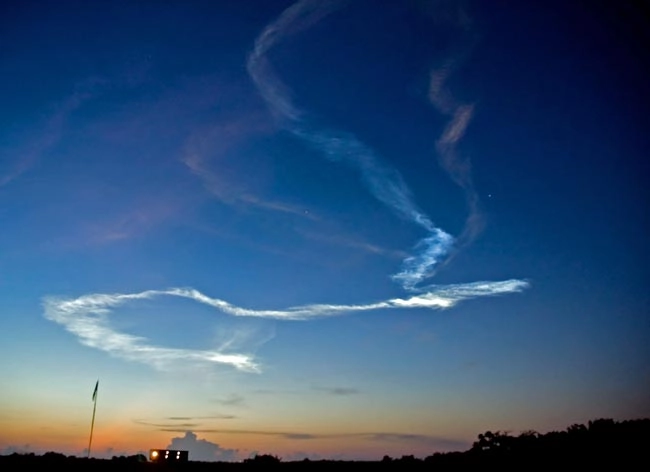
CAPECANAVERAL, Fla. ? NASA's planned launch of the space shuttle Endeavour tonightisn't likely to form beautiful trails of glowing clouds like those of previousliftoffs, weather experts at Kennedy Space Center (KSC) said.
NASA's Junespace shot of Atlantis produced onesuch striking display of the noctilucent -- or night-shining -- clouds, aswell as with the launch of the Mars-boundPhoenix spacecraft last weekend. Weather experts here at KSC, however,aren't crossing their fingers for a rare appearance of the clouds after shuttleEndeavour launches at 6:36 p.m. EDT (2236 GMT) tonight.
"I'dbe surprised to see noctilucent clouds after this launch," said JohnMadura, KSC's weather office manager. "We'll see the standard rocketexhaust plume and that may be pretty, but we probably won't see theclouds."

But TimGarner, a spaceflight meteorologist at NASA's Johnson Space Center (JSC) inHouston, Texas is more optimistic about seeing the rocket-induced clouds 10 to20 miles (16 to 32 kilometers) above Earth.
"Thelaunch is so close to sunset, I think we have a decent shot at seeingsome," Garner said. "The clouds will be diffuse, but we'll have agood lighting angle."
Cloudyrecipe
Maduraexplained that forming the glowing clouds from rocket exhaust follows asensitive recipe: Made mostly of water, the exhaust plume must freeze into icecrystals and reflect sunlight just before sunrise or after sunset afterhigh-altitude winds blow them around.
"Youneed the right moisture, the right altitude and the right angle of light comingfrom the sun," he said. Too much sunlight hides the thin clouds, while toolittle fails to light them up well enough to see in darkness.
Understandinghow naturalnight-shining clouds form, however, continues to elude researchers.
"Thebest knowledge we have suggests it's too dry for them to form, but they formanyway," said KSC atmospheric scientist Frank Nerceret. "We need tofind out why that's happening, which is why we recently launched a newsatellite."
Thatsatellite, launched in April on NASA's Aeronomy of Ice in the Mesosphere (AIM)mission, will monitor the natural formation of the clouds near the polarregions of Earth to shed light on the mysteries of noctilucent cloud formation.
Endeavour'sSTS-118 astronaut crew is commanded by veteran astronaut Scott Kelly andincludes NASA's first professional educatorastronaut Barbara Morgan, who first joined the agency in 1985 as the backupfor Teacher in Space Christa McAuliffe before the Challenger tragedy. Theplanned 11-to-14 day mission will deliver fresh cargo, spare parts and a newstarboard-side truss segment to the International Space Station in Earth orbit.
Click here for SPACE.com'sSTS-118 launch and mission coverage.
- VIDEO: Shuttle Endeavour Launch Animation
- VIDEO: Teaching the Future: Teacher-Astronaut Barbara Morgan
- IMAGES: Barbara Morgan, Crewmates Train for STS-118