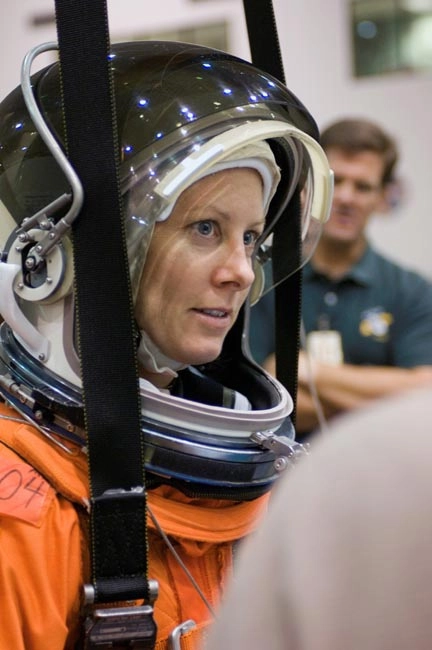
Two astronautsare looking forward to their first taste of space when NASA?s shuttle Endeavourrockets towards the International Space Station (ISS) this week.
Missionspecialists Tracy Caldwell and Alvin Drew, Jr. are each poised to make theirfirst career spaceflights with NASA?s STS-118 mission set tolaunch Aug. 8.
?It?salmost unreal,? Caldwell told reporters in an interview. ?I haven?t allowedmyself to get too giddy imagining what floating in space is going to be likeand trying to do all the things that I'm trained to do.?

Caldwell,Drew and five crewmates will launch from NASA?s Kennedy Space Center in Floridato deliver cargo, spare parts and a new piece of the space station?sstarboard-side truss. Endeavour?s crew also includes teacher-turned-astronautBarbara Morgan, who joined NASA as the backup for Teacher in Space ChristaMcAuliffe in 1985. McAuliffe and six astronauts were aboard the space shuttleChallenger when it broke apart just after launch in January 1986.
Teacherin Space?s legacy
As MissionSpecialist 1 during the STS-118 mission, Caldwell will choreograph up to fourspacewalks from inside Endeavour, as well as wield the orbiter's robotic arm.She joined NASA's astronaut corps in 1998, but her interest in spaceflightbegan at age 16 in 1986 while the agency was preparing to launch the firstteacher into space.
"Itwas all because of Christa McAuliffe, and she was a teacher that was going upinto space," said Caldwell, now 37 and a private pilot, in a NASAinterview. "So I started thinking, 'Wow, if a teacher can become andastronaut, I wonder if I could too.'"
Growing upin Arcadia, California, Caldwell routinely helped her electrician father rewirehouses and repair cars before working to obtain a Ph.D. in physical chemistry fromthe University of California at Davis. That training, as well as her ongoinginterest in athletics, is welcome practice for her role as the intravehicularspacewalk choreographer, she said.
"You'vegot to think ahead, and what tools you need, and how you approach aproblem," Caldwell said. "Dad prepared me really well for that."
Sincejoining NASA, Caldwell helped test and integrate Russian-built hardware andsoftware bound for the ISS. She served as the prime crew support astronaut for thespace station's Expedition 5 mission has also served as spacecraft communicatorfor later ISS flights.
Off all theadvice she's received from veteran spaceflyers, taking time to look out thewindow while in Earth orbit is one Caldwell takes to heart.
"I'mnot just going up there," she told reporters. "My family, my friends,my professors. Everybody that's played a role and I'm going to look out thatwindow for them."
CAPCOMto crewmate
A lateaddition to the STS-118 mission, Drewis Mission Specialist 5 on Endeavour?s crew and will serve as sort of autility astronaut.
?I?msupporting cast for this mission,? he said in a NASA interview, adding that hewill help out on tasks and packing things in the right place. ?It?s not a very glamorousrole, but it?s something that I?m very happy to be doing.?
Drew, 44,joined Endeavour?s crew in late April as a replacement for ISS Expedition 15flight engineer Clayton Anderson, who launched earlier during June?sSTS-117 mission to relieve fellow NASA astronaut Sunita Williams. At thetime, he was training to serve as a shuttle spacecraft communicator, or CAPCOM,to speak to orbiter crews for Mission Control.
?My initialreaction was just plain shock,? Drew told reporters in a preflight briefing. ?I?venever heard of anybody being selected for a mission about three and a halfmonths out in front of a launch. After that, it was just time to get busy.?
A colonelin the U.S. Air Force and native of Washington, D.C., Drew joined NASA?sastronaut corps in July 2000. After gaining experience as a combat helicopterpilot, he has logged 3,000 of flying time in over 30 different aircraft and hasworked in the space station branch of the Astronaut Office.
?I?ve justbeen all over,? Drew said. ?My fingerprints are all over parts of space stationat this point.?
Drew?sinterest in space began at age six, when he watched NASA launch the Apollo 7mission at school with his classmates in 1968. He later obtained degrees inphysics, aeronautical engineering, aerospace science and political scienceduring his Air Force career. But despite the long path, Drew said he isn?t surewhat part of his first flight will make the biggest impression.
?Knowinghow my brain works, I won?t think about that until after I?ve landed andhopefully I?ve got a set of good memories to go reflect back on,? Drew said.
- VIDEO: Teaching the Future: Teacher-Astronaut Barbara Morgan
- Complete Space Shuttle Mission Coverage
- IMAGES: NASA's STS-117 Shuttle Mission in Pictures
