





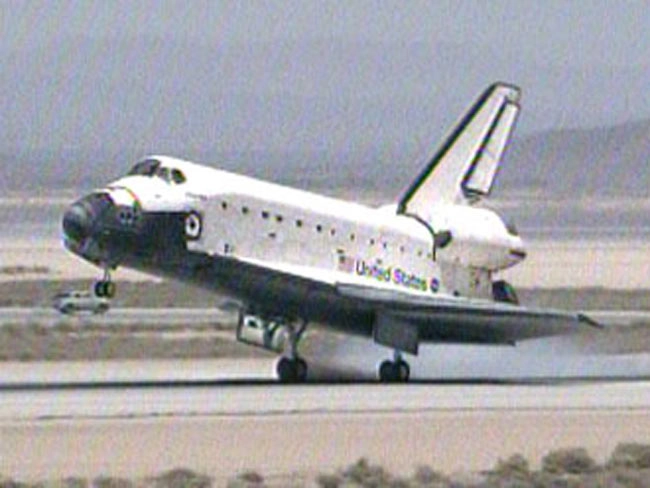
CAPECANAVERAL, Fla. -- The successful return of seven astronauts aboard NASA?s shuttleAtlantis kicks off a challenging construction year for the International SpaceStation (ISS), NASA officials said Friday.
Atlantis returnedFriday with veteran shuttle flyer Rick Sturckow at the helm to complete NASA?sSTS-117 mission to deliver new trusses, solar arrays and one crewmember to theISS.
?It was a beautifullanding out there, right on the money,? NASA launch director Mike Leinbach saidafter Atlantis? 3:49 p.m. EDT (1949 GMT) arrival at a backup runway atCalifornia?s Edwards Air Force Base.
The shuttle?s14-day spaceflight primed the orbital laboratory for the addition of a new connectingmodule and the European Space Agency?s Columbus laboratory later this year,as well as the first pieces of Japan?s three-segmentKibo module in early 2008.
To do that,NASA plans to launch the space shuttle Endeavour?s STS-118 mission on Aug. 9 todeliver a small spacer piece to the station?s starboard truss. Barbara Morgan, NASA?sfirst educator-astronaut, will also fly on that mission.
The shuttleDiscovery follows on Oct. 20 to haul the Harmony connecting node to the ISS,with Atlantis again on tap to deliver Columbus in December. Each of those spaceflights,plus vital spacewalks and other assembly tasks by ISS crews in between them,must occur in order to continue the station?s construction.
?I thinkthere?s even bigger challenges in front of us as we continue assembly through therest of this year,? said Bill Gerstenmaier, NASA?s associate administrator forspace operations, after the STS-117 mission.
NASA plansat least 12 more shuttle flights through September 2010 to complete the spacestation?s construction. Two additional shuttle flights to ship cargo, spareparts and equipment to the ISS, may also fly. One additional flight to service theHubble Space Telescope in September 2008 is also on tap.
Learningfrom glitches
Gerstenmaiersaid NASA and its international partners have taken key lessons from Atlantis?STS-117 mission.
Engineershave already performed a series of pull tests on protective thermal blanketsaboard Endeavour to ensure their secure after a similar one peeled back fromits left aft engine pod mount during Atlantis? June 8 launch.
STS-117spacewalker Danny Olivas securedthe torn blanket with medical staples and pins. While an initial inspectionfound a slight gap between the blanket and surrounding heat tiles afterlanding, the anchor pins were still in place, NASA said.
Gerstenmaiersaid that a major crash of vital Russian control and navigation systems duringthe STS-117 mission has also paid off with lessons of the limits of current andfuture station hardware.
Engineersand ISS cosmonauts traced the crash to the failure of redundant surge-protectorlike circuits within the computers, and then bypassedthe fault using jumper cables. But it will likely take months to determineexactly what caused the circuits to fail in the first place.
During thattime, ISS engineers will take a close look at similar computer systems aboardthe Columbus laboratory and Europe?s unmanned station cargo ship, the AutomatedTransfer Vehicle, Gerstenmaier said.
Meanwhile,Atlantis? seven-astronaut crew will return to Houston - home of NASA?s JohnsonSpace Center astronaut training facility - for some much-deserved rest.
?Thisflight crew did a phenomenal job on orbit,? Gerstenmaier said of the STS-117astronaut. ?They seem in great spirits?
- SPACE.com Video Interplayer: Space Station Power Up with STS-117
- IMAGES: Atlantis Shuttle?s STS-117 Launch Day
- Complete Shuttle Mission Coverage
