

This story was updated at 7:37 p.m. EDT.
HOUSTON – NASA's space
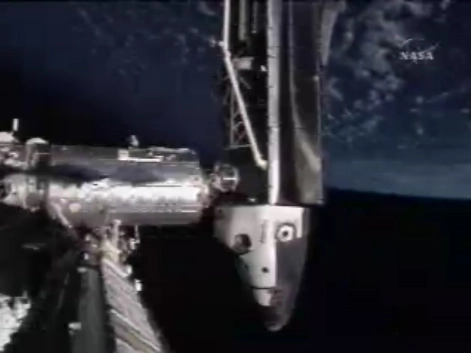
shuttle Atlantis berthed with the International Space Station (ISS) Sunday
afternoon, ending a two-day chase to deliver new solar arrays to the orbital
laboratory.
The high-flying
linkup occurred on time at 3:36 p.m. EDT (1936 GMT), as the shuttle docked
with the space station's Destiny laboratory module.
"We're looking forward to a
great day and seeing our friends on the station," STS-117 mission specialist
Clayton Anderson said before docking.
About one hour before
docking, as Atlantis hovered about 600 feet (182 meters) below the station,
STS-117 commander Rick Sturckow flipped the shuttle nose-over-tail
in a nine-minute Rendezvous Pitch Maneuver, or RPM, to allow ISS Expedition 15
commander Fyodor Yurchikhin and flight engineer Oleg Kotov to take high-resolution images of heat shields on the
shuttle's underbelly. Those images will be beamed down to mission control later
today to look for signs of damage incurred during ascent.
Hatches between the two
spacecraft were opened at about 5:20 p.m. EDT (2220 GMT), and were followed by
a brief welcome ceremony that included presenting a set of STS-117 crew shirts
as gifts for the Expedition 15 crew, NASA's lead shuttle flight director Cathy Koerner said during an evening mission briefing.
"We had just a picture perfect rendezvous and docking," Koerner said, lauding the grace with which Atlantis and the
ISS came together. "We made this look easy. To put that in perspective for you...we took a quarter-million pound vehicle today and we connected it with about a half a ton vehicle, and we did that all at 17,500 miles per hour."
Atlantis and its seven-astronaut
crew launched
towards the ISS late Friday in a near-flawless liftoff from NASA's Kennedy
Space Center in Florida.
Busy night ahead
Before the shuttle and
station astronauts sleep tonight, they will use Atlantis' robotic arm to haul
the 17.5-ton Starboard 3/Starboard 4 (S3/S4) truss
segment and solar arrays from the shuttle's cargo bay and hand it off to
the space station's arm, where it will await installation on Monday on the
first of three planned spacewalks.
The $367.3 million truss
segments and solar arrays will be installed to the starboard side of the
station's main truss, which serves as a sort of metallic backbone for the
orbital laboratory. Combined with a pair of portside solar wings already
attached the station, the new arrays will lay the power foundation to support
the addition of new modules and international
laboratories to the ISS.
Anderson
is also scheduled to relieve
astronaut Sunita Williams, who has been aboard
the station as Expedition 15 flight engineer since December.
On
June 16, Williams will break a world record set by astronaut Shannon Lucid in
1996 for the most time spent by a woman in space during a single spaceflight.
"Records are made to be
broken, so we look forward to the next one," said shuttle program manager Wayne
Hale. "I'm sure we that will have greater endurance records in the future, and
going greater distances and exploring new planets, and I'm sure that women will
be a part of the team."
NASA is broadcasting the
space shuttle Atlantis' STS-117 mission live on NASA TV. Click here for mission updates and
SPACE.com's video feed.