





A new pairof solar wings and two massive trusses are packed and ready to rocket intoorbit aboard NASA's shuttle Atlantis this week to become the latest additionsto the International Space Station (ISS).
Weighing inat more than 17.5 tons, the hefty Boeing-designed Starboard 3/Starboard 4(S3/S4) truss segments and solar arrays are the first new components bound forthe ISS this year, and are vital for the station to support new internationallaboratory modules during upcoming shuttle flights.
"It'sthe heaviest payload for the space station yet," Chuck Hardison, Boeing'sISS site manager at NASA's Kennedy Space Center in Florida, told SPACE.com.
Atlantis'seven-astronaut STS-117 crew, commanded by veteran shuttle flyer Rick Sturckow,is set to launch towards the ISS the evening of June 8 to begin the two-daytrek to the orbital laboratory. The S3/S4 truss is expected to be installedover the course of three spacewalks during the planned11-day mission.
Power-fulpayload
The35,678-pound (16,183-kilogram) station trusses and solar arrays outweigh theirportside counterparts ? the Port 3/Port 4 elements launched in September 2006 ?by about 701 pounds (317 kilograms). Together, the two new starboard solarwings are expected to unfurl to a wingspan of about 240 feet (73 meters) andgenerate a total of 66 kilowatts, or enough to power 30 homes, NASA officialssaid.
"Sothat's our primary payload," Atlantis shuttle pilot Lee Archambault saidin NASA interview. "That's our goal, to install this and have it up andoperating by the time we leave."
Less than1,000 pounds (453 kilograms) of other cargo, spacewalking tools and supplieswill ride up to the ISS inside Atlantis' middeck. Tucked among that cargo are aRussian-built Sokol spacesuit and Soyuz spacecraft seat liner for ISSExpedition 15 flight engineer Clayton Anderson, who will launch aboardAtlantis and relieve NASA astronaut Sunita Williams as station crewmember.
The $367.3million S3/S4 element is an integrated pair of aluminum trusses that measurealmost 45 feet (13 meters) long, more than 16 feet (4.8 meters) wide and 15feet (4.5 meters) high.
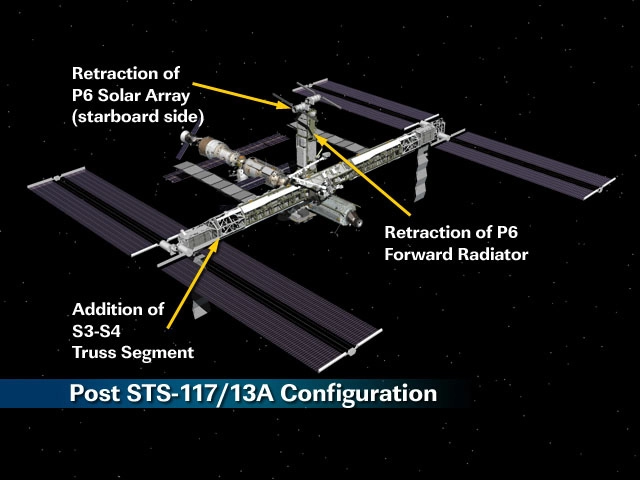
Once theSTS-117 crew arrives at the ISS aboard Atlantis, the astronauts will pluck theS3/S4 segment out of the shuttle's payload bay for later installation on thespace station's starboard side. The segment's hexagonal S3 piece attaches tothe station's Starboard 1 (S1) truss ? a Starboard 2 element was dropped fromthe station during an earlier redesign ? and connects to the S4 truss via arotary joint that allows the outboard solar arrays to turn like a paddle wheelto track the Sun.
The newstarboard solar wings are the third of four arrays planned for the ISS. Theolder Port 6 solar arrays stand half-furled above the station while the mostrecent addition of P3/P4 lends the station itscurrent off-kilter look. During the STS-117 mission, starboard-reachingPort 6 array will also be folded away to give the space station a moresymmetrical appearance.
"[W]e'llbe balancing out the station with the solar arrays on that side," saidSTS-117 spacewalker Jim Reilly in a NASA interview.
