





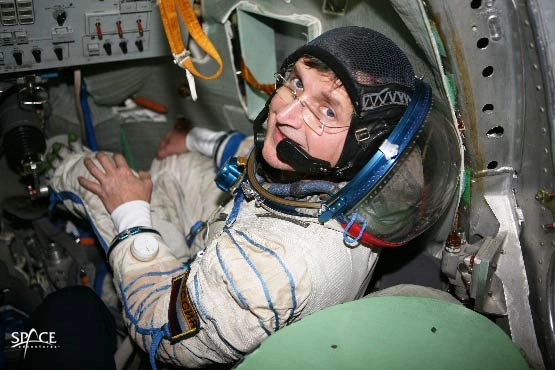
American software developer Charles Simonyi, the next paying tourist to visit the International Space Station (ISS), will get two extra days in orbit - at no additional cost - thanks to a tricky bit of orbital mechanics.
Instead of an 11-day trip to the ISS with two Russian cosmonauts, Simonyi is now gearing up for 13 days in orbit after station mission managers extended the flight to maintain a desired landing trajectory, NASA officials told SPACE.com.
Simonyi is training to launch towards the ISS on April 7 with Expedition 15 commander Fyodor Yurchikhin and flight engineer Oleg Kotov, who will take control of the station from its current Expedition 14 crew [image]. Their Soyuz TMA-10 spacecraft is due to dock at the space station on April 9.
"Normally, the docked operations are nine days," NASA spokesperson Rob Navias, of the agency's Johnson Space Center, adding that the two-day extension is designed so Simonyi and two Expedition 14 astronauts will touch down at their landing site in daylight on April 20. "This is unusual in a sense that it is a little bit longer than usual docked ops, but it's all designed to bring in the proper landing site."
Simonyi is paying more than $20 million for his spaceflight under a deal brokered with Russia's Federal Space Agency by the Virginia-based space tourism firm Space Adventures.
"To Dr. Simonyi's benefit, he will have the additional days on the ISS at no extra cost," Space Adventures spokesperson Erin Lundberg told SPACE.com.
With the planned 13-day mission, Simonyi is expected to set a new record by racking up the most days in space ever for a private spaceflyer, Space Adventures officials added [image]. Yurchikhin and Kotov, meanwhile, will settle in for a six-month stay aboard the ISS and join their third crew member, NASA astronaut Sunita Williams, already aboard the station.
A native of Hungary and lifelong space enthusiast, Simonyi, 58, is the co-founder of Intentional Software Corp. and a former Microsoft software developer. He plans to participate in a series of biomedical experiments during his now 13-day spaceflight, and has kept a continuous log of his training activities via his website: www.charlesinspace.com.
Landing trajectory key
Navias said that Russian mission managers had to adjust their launch and landing plans for the Expedition 15-Simonyi flight due to the delay of NASA's STS-117 mission. That flight was slated to liftoff March 15 to deliver new solar arrays to the ISS, but a severe Feb. 26 hail storm damaged its external tank and pushed the mission's launch to mid-May at the earliest.
"When STS-117 was delayed, the whole phasing plan for Soyuz had to change as well," Navias said, adding that the two-day mission extension is the first since NASA began returning astronauts to Earth aboard Soyuz spacecraft.
Russian mission managers originally planned to extend the docked mission one day - with a landing set for April 19 - when they chose the April 7 launch date. The measure would ensure that Simonyi and Expedition 14 astronauts Michael Lopez-Alegria and Mikhail Tyurin would touch down at their intended landing site before sunset.
The delay of NASA's STS-117 mission, and the station's successful orbital reboost last week, prompted an extra day in orbit for Simonyi in maintain that daylight landing, now set for April 20 at 7:30 p.m. Local Time on the steppes of Kazakhstan near the city of Arkalyk, Navias said.
Russian mission managers prefer daylight Soyuz landings to help recovery crews locate the spacecraft quickly in the event of an emergency, NASA has said in the past.
During the additional two days of docked operations, the Expedition 14 and 15 astronauts plan to perform extra orbital training and familiarization tasks, as well as some other chores to ready the station for the arrival of NASA's STS-117 shuttle crew, Navias said.
Simonyi will be the fifth space tourist to visit the ISS since the 2001 spaceflight of American businessman Dennis Tito. South African entrepreneur Mark Shuttleworth flew to the ISS in 2002, followed by Americans Greg Olsen, in 2005, and Anousheh Ansari in 2006.
