


This story was updated at 6:15 p.m. EST.
A freak hail storm that peppered NASA's space shuttle Atlantis late Monday, damaging its external fuel tank and sending launch pad workers seeking cover, has delayed the orbiter's planned March liftoff by at least one month, mission managers said Tuesday.
Shuttle workers are now preparing to haul Atlantis from its perch atop NASA's Launch Pad 39A for the slow trek back to the Vehicle Assembly Building (VAB) at Florida's Kennedy Space Center, where a cadre of inspectors will comb the orbiter's 15-story fuel tank and fragile heat shield for hail damage and make repairs. The resulting delay pushes Atlantis' planned launch to no earlier than April 20 or so, NASA officials said.
"This constitutes, in our evaluation, the worst damage that we have ever seen from hail on the external tank foam," Wayne Hale, NASA's shuttle program manager, told reporters during a Tuesday press briefing. "The bottom line is that, at this point, we do not believe we can make the launch window for a March launch of Atlantis."
The announcement came in the middle of NASA's standard, two-day pre-launch Flight Readiness Review meeting to determine whether Atlantis is ready for its upcoming spaceflight.
Commanded by veteran shuttle flyer Rick Sturckow, Atlantis' STS-117 astronaut crew was preparing to launch towards the International Space Station (ISS) on March 15 to deliver a new set of starboard solar arrays. In order to make a March flight, NASA had to launch Atlantis by around March 25 to complete the planned 11-day STS-117 mission before the April 7 launch of a new crew to the ISS, NASA has said.
Current NASA procedures call for a 72-hour buffer period between departing and arriving spacecraft to give the ISS astronaut crew time to rest during the busy schedule. The ISS crew swap — which will mark the station's shift between its Expedition 14 and Expedition 15 missions — should be complete by April 20, clearing the way for an arriving shuttle a few days later, Hale said.
Atlantis' solar array cargo will be removed from the orbiter's 60-foot (18-meter) payload bay later this week, setting the stage for its return to the VAB on Sunday or Monday, mission managers said.
A hail 'explosion'
Hale said Monday's hail shower stemmed from an extremely localized storm, which NASA shuttle weather experts dubbed an "explosion," right over the agency's Pad 39 launch site at Kennedy Space Center in Cape Canaveral, Florida.
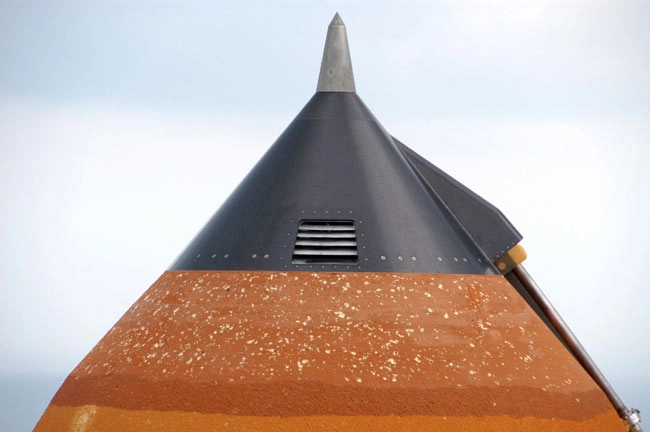
Initial estimates indicate that hail up to the size of golf balls caused upwards of 7,000 dings around the nose cone and upper regions of Atlantis' external tank, but it is possible that only a few hundred of those will require repairs, said John Chapman, NASA's external tank project manager at the Marshall Space Flight Center in Alabama, during the briefing.
"The key right now is to get it back [in the VAB] and look at it and assess exactly what we've got to do," Chapman said.
Launch pad cameras offered initial glimpses of the fuel tank's hail damage and were followed up by photographic inspections. The damage is more extensive than that seen in 1999 when the fuel tank for NASA's STS-96 mission aboard Discovery suffered 650 dings, which required four days to fix and caused a one-week launch delay, shuttle mission managers said.
A 360-degree area around the tip of Atlantis' external tank suffered hail damage, as well as three protective ice-frost ramps that insulate brackets along the vessel's exterior.
Preliminary surveys also found up to 27 minor dings on the heat-resistant tiles of Atlantis' left wing, though they appear to be limited to minor surface damage. The damage apparently stems from ricocheting hail that penetrated the protective Rotating Service Structure which shrouds Atlantis from weather, NASA officials said.
"We have not seen any orbiter damage that causes us real concern," NASA launch director Mike Leinbach told reporters in the briefing, adding that pad shuttle workers took cover during the hail. "It was dynamic, the guys knew it was hailing on them."
If only minor repairs are required, engineers could extend platforms and scaffolding around Atlantis' external tank to sand, shape and pour new foam insulation into damaged areas inside the VAB. But if the tank is completely unusable — a scenario NASA shuttle officials believe is not likely — Atlantis would have to wait until April 10 for the arrival of a replacement, pushing the STS-117 mission into June.
"Right now, we don't think that's likely," Hale said. "But I can't rule it out."
The integrity of foam insulation covering shuttle fuel tanks has been a top concern for NASA engineers since 2003, when a briefcase-sized chunk shook free during the launch of Columbia and damaged heat shielding along the orbiter's left wing leading edge. The damage later led to the loss of Columbia and its seven STS-107 astronauts during reentry on Feb. 1, 2003.
Since then, NASA has redesigned shuttle fuel tanks to reduce the amount of foam debris at launch and taken steps to avoid striking large birds during liftoff, which could also damage an orbiter's heat shield should they hit the spacecraft, shuttle officials have said.
History of hail
Hail is not uncommon to NASA's Florida launch site and has damaged NASA orbiters and fuel tanks in the past, shuttle officials said.
In addition to the May 1999 damage during STS-96, hail also damaged Atlantis' heat resistant tiles in 1990 as the shuttle was being readied for launch of its STS-38 mission. Northern Flicker woodpeckers have also damaged shuttle fuel tanks before a launch. The birds pecked nearly 200 holes in the space shuttle Discovery's fuel tank foam during preparations for NASA's STS-70 mission in 1995.
But Atlantis' current delay to April will cause some schedule jockeying for NASA's four additional ISS-bound shuttle flights slated for later this year. Prior to today's STS-117 launch delay, NASA targeted a June 28 launch for the Endeavour orbiter's STS-118 flight, an Aug. 26 liftoff for Atlantis' on STS-120 mission, and two fall shuttle flights to deliver new international laboratory components to the ISS.
"I am fully confident that by the end of the year, we'll be back to where we would have been barring any additional complications," Hale said. "You'll see some launch dates change, but it won't be by large amounts and it won't ripple out for a large number of flights."
