





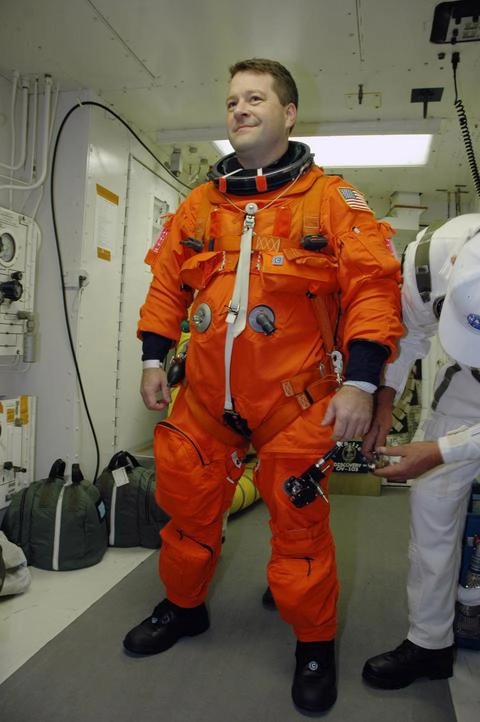
Twoastronauts poised to make their first spaceflight aboard NASA's shuttle Discovery this week havean orbital ballet of robotics awaiting them in space.
Astronauts NicholasPatrick and JoanHigginbotham are set to launch aboard Discovery Thursday at 9:35:47 p.m.EST (0235:47 Dec. 8 GMT) on a constructionmission to the InternationalSpace Station (ISS).
Bothexperienced engineers, Patrick and Higginbotham will wield robotic arms aboardDiscovery and the ISS to help spacewalkers install a new piece of the outpost--thePort 5(P5) truss--and bring the station's primary power and thermal systems online.
"It's abusy, fun-packed mission from a robotics point of view," Patrick said in apreflight interview.
Patrick willbe the prime operator of Discovery's robotic arm during the 12-day STS-116mission, while Higginbotham will control the space station's mechanicalmanipulator alongside fellow STS-116 crewmate SunitaWilliams.
Anengineer-pilot before NASA
Reaching space hasbeen a lifelong goal for Patrick since age five, when he watched NASA Apollo 11 astronautswalk on the Moon in 1969.
"I rememberexactly where I was, watching it with my parents," Patrick, now 42, said in aNASA interview. "And from that point on, I decided I wanted to be an astronaut."
The dayafter Thursday's planned launch, the duty falls primarily on Patrick to useDiscovery's robotic arm and a 50-foot (15-meter) sensor-laden boom to scan thespacecraft vital heat shield for any signs of damage. But while the inspectionwill help shuttle engineers determine the health of Discovery, it's all in aday's work for Patrick, who holds the Mission Specialist-1 slot on the STS-116crew.
"I think ofit as a simple job to do, moving the arm around in the right sequence at theright time," Patrick said in a preflight interview, adding that image analystson Earth--who must actually study theimages--have the hard part.
Born in theUnited Kingdom, Patrick grew up in London and later earned a Ph.D. inmechanical engineering from the Massachusetts Institute of Technology (MIT).Flying was a passion for him long before he joined NASA's astronaut corps in1998, and he has flown both as a private pilot and later as a flight instructor.
"Flyingobviously is a wonderful thing to do to prepare yourself for spaceflight," saidPatrick, who is married and has logged more than 1,900 hours flying variousaircraft. "I think those experiences have really helped me hone my operationalskills."
The ocean,Patrick said, is another way to prepare. In July 2004, he participated in NASA's10-day NEEMO6 mission to the Aquarius laboratory on the floor of the Atlantic Ocean,just off the Florida Keys. But while diving underwater is about the closest youcan get to floating in space on Earth, it is an orbital view Patrick is waitingfor.
"I'm hopingto come back with a more visual sense of how small and isolated the Earth is,"adding that he is especially hopes to take some time to look out Discovery'swindows and see an Earth devoid of political boundaries that define our terrestrialmaps. "I'm sort of looking forward to looking at an apolitical Earth."
Fromspaceport to space
UnlikePatrick, Higginbotham began her engineering career at NASA but did not make theimmediate jump to the astronaut corps. In 1987, she began work as a payloadelectrical engineer at NASA's Kennedy Space Center spaceport.
"My careerplan originally did not include becoming an astronaut," Higginbotham, 42, saidin a NASA interview, adding that she applied to the astronaut ranks after asupervisor kept suggesting it. "I guess he just saw something in me that hethought I would make a great astronaut," she said later.
A native ofChicago, Illinois, Higginbotham first met her STS-116 crewmates RobertCurbeam and MarkPolansky--the flight's commander--during her first round as an astronautapplicant, but it was only after a second attempt and a second Master's degree thatshe joined NASA's spaceflyer ranks in 1996. She enjoys motivational speakingand draws discipline from hobbies such as bodybuilding.
Higginbothamand Curbeam are making a bit of history with the STS-116 mission. Their flightmarks the first time two African-American astronauts have flown in spacetogether, though Higginbotham will remain only the third African-American womanto fly in space.
"I don'tnecessarily tie a significance to that only because when the missions werefirst assigned...I was actually assigned to 117 so we were actually on missionsback to back," Higginbotham said in an interview, adding that actually flyingin space--not statistics--is likely to grab the public's attention more. "If theysee something they want to emulate, than that's a wonderful thing."
In additionto her role as ISS robotic arm operator Higginbotham--STS-116's MissionSpecialist-4--also serves as Discovery's loadmaster, and will oversee thetransfer of thousands of pounds of cargo between the two spacecraft.
"I am alsoin charge of deploying some small satellites once we undock from the spacestation," she added.
With onlydays remaining until her planned launch, Higginbotham concedes that her upcomingspaceflight seems more real than ever.
"I alwaysthought they were 'those guys' who flew," she said. "But, you know, I guess I'mone of those guys."
- STS-116 VIDEO: Major Tasks
- IMAGES: Shuttle Discovery Poised for STS-116
- STS-116 VIDEO: Power is Everything
- Complete Space Shuttle Mission Coverage
- STS-116 VIDEO: Back in Business
- Mission Discovery: The ISS Rewiring Job of NASA's STS-116
- STS-116 VIDEO: Building Blocks
- The Great Space Quiz: Space Shuttle Countdown
- All About the Space Shuttle
