





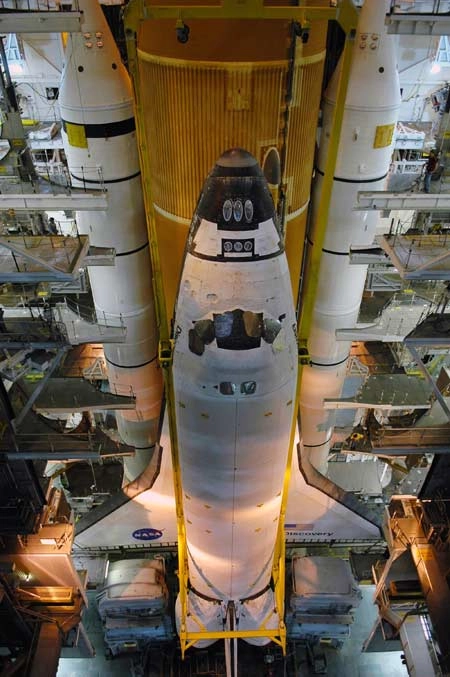
HOUSTON-NASA's space shuttle Discovery is closing in on a scheduled December launch towards the International Space Station (ISS), where astronauts plan to deliver a new piece of the outpost and rewire its power grid, mission managers said Monday. The spaceflight may even launch a day early, they added.
"We are working ahead of schedule well enough that the team thinks we might even advance the launch day an additional day, to Dec. 6," Wayne Hale, NASA's shuttle program manager, said in a preflight briefing here at the agency's Johnson Space Center.
Discovery and its STS-116 astronaut crew are currently poised to blast off on Dec. 7, about a week earlier than initially planned. The launch will mark NASA's first night launch in four years, a welcome milestone since night launches are essential to the agency's plan to help complete the ISS by the orbiter fleet's 2010 retirement.
"I am extremely proud of the work our crew did at the Kennedy Space Center," Hale said of NASA's shuttle spaceport of Cape Canaveral, Florida. "I cannot, in the entire history of the shuttle program, remember a time where we advanced the launch date by a week within the last couple of months of preparation."
Discovery's speedy turnaround since its last flight-NASA's STS-121 mission in July-cleared the path for the STS-116 spaceflight, which many in the agency described as the most difficult to date.
"Every mission says that theirs is the most challenging and complicated to date," said NASA's Tony Ceccacci, the mission's lead shuttle flight director. "Well, that's no different for STS-116."
Discovery's seven-astronaut crew, commanded by veteran shuttle flyer Mark Polansky, is slated to deliver the spacer-like Port 5 (P5) truss segment to portside edge of the station's metallic backbone during the first of three planned spacewalks to rewire the orbital laboratory's power grid.
The station has relied primarily on a pair of solar arrays attached to its mast-like Port 6 (P6) truss, but the arrangement was always meant to be temporary since that segment must be moved in the future. STS-116 spacewalkers will shift the ISS power systems from the P6 arrays to the solar panels on the station's recently installed Port 3/Port 4 (P3/P4) truss delivered in September.
As part of the STS-116 rewiring process, one of the P6 solar arrays must be folded away to allow the newer solar panels to rotate and track the Sun. The folding procedure has never been tried before, and both P6 solar arrays have been in space since 2000, experiencing drastic temperature changes that range from minus 200 degrees Fahrenheit (minus 129 Celsius) to plus 200 degrees Fahrenheit (93 Celsius) every 45 minutes.
There are, however, backup plans in place in case the solar arrays fail to retract automatically.
"They've built in a lot of contingency devices into the design," said STS-116 mission specialist Robert Curbeam. "We'll go up there and if it doesn't retract, we'll retract it by hand using a pistol grip tool or a cordless drill if that's necessary. We'll latch it if that's necessary...One way or another, we're going to get it retracted."
A bigger worry, Curbeam said, is the possibility that some ISS equipment will not work after the rewiring. Equipment has to be turned off prior to rewiring, and then turned back on again. Some of the equipment is vital to the operation of the station and the crew's life support, so if they don't function properly after rewiring, the spacewalkers will have to undo everything and do it again.
"That's my biggest worry, if things don't power up correctly," Curbeam said.
In addition to Curbeam and Polansky, the seven-member STS-116 crew includes shuttle pilot William Oefelein and mission specialists Joan Higginbotham, Nicholas Patrick, Sunita Williams and Swedish spaceflyer Christer Fuglesang, of the European Space Agency (ESA). Williams will relieve ESA astronaut Thomas Reiter, of Germany, who has served aboard the space station since July.
- Mission Discovery: The ISS Rewiring Job of NASA's STS-116
- Complete Space Shuttle Mission Coverage
- Complete Coverage: ISS Expedition 14
- The Great Space Quiz: Space Shuttle Countdown