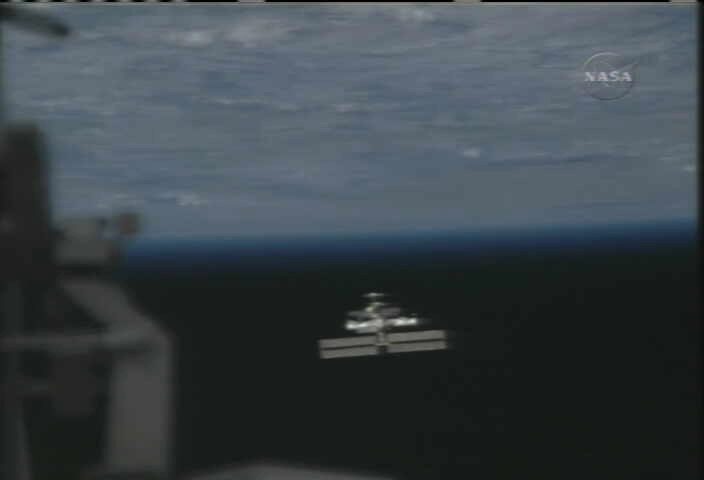
HOUSTON - Shuttle managers cleared theDiscovery orbiter's left wing for landing Saturday, with the rest of theorbiter expected to follow after a late-night analysis by engineers and flight controllers.
Analystsfound no signs of heat shield damage - from either orbital debris ormicrometeorites - to the vital heat-resistant panels on the leading edge ofDiscovery's left wing, based on imagery relayedto Earth Friday and Saturday by the spacecraft's six-astronaut crew, NASAofficials said.
JohnShannon, NASA's deputy shuttle program manager here at Johnson Space Center,said analysis is still pending on imagery from Discovery's right wing leadingedge and nose cap received today, but should be completed no earlier than 4:00a.m. EDT (0800 GMT) Sunday with few surprises anticipated. The spacecraft'sheat shield already received an initial cleanbill of health on July 9.

At aboutthat same time as the heat shield decision, the six STS-121astronauts aboard Discovery - slated to make a 9:14 a.m. EDT (1314 GMT)landing Monday at NASA's Cape Kennedy Space Center (KSC) in Florida - willbegin their flight control systems check to prime the spacecraft for Earthreturn after a 13-daymission to the International Space Station (ISS). They will also check a potentialfuel leak in one of the orbiter's three auxiliary power units (APUs) byactivating the unit.
"You reallywake the vehicle up and get it ready for entry," said Shannon, who chairsDiscovery's STS-121 Mission Management Team, of the systems check. "It's reallya full, top to bottom check of all the instrumentation that you would use for anormal entry."
Discovery'sSTS-121 mission is NASA's second shuttle to fly since the 2003 Columbia accident and thelast of two flight tests before construction resumes on the ISS. The shuttlecrew launched on July 4 and docked at the space station two days later. Aftereight days of joint operations, the STS-121 crew castoff from their ISS berth early Saturday.
STS-121commander StevenLindsey and his crewmates are scheduled to begin that systems check atabout 3:58 a.m. EDT (0758 GMT), and activate APU 1.
The APU isone of three units powering the hydraulics necessary to for Discovery'selevons, landing gear, steering and other moving systems required to land thevehicle safely. Flight controllers are tracking a steady pressure drop in APU 1'sfuel tank, but are unsure if it is harmless gaseous nitrogen or toxic hydrazinepropellant dripping out.
"It's 50-50that it's nitrogen and not a problem," Shannon said of the apparent leak.
But to beon the safe side, engineers are treating the glitch as a hydrazine leak - a verysmall leak of about six drops an hour. If it is a hydrazine leak and remainsunchanged during the flight control systems check, it should pose a problem forlanding, Shannon said.
If the tankpressure decay worsens, or the potential leak increases, engineers plan simplyto run the APU 1 until it uses up all its fuel and shut it down.
With twoother functioning APUs, the only system to be affected would be landing geardeployment since they are linked directly to APU 1, Shannon said, adding that aseries of small pyrotechnic charges could then be used to deploy the landinggear.
After theflight control systems check and APU 1 evaluation, the STS-121 crew is alsoslated to test fire their primary attitude control jets and run tests on a finickyflash evaporating system (FES), which is part of Discovery's cooling system.
"It'sreally hard to check a FES out on the ground because you're not in the vacuumenvironment," Shannon said. "The easiest place to check it out is in space."
Meanwhile,shuttle officials are preparing NASA's KSC Shuttle Landing Facility forDiscovery's initial landing attempts on Monday.
Currentplans call for the STS-121 crew to land at 9:14 a.m. EDT (1314 GMT) or 9:50a.m. EDT (1350 GMT), Shannon said. More opportunities arise at KSC and California's Edwards Air Force Base on Tuesday before the shuttle's liquid oxygen supplies -used for breathing air and power - run low, he added.
"We'd wantto be down on Wednesday," Shannon said.
- Gallery: Shuttle's First Flight
- Gallery: Rare Space Shuttle Images
- Shuttle Discovery: Complete Mission Coverage
- Great Space Quizzes: Space Shuttle Countdown
- Great Space Quizzes: The Space Shuttle
- Great Space Quizzes: Life in Orbit
