
HOUSTON
– An early look at launch and inspection data from NASA's space shuttle
Discovery has yielded no concerns over the health of the vehicle, a top shuttle
official said Wednesday.
John
Shannon, NASA's deputy shuttle program manager, said early image analysis of
Discovery's external tank, nose cap and heat shield-lined wing edges has
revealed some items of interest but nothing to worry flight controllers or the
crew.
"Right now
it's zero," said Shannon, chief of Discovery's STS-121 Mission Management Team,
of the number of orbiter concerns. "We'll get the truth data tomorrow."
Tomorrow,
July 6, Discovery and its STS-121 crew arrive at the International Space
Station (ISS), where the two-astronaut team of Expedition 13 will conduct a
high-resolution photographic survey of the orbiter's tile-lined belly as the
spacecraft flies through a backflip maneuver. The images from that survey will
help analysts complete their health check of Discovery's heat shield.
Earlier
today, STS-121 mission specialists Lisa Nowak and Stephanie Wilson, with the
help of shuttle pilot Mark Kelly, put Discovery's sensor laden orbital boom to
work scanning
the heat-resistant reinforced carbon carbon (RCC) panels along the orbiter's
wing leading edges.
Aside from
the typically scuffs, coloring or bird
droppings – which were documented before Discovery launched and do
not impact heat shield performance – image analysts have not been
surprised, Shannon said.
"The team
very carefully maps each one of the RCC panels preflight," Shannon said.
The boom
survey also caught an unexpected find: a protruding
gapfiller jutting out a half-inch from the underside of Discovery's port
wing.
During
Discovery's July 2005's STS-114
mission, NASA's first since the 2003 Columbia accident,
spacewalker Stephen
Robinson plucked two
gapfillers from the shuttle's belly because they were located further up on
the orbiter's body and could have led to increased heating in certain areas
during reentry.
But the
gapfiller found today by the STS-121 crew is an area that presents less of a
threat, Shannon said.
"This is
one of the areas that we were not really concerned about gapfillers," he added.
Discovery's
STS-121 spaceflight is NASA's second post-Columbia accident shuttle mission, and
will deliver fresh cargo and a third crewmember to the ISS. The shuttle
launched toward the ISS on July 4.
Fuel
tank foam performs
Shannon
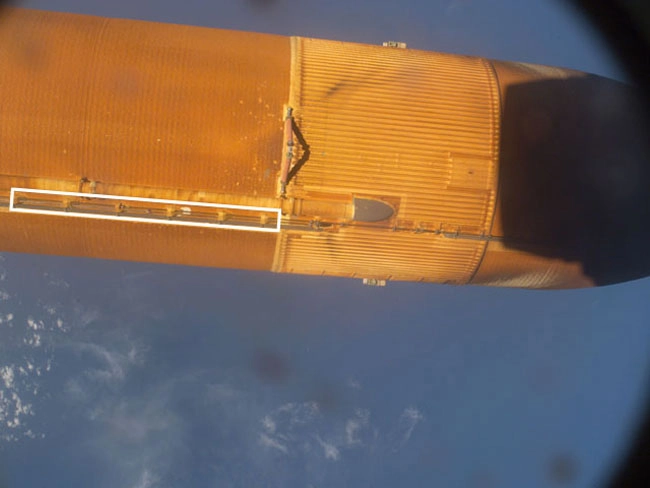
said that the two primary concerns over Discovery's tank – the removal
of a wind screening foam ramp, which then exposed a series of foam-swathed ice
frost ramps –
appears to have performed well during the shuttle's near nine-minute launch
into space.
"The ice
frost ramps performed very well," Shannon said. "All 17 of the [liquid]
hydrogen ones that we looked at appear to be intact."
Early
images suggest that a one-inch by two-inch sliver of foam may have separated
from an ice frost lower down on Discovery's fuel tank, but study is currently
still ongoing, Shannon said.
Image
analysis also found that about two minutes and 57 seconds into Discovery's
launch – which is after the two-minute, 15-second deadline for foam to
pop free and cause significant shuttle damage – a thin sheet of acreage
foam separated from the fuel tank, NASA officials said.
Acreage
foam is typically applied mechanically to the aluminum hull of a shuttle fuel
tank.
Shannon said
the sheet fell off in about six separate pieces that, when measured together,
would cover an area about the size of a piece of typing paper. Engineers
suspect warming of the shuttle fuel tank as it's drained, but are still
studying the issue, he added.
A
different mood
Shannon
said that compared to the STS-114 return to flight mission, the ground teams
for Discovery's current spaceflight are working – and feeling – a
bit different.
"It is
totally different," Shannon said, adding that the nearly full year of delays
for the STS-121 mission has given flight teams time to shake down their
operations. "Everybody came out of the mission briefing room and said, 'It
looks like we've done this before'"
The fact that
Discovery and its fuel tank had much fewer issues than during the STS-114
flight has been an added bonus, NASA said.
"People are
very excited that we have not been surprised by anything," Shannon said.