


This storywas updated at 9:30 p.m. EDT.
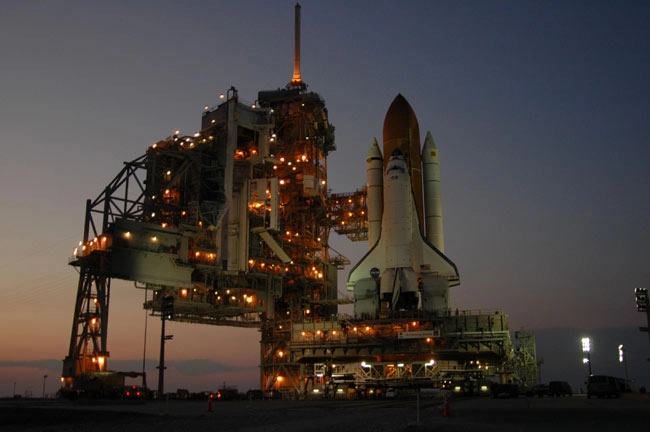
CAPE CANAVERAL, Fla. – The space shuttle Discovery isback at the launch pad as workers prepare the spaceplane for NASA’ssecond orbiter mission since the 2003 Columbia accident.
A massive crawler carrier hauled Discovery and its mobilelaunch platform up to Pad 39B at the Kennedy Space Center (KSC) here more thanseven hours after leaving the shelter of NASA’s Vehicle Assembly Building(VAB) at about 12:45 p.m. EDT (1645 GMT).
“It’s a fabulous feeling to see that we’rerolling Discovery back to the launch pad for our next launch attempt,”NASA’s shuttle program manager Wayne Hale told reporters after ridingwith the orbiter as it left the VAB. “I think we’re on a reallygood path to make that July 1 window opening day.”
The orbiter's move marked a major milestone for NASA's STS-121mission – the agency's second shuttle test flight since the 2003 Columbia accident.Discovery is currently slated to launch its astronaut crew, commanded byshuttle veteran StevenLindsey, on a mission to test shuttle fuel tank modifications, orbiterrepair techniques and resupply the International Space Station (ISS) betweenJuly 1 and July 19.
Hale said that preliminary results of wind tunnel tests tocheck changes to Discovery’s external fuel tank – primarily the removalof a foam ramp that guarded pressure lines – are positive, butwon’t be final for about three weeks. While wind tunnel tests haveconcluded, a detailed analysis of their data is still underway, he added.
“We have to wait until we get to the bottom line,”Hale said. “We could be smarter tomorrow and somebody could find outsomething we need to deal with.”
Today’s rollout allowed Discovery to join its payload– a cargo pod dubbed Leonardo, spare space station parts and other items– at Pad 39B. The Leonardo module and equipment palettes will be loadedinto Discovery’s cargo bay after engineers shroud the spacecraft with itsprotective Rotating Service Structure, an activity currently slated to occurSunday, NASA officials said.
Meanwhile, Hale said he is confident that Discovery’splanned July launch will be the first of three shuttle flights this year.Additional launch opportunities arise on Aug. 28 and Dec. 14, he added.
“Now it will be tight…it depends a lot on thetank,” Hale said of the third shuttle flight’s external tank– External Tank 123 – which engineers are working to complete earlyto support a possible rescue flight should anything go awry during the plannedAugust space shot. “Given that, we have a good shot at making threeshuttle flights this year.”
Preparing Discovery
Engineers at KSC spent the last week mating Discovery to the externaltank and solid rocket boosters – known as the launch stack – thatwill push the 100-ton spaceplane into orbit. During that time, shuttle workersalso took detailed photographs of the orbiter's heat shield to be compared toimages from in-orbit inspections during the STS-121 mission, integrationengineers told SPACE.com,adding that they took similar photos while preparing Discovery for NASA's firstpost-Columbia mission STS-114.
"Everyone was excited for STS-114 and they're doubly sofor STS-121 because it's our opportunity to get into regular launch modeagain," said Tim Riley, the shuttle's integrated operations chief for NASAcontractor United Space Alliance, in a recent interview. "Hopefully, we'llget a couple more [shuttle flights] in this year.
Discovery's STS-121 mission is the last of two post-Columbiaaccident test flights to shakedown new shuttle safety and repair methods beforeNASA can resumeconstruction of the ISS later this year. While NASA is currently targetingJuly 1 to launch Discovery's STS-121 mission, the orbiter has a flightwindow that extends through July 19. Additional shuttle launch opportunitiesopen in late August and mid-December.
NASA's 5.5 million-pound (2.5 million-kilogram) crawlervehicles have transported NASA spacecraft to and from their launch pads sincethey first became operations in 1966. The entire assembly – includingDiscovery, its fuel tank and boosters, mobile launch platform and crawlervehicle – weight about 17.5 million pounds (7.9 million kilograms) andmove at a top speed of about one mile per hour (1.6 kilometers per hour).
“It was great,” said Hale, who rode the immensecrawler as hefted Discovery toward the launch pad. “It’s betterthan going on a cruise ship.”
- STS-121 Astronauts Train Hard for Shuttle Launch
- NASA Forgoes Fuel Tank Test for Next Shuttle Launch
- NASA's Next Shuttle to Fly Without Ice Frost Ramp Fix
- Return to Flight: NASA's Road to STS-121
