





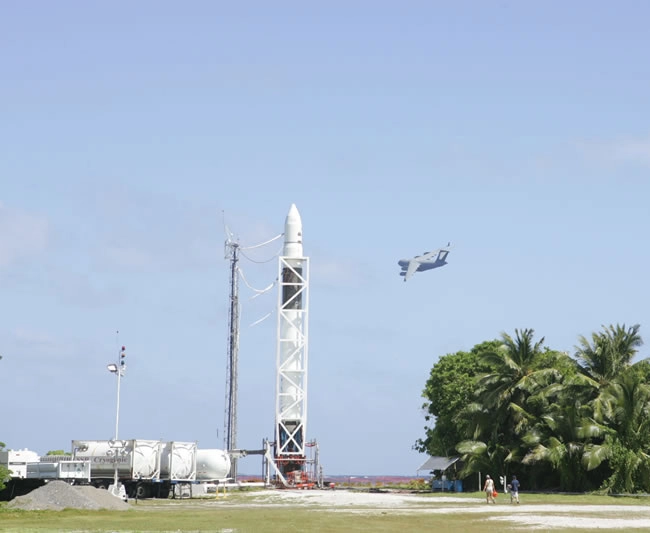
It was astructural issue, not high winds, which scrubbed the private launch firmSpaceX's second attempt to send its first Falcon 1 rocket into orbit Monday.
SpaceXofficials found the problem with the rocket's first stage almost three hoursinto the rocket's eight-hour launch window. Prior to the discovery, winds inexcess of 24 knots at its island launch site looked set to delay liftoff. Therocket's spaceflightdebut has been pushed into early 2006.
"The launchis scrubbed for the year," said SpaceX chief Elon Musk in an e-mail update tothe firm's El Segundo, California headquarters. "We noticed a structural issuewith the first stage fuel tank that will require repair."
Furtherdetails on the structural glitch will be provided a soon as they are available,SpaceX officials said, adding that the rocket must be made safe for groundcrews before engineers can track the problem at the launch pad.
"I expect that the earliest that launch would occur is late January," Musk said. "Third time's the charm."
Secondscrub
Monday'slaunch attempt marked the second scrub for SpaceX's Falcon 1 rocket and itsU.S. Air Force (USAF) cadet-built satellite payload FalconSat-2.
SpaceXofficials calledoff a Nov. 26 launch attempt after exhausting a four-hour launch window,during which the Falcon 1 rocket experienced a computer reboot and loss ofliquid oxygen supply.
Monday'sscrub announcement came at about 2:30 p.m. EST (1930 GMT), half an hour afterthe window opened for the Falcon 1 space shot at its Omelek Island launch padat the U.S. Army's Ronald Reagan Ballistic Missile Defense Test Site. The testsite sits on Kwajalein Atoll in the Pacific Ocean's Marshall Islands chain nearthe equator.
"We'regoing to get back on the pad as soon as we possibly can," Gwynne Shotwell,SpaceX vice president of business development, during a teleconference withreporters. "Structural repairs can be done on the ground and we can test them,so I'm comfortable with this."
Shotwellsaid the Kwajalein facility was available during the third week of January, butwhether SpaceX will choose to target that time for a new launch attempt isstill undetermined.
The Falcon1 rocket is the first of a three-booster family planned by SpaceX to offercommercial launch services to consumers, governments and the military.
Thetwo-stage rocket stands about 68 feet (21 meters) and is designed to launchpayloads of up to 1,256 pounds (570 kilograms) into low-Earth orbit. Its firststage is also designed to parachute to the ocean and be reused on subsequentflights.
Each Falcon1 launch is slated to carry a $6.7 million price tag, SpaceX officials havesaid.
A longerwait
Monday'sscrub does mean that cadets at the USAF Academy in Colorado will have to wait abit longer to see their space plasma measuring satellite fly.
Cadetsdesigned and built the $800,000 FalconSat-2 spacecraft by January 2003 under aprogram to provide students practical experience developing spacecraft. Thelaunch is supported by the USAF and the Defense Advanced Research ProjectsAgency (DARPA).
"You wanteverything to be absolutely perfect on a launch like this," academyspokesperson John van Winkle told SPACE.com, adding that there was some disappointment- as expected - at the academy following the scrubbed launch attempt.
But many ofthe cadets who helped design and build FalconSat-2 were unable to watchMonday's launch attempt due to final exams, van Winkle said. A delay untilJanuary would give them another chance.
Also, theacademy's ground control station did not plan to take initial telemetry datauntil the start of the Spring semester in January anyway, van Winkle said.
"This has verylittle impact on us over the long term, and may actually end up better for us,"he added.
