Japan's Hayabusa space
probe currently orbiting asteroid Itokawa ran into trouble during a November 4 practice landing
session.
According
to a statement by the Institute of Space and Astronautical Science (ISAS), a
space science research division arm of the Japan Aerospace Exploration Agency
(JAXA), the rehearsal descent was nixed due to an unspecified problem.
At
the crucial go/no go decision point in carrying out the practice run, there was
detection of an anomalous signal that curtailed spacecraft operations.
Subsequently, the practice descent of Hayabusa was canceled.
That
action also meant holding off on the release of an ultra-small 1.3 pound (591
grams) device hopping lander, called MINERVA - short for MIcro/Nano
Experimental Robot Vehicle for Asteroid. Also postponed was release of a target
marker to assist in landing Hayabua on the surface of asteroid Itokawa.
No
further word as yet regarding the rescheduling of another trial run of
spacecraft systems prior to a true attempt at landing on the space rock.
Historic attempt
Hayabusa
remains poised for an historic attempt to collect and return a specimen to
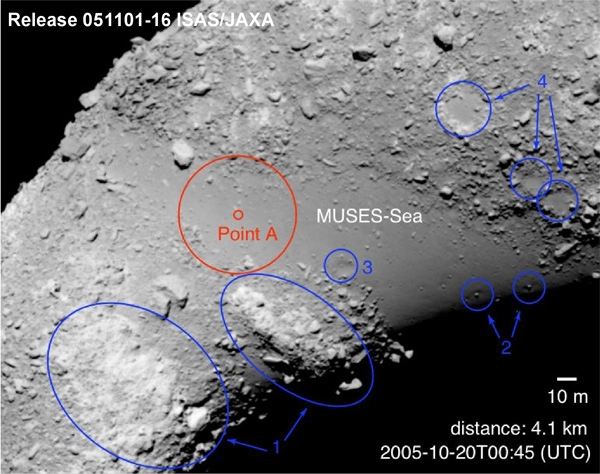
Earth from such an object. Impressive imagery relayed from Hayabusa is being
used by Japanese scientists to target possible touchdown sites on the asteroid.
The probe was rocketed into space from Japan's Kagoshima Space Center on May 9, 2003. The
spacecraft arrived at its exploration target, near Earth asteroid Itokawa, on
September 12, 2005.
The
now-canceled practice run was designed to verify procedures for a first
touchdown of the probe on the asteroid on November 12, followed by a second
touchdown on November 25.
Hayabusa
is equipped to gather specimens of the asteroid for return to Earth. If
Japanese scientists and engineers running the mission are successful, the
probe's return capsule carrying the samples would return to Earth in June 2007,
landing by parachute in a desert touchdown spot of Woomera, Australia.