


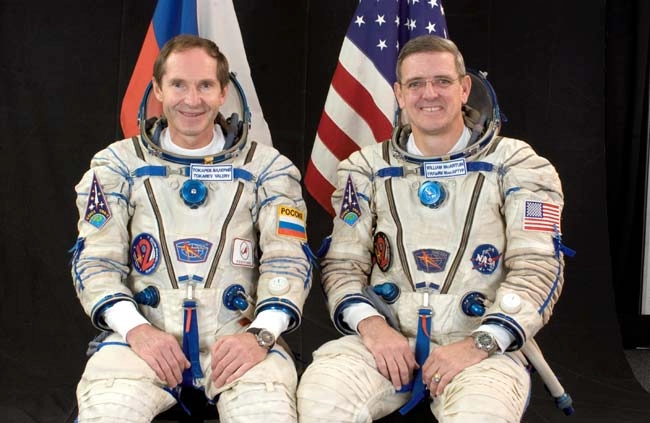
Twoastronauts finished their second week in charge of the International SpaceStation (ISS) Friday while preparing to conduct orbital repairs and theirmission's first spacewalk.
ISS Expedition12 commander Bill McArthur and flight engineer Valery Tokarev are now wellinto their six-month mission aboard the space station, though time seems tohave flown for the veteran astronauts.
"It's hardto believe that 20 days have already passed," McArthur told students in GermanyThursday during a question and answer session from space. "It seems like such ashort time for us."
McArthurand Tokarev launchedinto space late Sept. 30 EDT and dockedat the ISS on Oct. 3 with U.S. space tourist GregoryOlsen. They took command of the orbital laboratory late Oct. 10, after thestation's previous crew - Expedition11 commander Sergei Krikalev and flight engineer John Phillips - leftthe ISS with Olsen.
Tokarevsaid that despite spending three weeks in Earth orbit, he does not yet feelnostalgic for his terrestrial stomping grounds.
"In acouple or three months I'll tell you what I'm missing," he told the students.
TheExpedition 12 crew spent this week going over plans for their first spacewalk,a Nov. 7 extravehicular activity (EVA) to be performed in U.S.-builtspacesuits, performing a kidney stone experiment and working with station's newPulmonary Function System, which analyzes exhaled gases aboard the ISS.
On Friday,the two astronauts briefly reactivated the space station's Elektron oxygengenerator - which switched off last week due to a low water supply - before itshut down once more. Additional trouble shooting is slated for Saturday, NASAofficials said, adding that Russian flight controllers also plan to test theengines of an unmanned Progress 19 on Wednesday following a failedreboost maneuver earlier this week.
But bothastronauts are looking forward to the upcoming spacewalk, which will be the firstISS EVA to be performed in U.S. space suits since Expedition 6in 2003.
"It lookslike we'll get to do the first two-person EVA in the U.S. suits on the U.S.segment since we've gone a two person crew," McArthur told SPACE.comduring a space-to-ground interview earlier this month. "We think that will be abig challenge for us."
ISS crewshave been limited to two astronauts, rather than the typical three, since theNASA's Columbia shuttle accident. Since then, the two-astronaut crews have leftthe ISS empty during spacewalks, but have relied on Russian Orlan spacesuits.
Anastronaut's final flight
Hailingfrom Wakulla, North Carolina, the 54-year-old McArthur is a veteran three pastshuttle flights and visited both Russia's Mir space station and the ISS duringhis astronaut career. But Expedition 12, his first long-duration mission, willlikely be the icing on the cake.
"Ianticipate that this will be the last flight of my astronaut career," McArthur,a retired U.S. Army colonel, told reporters before launching into orbit. "My previousexperiences seemed like vacations in space, or visits to space, and I alwayswanted the opportunity to live in space."
Before hisflight, McArthur told SPACE.com that it was one night in October 2000, whilehe slept in an ISS node during NASA's STS-92shuttle flight, that he decided to shift toward a space station mission.
"It justdawned on me that, more and more, this was something that would be like thenext step," said McArthur, whose wife and two daughters watched him launchtoward the ISS form Baikonur Cosmodrome in Kazakhstan.
McArthurhad hoped that he and Tokarev would join European Space Agency astronaut Thomas Reiteraboard the ISS for Expedition 12. But Reiter's shuttle flight, STS-121, hasbeen delayed until at least May2006 as NASA works through ongoing foam debris and hurricane recoveryefforts.
"It's hardto convey how much more effective the crew is when we have a few more people,"McArthur told SPACE.com from orbit on Oct. 6. "We are disappointed notto have a third crewmember."
ButMcArthur, who also serves as NASA's Science Officer for Expedition 12, saidthat the need to explore space is a fundamental part of the human spirit.
"I'vealways been interested in things that leave the surface of the Earth," he saidin a preflight interview. "There is no arena in which we challenge ourtechnical ability greater than when we send people into space."
Fromhorses to orbit
Tokarev,52, is also flying his first long-duration spaceflight with Expedition 12, thoughlife in Earth orbit was not always his goal.
A veteran cosmonautwith Russia's Federal Space Agency, Tokarev initially planned to be a fighterpilot - which seemed almost unattainable during his youth in the village ofKap-Yar in the country's Astrakhan Region.
"When Igrew up in my small village, I couldn't ever imagine what it meant to be acosmonaut," Tokarev, also a father of two, told SPACE.com in a preflightinterview. "It was just so far from our reality."
But thelocal library was much closer. Tokarev pored through books of World War 2fighter pilots and ultimately rose to the rank of colonel in the Russian AirForce. In the mid-1980s, Russia began its Buranshuttle program and Tokarev reported to become a test cosmonaut.
"I wasinterested in how to fly out of the atmosphere," Tokarev said, though he wouldhave to wait until 1999 to reach orbit, and then aboard NASA's Discoveryshuttle as a member of the STS-96 crew.
Tokarevspent 10 days in space during that flight to the ISS, then returned to Earth toprepare for his next mission.
"Every timeyou look at the Earth, at our planet, your memory reminds you of some situationwith your family or friends," Tokarev said, adding that despite reaching intolow-Earth orbit, never forgets his home planet. "So we stay on orbit, but wegrew up on Earth."
Tokarevwill perform the first spacewalks of his cosmonaut career - McArthur has twounder his belt from STS-92 - during Expedition 12, and will celebrate his 53rdbirthday in space on Oct. 29. The space station, he said, is just one in aseries of steps into space for humans, with the Moon as the next logicalchoice.
"It's probablyjust an initial step," he told students Thursday. "But it's not so easy to doit."
- Russian Spacecraft Fails to Boost ISS into Higher Orbit
- Complete Coverage: ISS Expedition 12
