


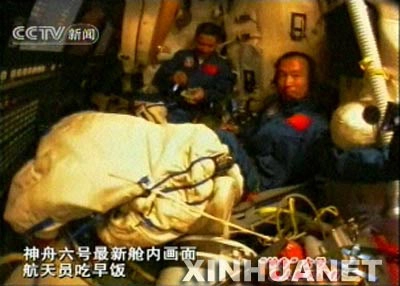
China's twoastronauts orbiting Earth aboard their Shenzhou 6 spacecraft received a callSaturday from President Hu Jintao, who praised their efforts and wished them a "triumphantreturn," according to state media reports.
"Themotherland and people are proud of you," Hu said in the long distance phonecall according to China's Xinhua News Agency. "I hope you willsuccessfully complete your task by carrying out the mission calmly and carefullyand have a triumphant return."
Shenzhou6 astronauts Fei Junlong and Nie Haisheng launchedinto orbit on Oct. 12 Beijing Time (late Oct. 11 EDT) on China's second manned spaceflight and its first to carry two spaceflyers on a multi-day trip. They are now in their fourth day of their missionand have traveled more than 1.3 million miles (2 million kilometers), accordingto state media reports.
"Thespacecraft is working well and we are feeling good," Nie told Hu, Xinhuareported. "You can rest assured, and all the people of the motherland can restassured."
Hu spoke tothe Shenzhou 6 crew from Beijing Aerospace Command and Control Center, andlater address mission scientists and flight controllers there, encouraging themto return Fei and Nie safely back to Earth, Xinhua said.
Fei and Nieare slated to spend up to five days, though there has been no official wordfrom China's government on when they will land. Xinhua has reported thatthe astronauts carried enough supplies into space with them to lastseven days if needed.
Chinaeyes island spaceport
Even beforethe two astronauts land, Xinhua reported that Chinese space officialsmay choose the southern province of its tropical island Hainan as a newspaceport to launch its next generation rockets.
Thelocation, however, comes as no surprise to China space experts, who saiddiscussions of a Hainanspace launch site have been going for at least five years.
"The island'shuge, and the [People's Liberation Army] owns several bases on Hainan," Chinaspace specialist Dean Cheng told SPACE.com in an earlier interview. "Itgives them immediate access to the land."
Located inthe South China Sea, Hainan is closer to the equator and could provide someadvantages over China's three other launch sites - including thenorthwestern-located Jiuquan Satellite Launch Center used to loft Shenzhou 6 -including heavier payloads and launching over water, China space experts said.Equatorial or near-equatorial launch sites are also used by Sea Launch andEurope's Guiana Space Center in Kourou, French Guiana.
Liu Zhusheng,chief designer of China's carrier rocket system, told Xinhua that thenew booster will be designed to loft payloads of between 1.2 and 25 tons intolow Earth orbit, and 1.8 to 14 tons into a geosynchronous transfer orbit. Aheavy-lift rocket woul
China'scurrent Long March rocket family - Shenzou 6 rode a Long March 2F into orbit -boasts four series and 12 separate models with payload capacities of up to 12tons for low Earth orbit space shots and about 5.2 tons into geosynchronoustransfer orbits, according to state media reports.
China'snext generation rocket family, the Long March 5, is reportedly undergoingground tests, said Joan Johnson-Freese, an expert on China's space efforts chairof National Security Studies at the U.S. Naval War College in Newport, RhodeIsland, in an earlier interview.
Johnson-Freesesaid China will likely have to build a new launch facility to suit the newrocket.
China hasannounced ambitions to build a mannedspace station for science research, as well as an unmanned Moon probe tolaunch by 2010.
The countryis the third nation to independently build and launch manned spacecraft intoorbit. Shenzhou 5, China's first piloted spaceflight, launched astronaut YangLiwei on a 14-orbit, 21 ? hour mission on Oct. 15, 2003.
- Shenzhou Rising: China's Second Manned Spaceflight
- Special Report: Emerging China, Engaging China
- ZOOM View: Close in on Shenzhou 6 on its Launch Pad
