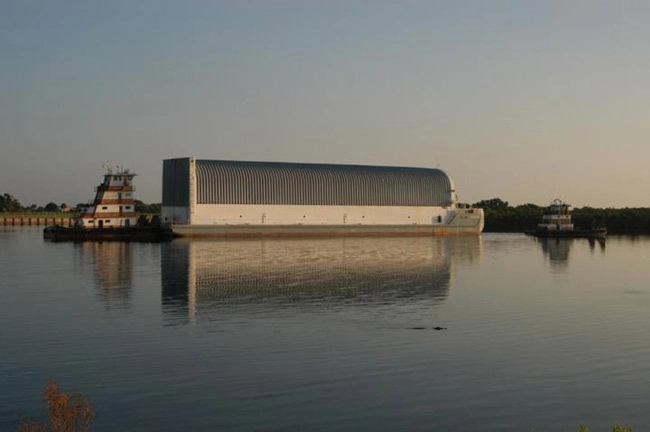
After aseries of hurricane-related delays,a space shuttle fuel tank is finally on heading back to its New Orleansfactory.
The externaltank, one of several to be returned to NASA's New Orleans-based MichoudAssembly Facility from Kennedy Space Center (KSC) in Florida, rode a barge outto sea Monday to begin the five-day trip.
"It's justa signal that everything is getting back to normal," NASA KSC spokespersonJessica Rye told SPACE.com.

Thedelivery of External Tank-119 (ET-119) to Michoud is vital for NASA's return toflight effort - which is aimed at launching the space shuttle Discovery and itsSTS-121 crew to the International Space Station next year. The ET-119 fuel tankis currently slated to help launch the STS-121mission, NASA's second planned orbiter flight since the Columbia disaster.
But first,engineers must determine how to reduce the chances of potentially harmfulpieces of insulating foam from popping free from protective ramps, known as a protuberance air load (PAL) ramps, on the tank's exterior during launch. Engineers have been studying theproblem at Michoud between hurricanes and hope to pick apart ET-119 for acloser look.
"The firststep is the non-destructive evaluation on both the hydrogen and oxygen PALramps," explained Martin Jensen, a NASA spokesperson and Marshall Space FlightCenter in Alabama where the agency's External Tank Project Office is based."Then we'll do some dissection of those PAL ramps and cut into them. That's thenear-term plan."
Foam debrisshedding doomed the space shuttle Columbia in 2003 when a1.67-pound chunk of foam fell from its tank during liftoff and pierced theorbiter's heat shield along its left wing leading edge. The resulting damageallowed hot gases to enter the wing during atmospheric reentry, which rippedapart the vehicle and killed its seven-astronaut STS-107 crew.
After twoand half years of study and safety modifications, NASA launchedDiscovery on STS-114,its first return to flight mission, on July 26, only to find unacceptablylarge pieces of foam fall from the PAL ramp - previously thought safe - andother locations during launch. While none of those pieces caused significantdamage to the orbiter, NASA pledged to address the shedding problem once morebefore the shuttle's next space shot.
The needfor more study forced NASA to abandonplans to launch the STS-121 mission aboard Atlantis this year, and instead targetMarch 2006 for the next shuttle mission.
Last week,NASA chief Michael Griffin told the Washington Post that the spaceagency will likely target May 2006 for its next shuttle flight in order torecover time lost from facility closures caused by HurricaneKatrina. That storm - and its successor Hurricane Rita -damaged Michoudand Mississippi's StennisSpace Center during Katrina and JohnsonSpace Center (JSC) during Rita.
"Butnothing has been decided," NASA's Dean Acosta, Griffin's spokesperson, told SPACE.com,adding that any definite launch target change would be made in an officialannouncement.
Jensen saidit should take ET-119 and its barge Pegasus until Sunday to reach Michoud in New Orleans, with engineers currently expected to unload it on Monday.
NASAofficials said that the next fuel tank to make the trip from KSC to Michoudwill be ET-120. That shipment should leave Florida in the next few weeks, theyadded.
