


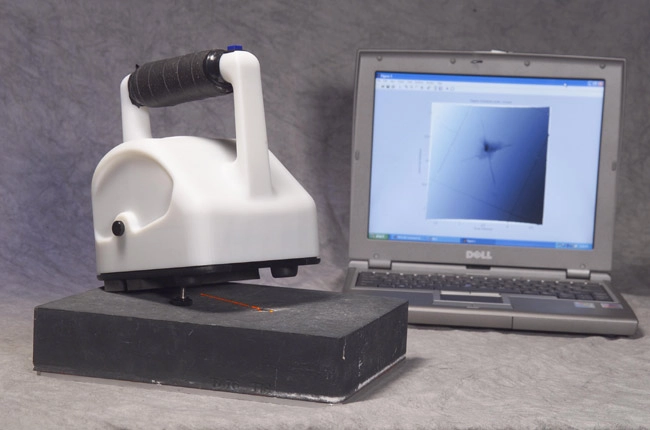
NASA hasdeveloped a new three-dimensional laser scanner to seek out cracks and otherdamage amidst the thousands of ceramic tiles that protect space shuttles fromthe heat of reentry.
Smaller andfaster than their orbital counterparts, the prototype scanners may helpastronauts and ground engineers track tile other thermal protection systemdamage with more accuracy than ever before.
"This is adirect result of the return to flight project," said Joe Lavelle, a seniorresearch engineer for three-dimensional instrumentation at NASA's Ames ResearchCenter, where the prototypes were built.
Lavellesaid two of the handheld, prototype laser scanners will be sent to NASA'sKennedy Space Center (KSC) in the next month, where shuttle engineers areexpected to put them through their paces on sample tiles and calibrationblocks. If all goes well, they may graduate up to scan tiles on hangar-boundorbiters like Atlantis and Endeavour - engineers are preparing Discovery forflight atop LaunchPad 39B. Two additional scanners will be delivered to KSC by October 2005,he added.
Boostingorbiter tile inspection techniques and tools has been a major focus of NASAsince the 2003 loss of seven astronauts aboard the space shuttle Columbia,which suffered damage to the protective thermal panels of its left wing leadingedge during launch. Investigators later found that that the damage - causedwhen a chunk of external tank foam insulation separated during liftoff andpunctured a reinforced carbon carbon (RCC) panel - led to the fatal accident.
The loss ofColumbia's crew prompted shuttle managers and engineers to develop a boom-mountedlaser ranging and camera system to check shuttle tiles and RCC panels fordamage during its next - and all subsequent - shuttle flights.
The crew ofNASA's STS-114 mission aboard the Discovery orbiter is expected to test that orbitalboom system during a test flight slated to launch no earlier than July 13. Themission is expected to mark NASA's return to shuttle flight and resumption ofInternational Space Station-bound orbiter missions.
Asmaller tool for no small task
Checkingeach of the about 30,000 ceramic tiles aboard a space shuttle after everyflight is a long process, and one that Lavelle hopes the new laser scanners canshorten.
Shuttle tiles are built to withstand up to 2,300-degreeFahrenheit (1,260-degree Celsius) temperatures that space shuttles encountereach time they return to Earth. Each of those tiles is checked for new damageor flaws after a flight to determine if repair is required.
"Right nowit's a very manual process," Lavelle said. "They use their eyes and takephotographs many times, and it's extremely time-consuming."
Reducingshuttle turnaround may be a critical asset for NASA, which is still determininghow many missions will be required to meet commitments to its InternationalSpace Station (ISS) partners. NASA's three remaining orbiters are slated forretirement by 2010, and the space agency's top administrator Michael Griffintold the HouseScience Committee Tuesday that not all of the 28 spaceflights originallyplanned for that period will be available by the end-of-the-decade deadline.
Lavelle'shandheld laser scanners are about the size of a hand sander and can detectcracks as small as five-thousandths of an inch (0.127 millimeters) down to adepth of about four inches (101 millimeters). They deliver three-dimensionalimages to a laptop computer via a USB cable.
Theprototype's laser-camera scanners are not limited to checking heat-resistanttiles, and could be used to check the reinforced carbon carbon panels that lineorbiter wing edges.
"It workson curved surfaces and different types of materials," Lavelle said.
On-orbitlasers
Weighingabout three pounds (1.3 kilograms), the handheld tile scanner is nearly 10 timeslighter than the boom-mounted system currently aboard the Discovery andAtlantis shuttles, Lavelle said. But Discovery's scanner system has one bigadvantage: certification.
"They wentwith the [scanner] they had that was flight-qualified," Lavelle said, addingthat his project's scanner is not space-hardened nor certified for orbital flight.
The laserdynamic range imager (LDRI) and laser camera system (LCS), along with anintensified television camera, will sit at the end of Discovery's 50-foot (15-meter)orbital boom during flight. The sensor package is accurate down to a fewmillimeters and its boom fits at the end of the orbiter's own robotic arm, fromwhich it can scan sensitive thermal protection areas.
The newlaser scanner, on the other hand, is currently limited to handheld use andwould have to be modified to fit at the end of a shuttle boom or arm, Amesresearchers said.
Discovery'sboom-mounted system currently relies on both manual and automated commands toperform scans at a maximum assumed rate of about 2.5 inches per second (6.3centimeters per second).
Equippingtomorrow's spacecraft
Lavellesaid that in addition to serving ground and orbital shuttle tile inspectionneeds, there is still one more role he hopes the handheld scanners can fill.
"It'sbasically a three-dimensional ranging device," Lavalle said. "I think a roboticapplication is a major focus now, and we're working in that area to get ourscanner on a Mars rover."
Bymodifying the arrangement of laser and camera, Ames researchers hope theirdevice could serve as an extremely accurate ranging tool for a robotic probe.
"You'd putit on a rover and it can scan the area ahead, right now out to two meters, soit maps out the three-dimensional area in front of the rover accurately,"Lavelle said.
The systemcould also be modified to scan future human-rated spacecraft, such as NASA'sshuttle successor the Crew Exploration Vehicle, if needed, he added.
"From ametrology standpoint, this is a first step in the automation of tileinspection," Lavelle said.
- Fixing NASA: Complete Coverage of Space Shuttle Return to Flight
