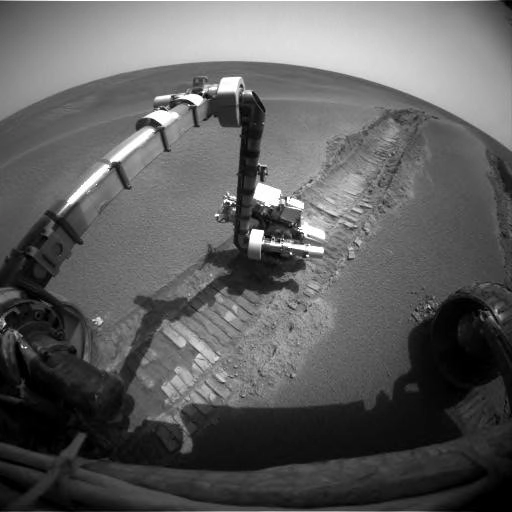
Now free to roam after weeks of being stuck in a sand trap,NASA's Mars rover Opportunity is cautiously inspecting the troubling terrain atMeridiani Planum.
Rover operators on Earth are attempting to discern whatcaused the robot to run afoulof an area now dubbed "Purgatory Dune." Part of that assessment isusing Opportunity's robot arm to study the problem area - and to plot out anexit strategy for safely driving onward.
"It's been slow going at Meridiani lately," notedSteve Squyres, lead scientist for the Mars Exploration Rover missions atCornell University in Ithaca, New York.

"We need to take a good hard look at Purgatory Dunewith the instrument arm, but we've also got to show this dune a lot ofrespect... it got us once, and we don't want it to get us again. So as we'remaneuvering into position on it, we're using a great deal of caution,"Squyres explained in an update to Cornell's Mars web site.
"We've got most of our safeguards on as we approachPurgatory, and we've been setting the limits very conservatively, to make surewe keep the vehicle safe in this treacherous terrain," Squyres said.
Devilish dune
Opportunity has positioned itself a few meters away from thetrouble-making dune.
"Just enough to turn around," Squyres told SPACE.com."Then we're going back to Purgatory to see what we can learn."
By using the extended robot arm, Squyres said researchershope to learn more about grain sizes of the sand, its composition, and whetheror not there's a cemented crust near the surface.
"Whatever we can learn to help us better understandPurgatory Dune," he added.
Why wasn't the robot arm used to disrupt the dune, to helpextract the rover from its predicament?
"The arm is a precision device for placinginstruments... it's not for digging or hauling," Squyres explained."We were always confident that the wheels would get us out if we used themproperly...and they did."
Squyres said that, with Opportunity in position, the plan nowis to use the robot's arm and investigate the area quickly, "and then beon our way."
"It'll feel very good finally to be moving again,"Squyres reported via his web site update.
First mountaineering on another planet
On the other side of Mars, Opportunity's rover twin Spirit ison the move at Gusev Crater. The robot is being maneuvered through the ColumbiaHills, and is now at the south side of an area tagged as Husband Hill.
"We've been spiraling up and around the west side ofthe hill, heading generally south and gaining elevation as we go," Squyresnoted on the Cornell web site. "I've been surprised, as I think the wholeteam has, at how well this part of the climb has gone so far."
Spirit has knocked off several drives of over 65 feet (20meters) lately, with one spurt adding nearly 10 feet (3 meters) of elevation tothe rover's climb. From its vantage point, another passing dustdevil was recently caught by the robot's camera system.
There are two big questions that face the Spirit team. Willthey go for the summit? And if that's accomplished, what can be seen given therover's first good view to the south?
"I really don't know about the summit. We all want it,of course...who wouldn't? We're doing the first mountaineering on anotherplanet, and it would be a little frustrating to get this close and not make itto the top," Squyres said.
Take it sol by sol
Both Squyres and one of the lead Spirit drivers, ChrisLeger, are rock climbers when they are not ascending features on Mars.
"So we both want this...," Squyres said.
On the other hand, driving Spirit to the summit must makesense scientifically.
"The summit is directly between us and the terrain tothe south that we want to explore...so going over the top may be a prettyefficient route to the good stuff," Squyres explained. "Also, the summit reallyis going to offer a pretty good view. Geologists in the field routinely climbto the top of the highest hill to get a good look at their surroundings andplan what they're going to do next, and we may want to do that here as well."
To be evaluated is just how hard Spirit's climb will be.Wasting a lot of time and eating up valuable Martian days, called sols, has tobe weighed. But for now, the robot is pressing forward, Squyres added.
"So I simply don't know what's going to happen. But fornow the going is good...and we'll just take it sol by sol."
- A Mars Rover's Great Escape
- Mars Rover Special Report