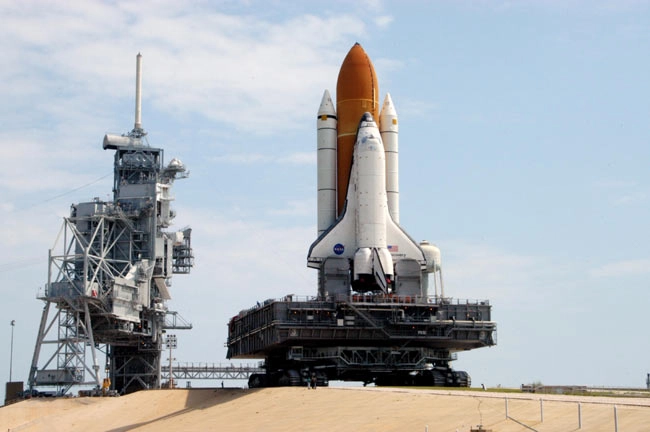
The spaceshuttle Discovery is once again atop its Florida launch pad, after receiving afresh external tank in preparations for NASA's first orbiter flightsince the Columbia disaster.
It tookDiscovery and its Mobile Launch Platform more than 10 hours to reach Launch Pad39B Wednesday at NASA's Kennedy Space Center in Cape Canaveral.
"It's a goodone to have under our belts again," NASA spokesperson Bruce Buckingham said ofthe successful rollout.

Wednesday'srollout began at 1:58 a.m. EDT (0558 GMT) as Discovery's massive crawler carrierinched its way out of the 52-story Vehicle Assembly Building (VAB) and onto the4.2-mile (6.7-kilometer) track to the launch pad.
The space shuttlewas initially slated to begin rollout operations at about 12:01 a.m. EDT (0401GMT), but difficulties switching power systems from the VAB to the transportercarrier, as well as minor clearance issues and the need to remove some accessplatforms, led to the delay, NASA officials said.
USA crawlerdrivers halted the massive shuttle transporter periodically to allowoverheating bearings a chance to cool down before continuing toward the launchpad.
"We had afew stops on the way, but it's there," said Tracy Yates, a spokesperson forshuttle contractor United Space Alliance (USA).
At 12:17p.m. EDT (1617 GMT), Discovery's Mobile Launch Platform settled onto the launchpad, Buckingham added.
Set tolaunch no earlier than July 13, Discovery first reachedits launch pad on April 7, but returnedto NASA's massive Vehicle Assembly Building to switch to a new external tank -originally slated to fuel the Atlantis orbiter during STS-121 - equipped with aheaterto cut down ice buildup.
Shuttlemanagers believed that icedebris from Discovery's original external tank could endanger the orbiterif it shook loose during launch and struck a vulnerable area. That tank willalso be equipped with an additional heater to prevent ice buildup.
Minimizingthe amount of ice and foam debris from shuttle external tanks at launch has beena prime concern for NASA since the Columbia orbiter was struck by asuitcase-sized chunk of tank insulation foam during launch in 2003. That debrisgouged a hole in Columbia's protective thermal skin, and later allowed hotgases to enter the orbiter's wing during reentry on Feb. 1, 2003. The orbiterbroke apart while flying over Texas, killing its seven-astronaut crew.
Discovery'sSTS-114 mission will test a series of orbiter and external tank modificationsto increase shuttle flight safety, as well as resupply the International SpaceStation.
It will be followedby a second test flight, Atlantis' STS-121 mission, later this year, NASAofficials said.
- Fixing NASA: Complete Coverage of Space Shuttle Return to Flight
