





The Voyager 1 spacecraft is on the verge of slicing into interstellar space, NASA officials said today.
Experts had thought the craft was at the solar system's edge back in 2003, but the claim was disputed.
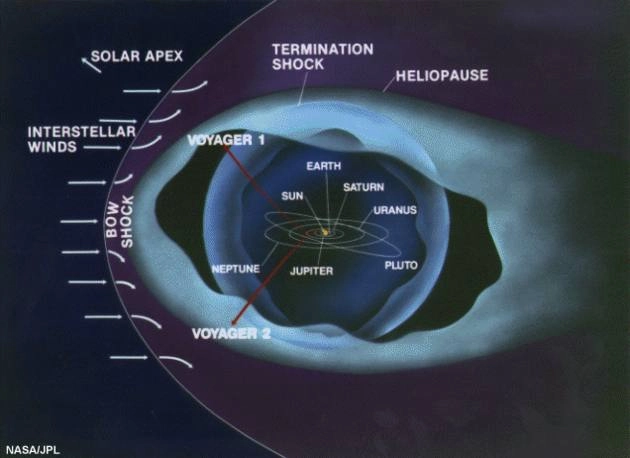
Now team members agree that the Voyager 1, launched in 1977, is plunging through the outer layer of the solar system, where the Sun's influence ends and the electrified solar wind slams into the thin expanse of gas between stars.
It still has a ways to go before it becomes the first manmade object to reach for the stars.
"Voyager has entered the final lap on its race to the edge of interstellar space, as it begins exploring the solar system's final frontier," said Edward Stone, Voyager project scientist at the California Institute of Technology in Pasadena. Caltech manages NASA's Jet Propulsion Laboratory in Pasadena, which built and operates Voyager 1 and its twin, Voyager 2.
In November 2003, the Voyager team said data indicated the probe might have entered the termination shock region of the solar system. Some scientists thought it was only approaching that tumultuous layer, however.
In fact, scientists don't know where the edge is. They assume it moves, as changes in the speed and intensity of the solar wind force the boundary in and out.
"The consensus of the team now is that Voyager 1, at 8.7 billion miles from the Sun, has at last entered the heliosheath, the region beyond the termination shock," said MIT's John Richardson, principal investigator of the Voyager plasma science investigation.


When the solar wind meets interstellar gas, a teardrop-shaped shockwave develops as it is slowed dramatically from an average speed of up to 1.5 million mph (700 kilometers per second). The solar wind, made of charged particles constantly streaming from the Sun, becomes denser and hotter at that point.
Voyager 1 has sent back measurements of a stronger magnetic field at its current location. That indicates the solar wind speed has decreased, scientists said. The magnetic field does not gain overall strength, but it becomes more dense and so stronger at any given location. As a rough analogy, consider how cars huddle closer when highway traffic slows, researchers suggested.
The magnetic field in November 2003 had increased in strength 1.7 times compared to previous levels. In December 2004 it jumped another factor of 2.5 and has remained at this higher level until now.
"Voyager's observations over the past few years show that the termination shock is far more complicated than anyone thought," said NASA scientist Eric Christian.
The leading edge of the solar system, as it orbits the Milky Way, is called the bow shock. It resembles the ripples of water raised by the bow of a boat. Voyager 1 still has years to go before it crosses the bow shock.
The Voyager probes surveyed the outer planets as their primary mission. Each probe could operate through the year 2020, NASA said today in a statement.
The twin probes are on different paths out of the solar system. Voyager 2 is about 6.5 billion miles away.
NASA has an animation showing Voyager approaching the solar sytem's edge.
- Top 10 Voyager Facts
- Voyager's Gravity Mystery
- Fastest Space Storm on Record Reaches Edge of Solar System
- A Glowing Discovery at the Forefront of Our Plunge Through Space
