





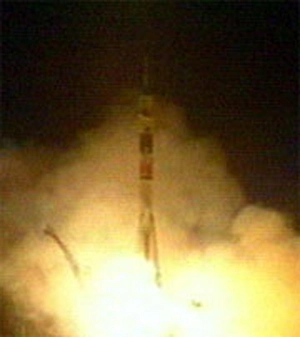
Threeastronauts bound for the International Space Station (ISS) are circling theEarth inside a Russian space capsule after successfully launching into orbitatop a Soyuz rocket.
Tuckedinside their Soyuz TMA-6 spacecraft, ISS Expedition 11 commander SergeiKrikalev, flight engineer John Phillips and Italian astronaut Roberto Vittori,have begun a two-day journey that will ultimately ferry them to the spacestation.
"No problems with thelaunch," Krikalev told flight controllers as his spacecraft rose up fromits launch pad at Baikonur Cosmodrome in Kazakhstan.
Liftoffoccurred on time at 8:46 p.m. EDT (0046 April 15 GMT), though it was 6:46 a.m.Local Time at Baikonur. Vittori and the Expedition 11 crew launched from thesame launch pad that saw Russia'sfirst manned space shot - the successful and historic spaceflight of YuriGagarin - that began the human space age on April 12, 1961.
Vittori andthe Expedition 11 crew are due to arrive at the ISS on April 16 at about 10:10p.m. EDT (0210 April 17 GMT), then open the hatches separating their Soyuzcapsule and the station about three hours later.
ISS crew change
Krikalevand Phillips will relieve the space station's current caretakers, Expedition 10commander Leroy Chiao and flight engineer Salizhan Sharipov, who have beenliving aboard the orbital outpost since October 2004.
Vittori, a visitingastronaut representing the European Space Agency (ESA), will conduct eight daysof science experiments while the Expedition 11 and Expedition 10 crews transferISS control.
All threemen are spaceflight veterans though today's launch marked the beginning ofKrikalev's sixth launch, the most amassed by any cosmonaut. By the end ofExpedition 11, he will have spent about 800 days living in space and set a newall-time record.
But beforethat Krikalev can commemorate his new spaceflight record, Phillips celebratedhis own milestone.
The NASAastronaut celebrated his 54th birthday just before liftoff,receiving birthday wishes from his wife Laura and a handmade sign that said'Happy Birthday Dad.' He has two children.
"We wishyou a safe flight," former cosmonaut Valentina Tereshkova,the first woman in space, told Vittori and the Expedition 11 crew duringprelaunch activities.
"Have agood time and take good care of the space station," said NASA's actingadministrator Fred Gregory before launch.
Preparing for ISS assembly, shuttlevisits
The launchof the Expedition 11 crew marks the beginning of a mission that, NASA officialshope, will see the visit of two space shuttles to the ISS.
Aftertaking control the station from the Expedition 10 crew, Krikalev and Phillipswill have just a few weeks to prepare for the arrival of the Discovery orbiterand NASA's STS-114 mission, the agency's first shuttle flight since the Columbia tragedy.
Just asRussian flight engineers began loading fuel into Expedition 11's Soyuz rocket,their shuttle counterparts at NASA's KennedySpace Centerin Cape Canaveral, Florida completed a fuel loading test ofDiscovery's redesigned external tank. Discovery is set to launch no earlierthan May 15.
"There'ssomething truly aligned about our two space programs," said Bill Gerstenmaier,NASA ISS program manager, after watching the Expedition 11 crew rocket intospace. "We're in a great position to begin with return to flight of the shuttleand return to assembly of the space station."
Duringtheir 180-day spaceflight, Krikalev and Phillips will also perform twospacewalks to support the ISS, receive two cargo delivers aboard unmanned Russiansupply ships and host the crew of NASA's STS-121 crew aboard Atlantis - theagency's second return to flight shuttle mission - when it arrives sometime inJuly.
They alsohope to see the arrival of a third ISS crewmember, something the space stationhas gone without since NASA grounded its shuttle fleet after the loss of Columbia. Two-personcrews have kept the ISS in working order until renewed shuttle flights couldonce again begin delivering the supplies needed to support a larger crew.
"The maintenance work required when you have three people onboard is basically the same as when you have two people on board, and you'vegot one whole extra person to do the scientific work," Phillips said inprelaunch NASA interview. "I think of it as kind of symbolic, it gets us backon the road to recovery."
- Complete Coverage: ISS Expedition 11
