SEARCH:

advertisement


Robotic Balloon Probe Could Pierce Venus's Deadly Clouds

By Robert Myers
Special to SPACE.com
posted: 07:00 am ET
13 November 2002

By Robert Myers

NASA contractor Global Aerospace recently developed a hybrid satellite-balloon. The contraption, dubbed the StratoSail, was originally conceived as a way to control the paths of weather balloons floating at the edge of space.

Yet this match made in the heavens might be headed for a very real hell: the nightmarish atmosphere of Venus. Global Aerospace's Dr. Alexey Pankine has conceived a rough-and-ready variant he calls DARE: Directed Aerial Robot Explorer.

"(With DARE) you can perform atmospheric studies, and you can have cameras," says Pankine. But that's just the start of the possibilities. "It can have small (probes) that can be dropped, and they can do chemical analysis of the surface. Or they could be small rovers. Or small planes that could descend, or go in circles that return to the balloon."

Exploring Venus with balloons is not itself a new idea. In 1985, two Soviet-launched spacecraft (Vega 1, and Vega 2) dropped unguided balloons below Venus's acidic cloud cover. Lasting 56 minutes and 46.5 hours respectively, Vegas 1 and 2 recorded strong winds and downward gusts. However, the unguided vehicles were at the mercy of the harsh environment, lacked cameras or additional probes, and could not be directed to fly over specific regions.
TECH WEDNESDAY
Visit SPACE.com to explore a new technology feature each Wednesday.
>>Go to Tech Wednesday archive page

   Images

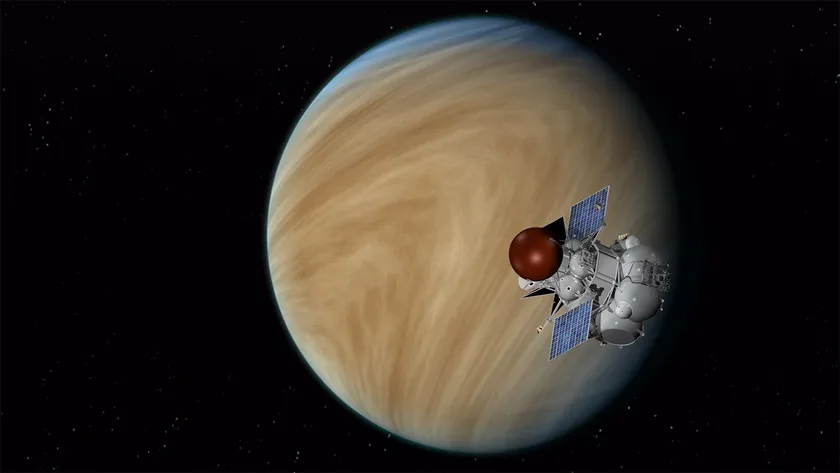
The DARE robotic probe could fly the unfriendly skies of Venus, sampling the poisonous atmosphere and photographing the mysterious surface. Dangling at the end of the lower tether is a payload of drop-probes ready to be Released. CREDIT: Global Aerospace Corporation. Background image D. P. Anderson, Southern Methodist University


A schematic of the gondola for the proposed DARE robotic balloon mission to Venus. CREDIT: Global Aerospace


An overview of Global Aerospace's proposed DARE mission to Venus. Floating above Venus's surface, the balloon navigates using the StratoSail, while releasing its payload of probes. CREDIT: Global Aerospace

   Related SPACE.com STORIES

Venus Express Mission Would Explore Sister Planet Mysteries


Ice Melter Could Find Europa's Warm Heart


Twin Mars Rovers: Planning for a Safe Landing


Japan Plans 2007 Mission to Venus

   TODAY'S DISCUSSION
What do you think of this story?
>>Uplink your views

Pankine's plan is more ambitious.

"The biggest difference from conventional balloons is (DARE) would be there for hundreds of days," says Pankine, "And they would not be at the mercy of the winds."

Venus: Always Fresh and Exciting

Earth's next door neighbor on the Sunward side, Venus makes the frozen deserts of Mars seem brisk and refreshing. Aside from being only spitting-distance from the Sun, Venus has a day even longer than its year. That means the lighted side has the dubious privilege of soaking up the powerful sunlight for about 122 straight Earth days -- before plunging into an equally long night. Writhing beneath the planet's opaque clouds of sulphuric acid, a dense carbon dioxide atmosphere traps that heat creating a supercharged greenhouse effect.

Those clouds kept the oven-like surface of Venus hidden from human eyes until 1983, when the Soviet spacecraft Venera 15 and Venera 16 used radar to map the surface. But as one mystery was dispelled, another rose to take its place. What those cloud-penetrating maps revealed was a planet surface so fresh you almost expect it to have that new-car smell (with more than a hint of sulphur).

Every so often it seems the entire surface of the planet is re-paved, as though a giant Zamboni were periodically laying down a new layer of rock.

"We want to understand the surface," says Pankine. "The surface is very young, we don't see many craters. The number of craters suggest the age of the surface. If you look at the Moon, it's covered with craters."

Even more perplexing, says Pankine, recent evidence seems to suggest that whatever wiped the crater record blank seems to have done the entire planet all at once, and it might be a regular incident. The latest such catastrophic re-paving seems to have happened about 500 million years ago, which is about 1/8th as long as the age of the planets.

Pankine says a popular theory is a veritable global festival of volcanoes.

"Suddenly you would have all the volcanoes erupting simultaneously," says Pankine. "Something very catastrophic, but we don't know what it is."

Flying the Unfriendly Skies

"Right now we can have an orbiter that observes the surface from high altitude. Or we can have a lander or rover," says Pankine. "Or we can have a probe like Galileo that they just drops into the atmosphere. But they are all limited in the area they can cover."

To study Venus's currently sedate surface though, you to get closer than a satellite's orbit. And the only way to do that, yet still cover more than a few yards of ground, is with guided balloons such as DARE.

But not just any balloon. Surviving in the hot, dense, turbulent and acidic air of Venus will take a balloon that scoffs at danger.

"Yeah, it's (Venus) pretty nasty," admits Pankine. "But these problems were dealt with before. For this mission materials (will be used) that can withstand the acid in the atmosphere. It is feasible with current materials."

Actually, in some ways Venus is one of the most balloon-friendly planets in the solar system.

"(By comparison) Mars has a very thin atmosphere, like the stratosphere of Earth," says Pankine. "(A similar balloon for Mars) would be on the order of 30m (90ft) in diameter. You'd need a very large balloon because the atmosphere is so thin."

The thin air of Mars would also mean the balloon would be practically hugging the ground.

"This (Mars) balloon would float about 10km (6 miles) above the surface. That would put it in danger of the topography. The balloon could actually crash into a mountain," Pankine warns.

The good thing about the thick air of Venus is it would provide a lot more lift, meaning a smaller balloon that floats at a safe height above the terrain.

"On Venus (the balloon) would be about 55km (33 miles) above the surface. The balloon would be small, about 10m (30ft) in diameter," says Pankine.

Navigation and Probes

The key to the mission would be weathervane-like StratoSail. Twisting in the wind on a tether far below the balloon's gondola, the StratoSail would control the balloon's movement and altitude. The control wouldn't be very exact, but it's far better than a rudderless meander through the sky.

Capping off the plan, Pankin proposes that the craft's gondola carry with it smaller versions of more traditional planetary probes -- such as penetrators, and rovers. These could be dropped or parachuted down when the gondola's camera's spy an interesting patch of land.

The gondola could also carry a flock of small probes that fly by flapping their wings, called entomopters. An entomopter could be released from the gondola, with or without a tether, and fly a wider area around the craft gather data before returning.

The cameras and other sensors on the rugged gondola itself would provide unprecedented close-ups of large swaths of an alien world. By comparison, a Mars orbiter may take in the whole planet, but smallest visible features are close in size to football fields. While a lander might get intensely intimate with the surface rocks, it can only observe about as much square footage as an average back yard.

However, a balloon, halfway between the surface and the vacuum of space, strikes a balance.

"You can observe the whole planet with hundred day probes," says Pankine, and do so in intensive detail. "We want to understand the atmosphere of Venus and we also want to understand the surface. There are very interesting features there. We want to have a closer look at them from the point of view of chemistry, meteorology, and surface structure."

Pankine believes the information will provide greater insight into the Earth's air, surface, and molten innards. Because whatever forces have driven Venus to become a world of extremes, are also at work here. Venus might provide clues to Earth's past, or its fate.

"Maybe Venus is the future of the Earth," Pankine wonders. "And we don't want that."


     about us | FREE Email Newsletter | message boards | register at SPACE.com | contact us | advertise | terms of service | privacy statement      DMCA/Copyright

     © Imaginova Corp. All rights reserved.