





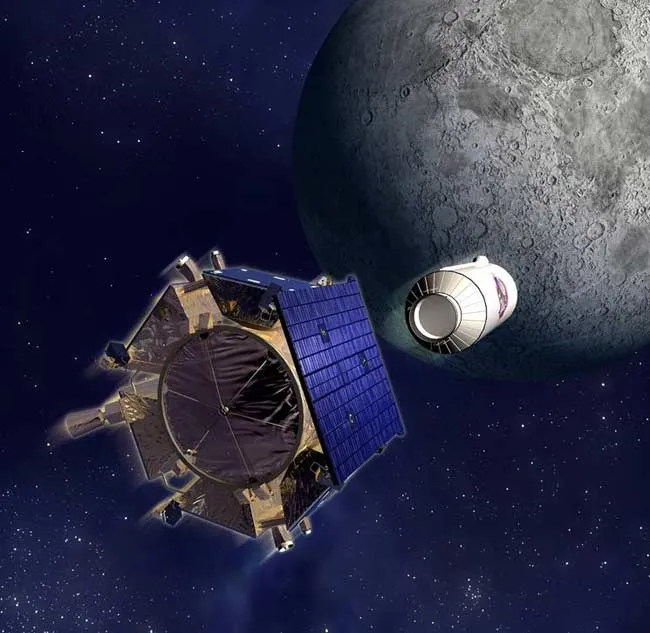
Scientists arepriming two spacecraft to slam into the moon's South Pole to see if the lunardouble whammy reveals hidden water ice.
TheEarth-on-moon violence may raise eyebrows, but NASA's history shows that suchmissions can yield extremely useful scientific observations.
"Ithink that people are apprehensive about it because it seems violent or crude,but it's very economical," said Tony Colaprete, the principal investigatorfor the mission at NASA?s Ames Research Center in Moffett Field, Calif.
NASA'sprevious Lunar Prospector mission detected large amounts of hydrogen at themoon's poles before crashing itself into a crater at the lunar South Pole. Nowthe much larger LunarCrater and Observation Sensing Satellite (LCROSS) mission, set for aFebruary 2009 moon crash, will take aim and discover whether some of thathydrogen is locked away in the form of frozen water.
LCROSS willpiggyback on the LunarReconnaissance Orbiter (LRO) mission for an Oct. 28 launch atop an Atlas 5rocket equipped with a Centaur upper stage. While the launch will ferry LRO tothe moon in about four days, LCROSS is in for a three-month journey to reachits proper moon smashing position. Once within range, the Centaur upper stagedoubles as the main 4,400 pound (2,000 kg) impactor spacecraft for LCROSS.
The smallerShepherding Spacecraft will guide Centaur towards its target crater, beforedropping back to watch - and later fly through - the plume of moon dust anddebris kicked up by Centaur's impact. The shepherding vehicle is packed with alight photometer, a visible light camera and four infrared cameras to study theCentaur?s lunar plume before it turns itself into a second impactor and strikesa different crater about four minutes later.
"Thispayload delivery represents a new way of doing business for the center and theagency in general," said Daniel Andrews, LCROSS project manager at Ames,in a statement. "LCROSS primarily is using commercial-off-the-shelf instrumentson this mission to meet the mission's accelerated development schedule and costrestraints."
Figuringout the final destinations for the $79 million LCROSS mission is "like tryingto drive to San Francisco and not knowing where it is on the map,"Colaprete said. He and other mission scientists hope to use observations fromLRO and the Japanese Kaguya (Selene) lunar orbiter to map crater locationsbefore LCROSS dives in.
"Nobodyhas ever been to the poles of the moon, and there are very unique craters -similar to Mercury - where sunlight doesn't reach the bottom," Colapretesaid. Earth-based radar has also helped illuminate some permanently shadowedcraters. By the time LCROSS arrives, it can zero in on its 19 mile (30 km) widetargets within 328 feet (100 meters).
Scientistswant the impactor spacecraft to hit smooth, flat areas away from large rocks,which would ideally allow the impact plume to rise up out of the crater shadowsinto sunlight. That in turn lets LRO and Earth-based telescopes see theresults.
"Byunderstanding what's in these craters, we're examining a fossil record of theearly solar system and would occurred at Earth 3 billion years ago,"Colaprete said. LCROSS is currently aiming at target craters Faustini and Shoemaker,which Colaprete likened to "fantastic time capsules" at 3 billion and3.5 billion years old.
LCROSS researchersanticipate a more than a 90 percent chance that the impactors will find someform of hydrogen at the poles. The off-chance exists that the impactors willhit a newer crater that lacks water - yet scientists can learn about thedistribution of hydrogen either way.
"Wetake [what we learn] to the next step, whether it's rovers or moreimpactors," Colaprete said.
This comesas the latest mission to apply brute force to science.
The DeepImpact mission made history in 2005 by sending a probe crashing into cometTempel 1. Besides Lunar Prospector's grazing strike on the moon in 1999, theEuropean Space Agency's Smart-1satellite dove more recently into the lunar surface in 2006.
LCROSS willtake a much more head-on approach than either Lunar Prospector or Smart-1,slamming into the moon's craters at a steep angle while traveling with greatermass at 1.6 miles per second (2.5 km/s). The overall energy of the impact willequal 100times that of Lunar Prospector and kick up 1,102 tons of debris and dust.
"It'sa cost-effective, relatively low-risk way of doing initial exploration,"Colaprete said, comparing the mission's approach to mountain prospectors whoused crude sticks of dynamite to blow up gully walls and sift for gold.Scientists are discussing similar missions for exploring asteroids and planets suchas Mars.
Nevertheless,Colaprete said they "may want to touch the moon a bit more softly"after LCROSS has its day.
- VIDEO: Deep Impact: 'To Poke a Comet'
- IMAGES: Poised for Impact
- VIDEO: Moon 2.0: Join the Revolution