


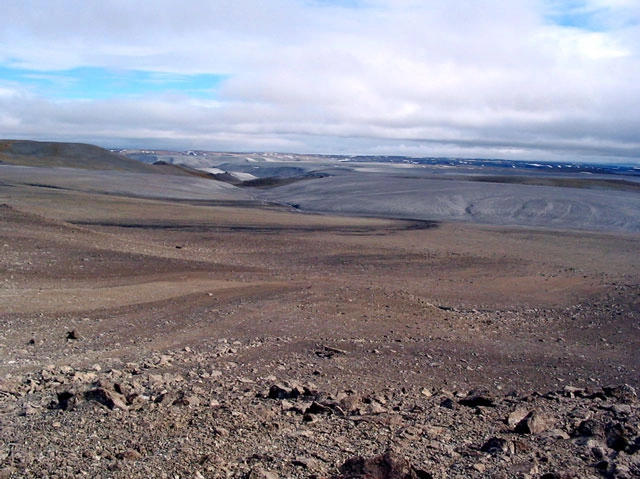
TheNASA Haughton-Mars Project (HMP) is an international field research projectcentered on the scientific study of a very special island in the Canadian HighArctic, Nunavut Territory. Devon Island is theworld's largest uninhabited desert island. It is cold, dry, desolateand contains an amazing feature -- a 24-kilometer wide impact crater that is 23million years old. All of this means that Devon Islandis a very good environment for scientists studying what it would take toconduct a manned mission on Mars.
Lookinginto Haughton Crater from the rim is an awe-inspiring sight. It is like lookingupon a vast Mars-like alien landscape that goes on as far as the eye can see.Dr. Pascal Lee (SETI Institute/Mars Institute/NASA Ames) recognized the beauty andvalue of Devon Island early on. Since 1997 Dr.Lee has been organizing expeditions to Devon Islandfor the NASA HMP. The HMP is headquartered at NASA Ames Research Centerand is managed jointly by the SETI Institute and by the Mars Institute.
EverySummer during the HMP field season, scientists andgraduate students from around the world are gaining important insights into thehistory of water and past climates on Mars, the effects of impacts on Earth andon other planets, and the possibilities and limits of life in extremeenvironments. The HMP Science program not only furthers our currentunderstanding of Mars, but also offers insight into what astronauts might wantto look for during real Mars expeditions in the future.
Inparallel with its Science program, the NASA HMP supports an Exploration programaimed at developing new technologies, strategies, humansfactors experience, and field-based operations which are key to planning thefuture exploration of the Moon, Mars and other planets by robots and humans.
Inthe summer of 2004, I was recruited by the Mars Institute to participate in theHMP as a photojournalist for their Education and Public Outreach Program. I hadgone the year before as a representative of the Space Frontier Foundation andhad been intensely inspired by the many Mars-related research projects beingconducted. This year was even more exciting.
TheDAME (Drilling Automation for Mars Exploration) project was organized by a teamfrom NASA Ames and Honeybee Robotics. The full-scale Mars-prototype deep drillwas tested this season under field conditions at a high-fidelity Mars-analogsite within Haughton Crater. The Mars-1 HumVee Rover served as a drillingplatform for the first drill site.
Ateam from Hamilton Sundstrand continued their research with their ConceptSpacesuit for Advanced Planetary Exploration, primarily focusing oncommunications. The Autonomous Medical Care Initiative, being done betweenmultiple NASA centers, collected data during several different tests, which includedcollaborations with Hamilton Sundstrand and the DAME team.
Amongthe more permanent structures at the NASA HMP Base Camp, the the Arthur Clarke Mars Greenhouse (donated by SpaceRef Interactive, Inc.), continued its research, nowself-powered with two windmill structures and solar panels.
TheCore Module of the new NASA HMP Base Camp configuration (the HMP X-1 Station)was built which will serve as a hub, connecting the tents into a starconfiguration. Many other science research projects were going on as well, bothin and out of Haughton Crater.
Thefull Education and Public Outreach Journal from 2004 can be found on the NASAHMP website http://www.marsonearth.org in the Field Reports section. There youcan follow along with the day-to-day adventures on Devon Island and get a taste for what participants are experiencing andlearning each year. Contact information can be found on the site for thoseinterested in participating in the upcoming field season.
Elaine Walker is the founderand visionary of the electronic pro-space band called ZIA. She has served onthe Board of Directors of both the National Space Society and the SpaceFrontier Foundation.