





IMAX hasbeen involved with space since its inception. Journey to the Outer Planets andTo Fly were two of the first films made in this large format. They took theaudience, with breathtaking clarity, to places only dreamed of previously. Atthe beginning of the Space Shuttle era, IMAX formed a partnership with LockheedMartin, which led to a highly successful string of films starting with HailColumbia, The Dream is Alive, and many others, including the most recent, SpaceStation 3D.
These filmsall appeared after the Apollo era was complete. Our missions to the Moon endedin December 1972 without any IMAX cameras flying there with the astronauts asthey do today on the shuttle and station. It has thus been impossible to trulyshare the experience of landing and walking on the Moon with everyone on Earth,until now.
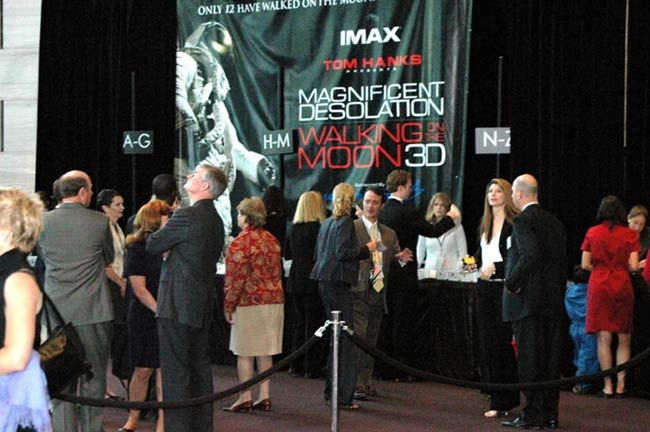
MagnificentDesolation: Walking on the Moon 3D opened September 23 with the widestrelease of any IMAX film. Two days previously, a world premiere event was heldat the Smithsonian's National Air and Space Museum in Washington, D.C. Inattendance were a gathering of many Apollo and Space Shuttle astronauts, theAdministrator of NASA, officials from IMAX, and a few Hollywood celebrities.
The mostvisible person was the one man responsible for making Magnificent Desolation happen, Tom Hanks. Tom is known for his devotion to theexploration of space. He always held a fascination with human flights out of theatmosphere, but this gelled during his starring role in Apollo 13, a decadeago. Soon after making that film, he was compelled to create From the Earth tothe Moon, the epic 12-part miniseries for HBO.
Even afterall that, Hanks felt there was more to the story of the Moon landings, apersonal one of the men themselves and what they experienced. On top of that,he felt a television or traditional movie screen could never impart the realfeeling of being on another world, which is ultimately what he wants to convey.
As BradWexler, IMAX Chairman, told me, "Tom Hanks brought the project to us. Hefelt that the story of the men who walked on the Moon had never really beentold, and the way the IMAX medium works, it really breaks down the wall withthe audience and sucks you in. His goal is very, very simple: When you leavethe theater, he wants you to feel as if you've walked on the Moon! IMAX is themedium to tell that story."
Throughserendipitous happen-stance, the release of the movie coincided with theannouncement, just days previously, of NASA's plan of action to get humanityoff this planet and into deep space, with a return to the Moon by2018 or even earlier.
Two time Space Shuttle veteran astronaut, Roger Crouch (STS-83& 94), told me at the premiere, "I think there's a synergism betweenNASA and the results of this movie. It has a positive view toward spaceexploration. When I go talk to school children about space, it always crystallizestheir vision of the future. I really see their excitement come up. I think it'svery important not only for the kids but for adults to have that positivevision of the future."
Movies andliterature have often provided the basis for inspiration, so I asked Roger whatmade him want to get involved in space in the first place, what inspired him tobecome an astronaut.
"WhenI was about nine years old, I saw a movie called Destination Moon. They did allthese really exciting things, it had all this adventure and other cool stuff,but then at the end of the movie it said 'The end of the beginning,' and thatreally captured my imagination. The future of the world was that adventure ofgoing to the Moon or going into space."
Will thismovie inspire the next generation to go into space? "Yes," Rogerreplied, "I'm hoping it will, I really am. Seeingthis movie in 3D will be absolutely awesome."
Hissentiments were shared by Apollo 17 Commander Eugene Cernan."I've been trying to share with people what it was like to walk on theMoon for over three decades," he said, "trying to recreate thatenvironment in their minds. I think this movie will help take them therevisually, and if you let your imagination wander, almost physically."
Howimportant does Gene believe it is for movies like this to be produced in orderto help inspire the public?
"Absolutely significantly important. I think the public will rallyaround this movie. I think you're going to see every IMAX theaterin the country filled to capacity.
"Peopleask me all the time," Gene continued, "'Why did we quit? When are wegoing back?' They're starved for something like this. It's exciting, it's aromance. Space and aviation have been a romance for a hundred years. Thegreatest and most important legacy that Orville and Wilbur [Wright] left us wasthe inspiration for people like me and those that follow to dream. Dream theimpossible, then make it happen. That's what this isall about."
The hope ofMagnificent Desolation is the rekindling of memories for those of us who werethere to watch in person and give those who weren't, afirst- hand perspective. For NASA Administrator Michael Griffin, this task isvery important in implementing our future vision to return to the Moon and gobeyond.
Griffintold me, "The biggest lesson I want to bring forward from the Apollogeneration is commitment. The President has set us on a far more exciting and afar more strategically important course for America's manned spaceflightprogram than we've had for 45 years. We need to get on that course."
Russell"Rusty" Schweickart (Apollo 9 Lunar ModulePilot) was the first person to pilot the craft that would land us on the Moon,but he never got to touch down there himself. How did he feel after seeing thefilm?
"It'sreally very, very good. What [the audience is] going to do is get thistremendous experience, the really high-quality, three dimensional experience ofwalking around on the Moon. It's very powerful, especially for kids. I thinks it's going to have a big impact. You realize thedegree of risk we were willing to take and the adventuresome spirit that wasembedded in Apollo. You kind of miss it when you realize we haven't had thatrecently. "
Living witha moonwalker had a significant impact on the life of Nancy Conrad. Better thanmost, she understands what it must have been like to be there because her latehusband, Apollo 12 Commander Pete Conrad, shared his adventures with her overtheir many years together.
"Iguess we all get to go to the Moon in this movie," she said. "Ifinally get to see what Pete saw. It's about time I got to go! I wish Pete werehere to see this movie himself. He would have jumped up and clicked both heelsand said 'Whoopee!' When I got the invitation to attend this evening, Tom[Hanks] wrote me and said Pete was inviting us all to come back."
WaltCunningham (Apollo 7), an astronaut who also did not make it to the Moon, saidof the movie, "I think it's excellent, it's very inspiring. Since I didn'tget to fly to the Moon, this is an immersion experience that makes me feel verygood and also makes me feel very envious of my friends who went."
Then Waltconfided in me that he did find a small fault in the movie. "You and Iboth know that we had four remarkably successful missions that laid thegroundwork for them [Apollos 7, 8, 9, & 10]. Itell you, most of the public doesn't remember and once more they are going tosee this film and think we just picked up and went to the Moon, landed, and didit again and again."
Hecertainly has a point, but obviously you can only put so much into a 40-minutefilm and getting across the feeling of landing and walking on the Moon was themandate of Magnificent Desolation. To that end, it succeeds beyond anythingthat has ever come before.
CommanderJim Lovell of Apollo 13 fame had the opportunity to land on the Moon, and thenit was yanked away by the near catastrophe. As he walked in to see MagnificentDesolation for the first time, I asked him if he was looking forward to steppingonto the Moon vicariously. He confided, "That's why I'm here. Since Imissed it on [Apollo] 13, I might as well see what I missed in 3D!"
Nearlyeveryone who is asked if they want to travel to the Moon and kick around on itsdusty surface, as did those twelve from Apollo, answer positively. With threeSpace Shuttle flights and one long duration stay aboard the International SpaceStation already under his belt, you might think Carl Walzwould say he has had enough of spaceflight. Instead, he enthusiastically jumpedon board.
"Iwould love to go to the Moon. I would sit on that rocket, you bet!"
WatchingMagnificent Desolation puts all of us on that flight to the Moon.