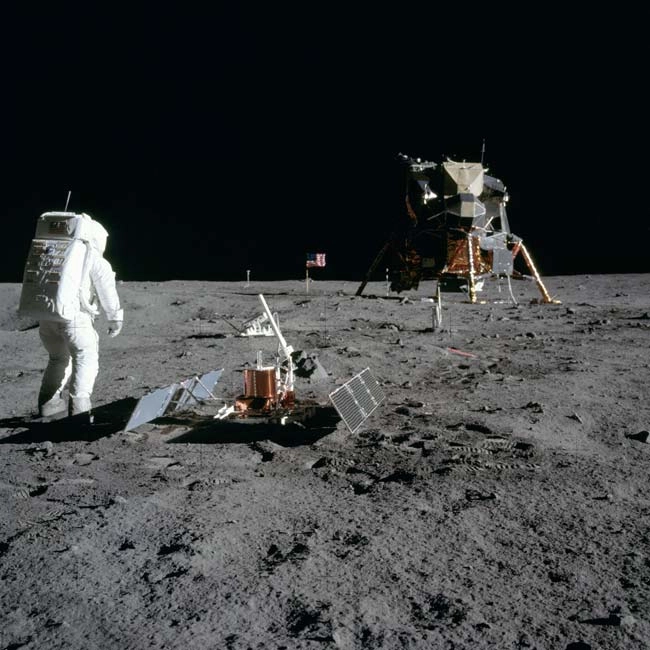
TheApollo 11 astronauts returned from the moon 40 years ago today, but they left behindmore than footprints. An experiment they placed on the moon?s surface is stillrunning to this day.
TheLunar Laser Ranging Experiment is the only moon investigation to continuouslyoperate since the Apollo11 mission. The experiment studies the Earth-Moon system and beams the datato labs around the world, including NASA's Jet Propulsion Laboratory (JPL) inPasadena, Calif.
"Yes,we are still going," said James Williams, a JPL scientist involved withthe experiment, in an e-mail interview.

Datafrom the ranging experiment has been used to learn ? among other things ? thatthe moon has a fluid core and is moving away from the Earth, and thatEinstein's Theory of Relativity is accurate.
Theinstrument itself, called a lunar laser ranging reflector, was originallyintended to accurately calculate the distance between the Earth andmoon by measuring the round-trip time of a laser fired from Earth to areflector on the instrument.
Theaverage distance from the centers of the Earth and the moon was calculated tobe 238,897 miles (384,467 km). NASA scientists say the measurement is one ofthe most precise distance measurements ever made and is equivalent todetermining the distance between Los Angeles and New York to one-hundredth ofan inch.
Theaccuracies will continue to improve as observatorieson Earth improve their technology.
"Technicalimprovements at the observatories rejuvenate the lunar laser rangingeffort," Williams said in 2004, when the experiment turned 35.Williams is one of four JPL scientists that analyze the data from the LunarLaser Ranging Experiment. "When the range accuracy improves, it is likegetting a new experiment on the Moon."
Theinstrument itself does not require any power to operate on the moon (only thelasers on Earth do), so it's likely to be in service for many years to come.Scientists at the University of California, San Diego and the University ofWashington are working with a new lunar ranging instrument that hassignificantly improved accuracy at the Apache Point Observatory in New Mexico.
"Theusefulness of continued improvements in range determinations for furtheradvancing our understanding of the Earth-moon system will keep the lunarreflectors in service for years to come," Williams said.
Thelunar measuring, ongoing for 40 years now, is by no means the longest-runningexperiment. Physicist Thomas Parnell set up aslow pitch-drop experiment in 1927 that has continued long after his death,with about one drop of the gooey stuff falling each decade. Other experimentsstill underway date back to the mid-1800s.
- New SPACE.com Video Show: Moon Shots: Apollo Astronauts Remember
- Image Gallery - Apollo 11: The Historic Flight in Pictures
- SPACE.com Special Report - THE MOON: Then, Now, Next