You are now subscribed
Your newsletter sign-up was successful
Want to add more newsletters?
Delivered daily
Daily Newsletter
Breaking space news, the latest updates on rocket launches, skywatching events and more!
Once a month
Watch This Space
Sign up to our monthly entertainment newsletter to keep up with all our coverage of the latest sci-fi and space movies, tv shows, games and books.

Once a week
Night Sky This Week
Discover this week's must-see night sky events, moon phases, and stunning astrophotos. Sign up for our skywatching newsletter and explore the universe with us!

Twice a month
Strange New Words
Space.com's Sci-Fi Reader's Club. Read a sci-fi short story every month and join a virtual community of fellow science fiction fans!
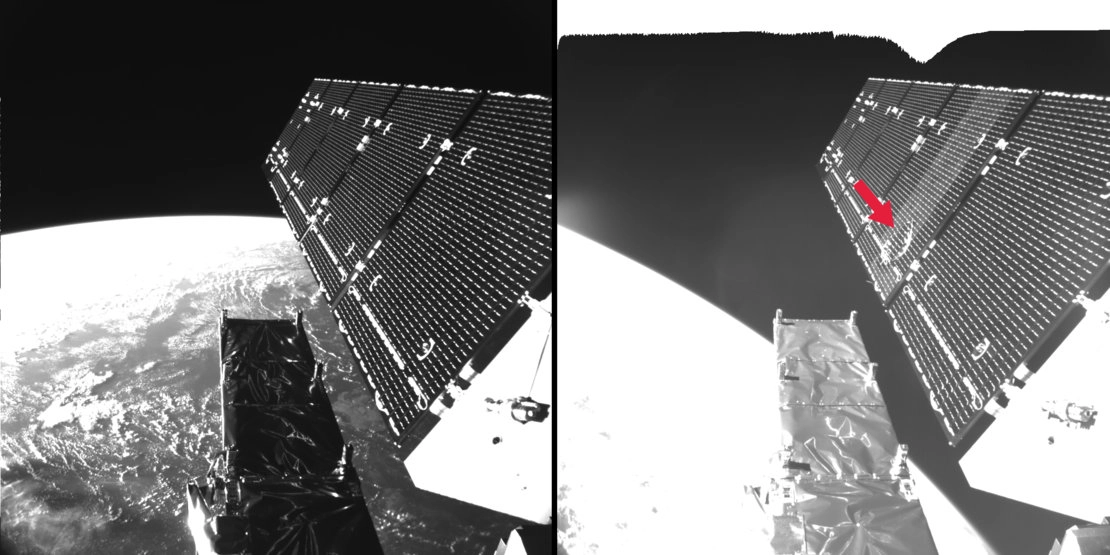
European Space Agency (ESA) engineers reported today (Aug. 31) that a solar panel on the Copernicus Sentinel-1A satellite was hit by a millimeter-size particle in orbit on Aug. 23.
The strike produced a sudden small power reduction and slight changes in the orientation and the orbit of the satellite. You can see our video overview of the space particle strike here.
"Following a preliminary investigation, the operations team at ESA's control center in Darmstadt, Germany suspected a possible impact by space debris or micrometeoroid on the solar wing," according to an ESA statement.
Engineers decided to activate the cameras onboard the spacecraft to acquire pictures of the array. These cameras were originally carried to monitor the deployment of the satellite’s solar wings just a few hours after launch in April 2014, and were not intended to be used afterwards.

Following their switch-on, one camera provided a picture that clearly shows the strike on the solar panel.
"Analysis continues to obtain indications on whether the origin of the object was natural or man-made. The pictures of the affected area show a diameter of roughly 40 centimeters [16 inches] created on the solar array structure, confirming an impact from the back side, as suggested by the satellite’s attitude rate readings," Holger Krag, head of the Space Debris Office at ESA’s establishment in Darmstadt, Germany, said in the same statement.
This event has no effect on the satellite’s routine operations, which continue normally, ESA stated.
The two Sentinel-1 satellites, part of the European Union’s Copernicus Program, are operated by ESA on behalf of the European Commission. The spacecraft help scientists monitor a variety of processes and activities on Earth.
Leonard David is author of "Mars: Our Future on the Red Planet," to be published by National Geographic this October. The book is a companion to the National Geographic Channel six-part series coming in November. A longtime writer for Space.com, David has been reporting on the space industry for more than five decades. Follow us @Spacedotcom, Facebook or Google+. Originally published on Space.com.