





Think Halloween is just for Earth? Think again! The universe is full of strange and spooky sights, from ghostly figures lurking in clouds of cosmic dust to terrifying skulls, zombie stars and even a giant jack-o'-lantern grinning back at us from the sun.
But don't worry, there's nothing supernatural going on here. These eerie apparitions are actually fascinating astronomical objects, captured by some of the world's most powerful telescopes and spacecraft. And while they might look like something straight out of a horror movie, the science behind them is often even more extraordinary.
So, in the spirit of Halloween, we've rounded up 13 of the creepiest cosmic images guaranteed to give you a fright. Take a look, if you dare!
Ghostly hand

It looks like a ghostly hand reaching out across the cosmos, complete with eerie, skeletal fingers. But this spooky structure is actually a vast cloud of energetic particles surrounding the remains of a dead star.
Nicknamed the "Hand of God," MSH 15-52 lies about 16,000 light-years from Earth. At its heart is a pulsar called PSR B1509-58, the rapidly spinning, incredibly dense remains of a massive star that exploded as a supernova.
The pulsar sends out streams of energetic particles, creating a glowing cloud known as a pulsar wind nebula. In this image, X-ray observations from NASA's Chandra X-ray Observatory reveal the hand-shaped structure, while observations from NASA's Imaging X-ray Polarimetry Explorer (IXPE) help astronomers understand how magnetic fields guide the particles through the nebula, forming its long, finger-like features.
Screaming skull

Yikes! This ghastly face in space appears to be screaming while suffering through a miserable, fiery death. But no real skulls were harmed in the making of this photo. It's actually an X-ray image of a cluster of galaxies known as the Perseus Cluster, captured by the Chandra Observatory.
Space ghosts

Ghastly figures appear to be fighting to escape from this cloud of interstellar gas and dust called SH2-136. The illuminated dark nebula is about 1,200 light-years away, towards the constellation Cepheus.
Asteroid skull

How did this skull wind up in space? A radar image of asteroid 2015 TB145, which NASA says is likely a dead comet, was captured using the Arecibo Observatory in Puerto Rico on Oct. 30, 2015. Astronomers determined that the asteroid likely completes one rotation every 2.94 hours and that it reflects just 5 or 6 percent of the sunlight that hits it.
Solar jack-o'-lantern

This striking NASA image shows the sun with an eerie jack-o'-lantern-like grin. Captured by the Solar Dynamics Observatory on Oct. 8, 2014, this composite photo reveals bright magnetic hotspots that form the "face"—two eyes, a nose, and a wide, spooky smile, with faint “ears” on each side.
Zombie Pac-Man nebula

An ominous-looking cosmic skull lurks in the constellation Cetus, about 1,600 light-years from Earth. Known as NGC 246, the aptly nicknamed "Skull Nebula" is a planetary nebula formed when a dying star sheds its outer layers into space.
The glowing cloud of gas is illuminated by the hot stellar remnant at its center, creating an eerie sight that looks remarkably like a skull staring back at us. Some observers also call it the "Pac-Man Nebula," thanks to its resemblance to the hungry video game character.
Witch Head nebula

A witch appears to be cackling out into space in this eerie image from NASA's Wide-Field Infrared Survey Explorer, or WISE. The infrared portrait shows the Witch Head nebula, named after its resemblance to the profile of a wicked witch.
Ever feel like you're being watched?

Is the Eye of Sauron watching us from space? This eerie red ring surrounding a dark center certainly looks like something straight out of "The Lord of the Rings."
But there's nothing sinister lurking here. This is the Fomalhaut star system, located about 25 light-years from Earth. The glowing ring is actually an enormous belt of icy and dusty debris surrounding the star Fomalhaut, which has been deliberately blocked out in this Hubble Space Telescope image to reveal the much fainter material around it.
And there's another mystery hiding in this cosmic eye. What astronomers once thought was a planet orbiting Fomalhaut is now believed to have been a vast cloud of dust created by a collision between two large objects. Talk about a dramatic ending!
Spooky face on Mars

Though we have yet to find any aliens on Mars, NASA did discover this creepy human face on the Red Planet. The original "Face on Mars" image was taken by NASA's Viking 1 orbiter, in grey scale, on July, 25 1976. NASA assures that the face is simply a peculiar pile of rocks — but that doesn't make it any less spooky!
Ghost Head nebula

The Ghost Head Nebula's two flaming-hot eyes peer at us all the way from the Magellanic cloud, located about 170,000 light-years away from Earth. Its glowing eyes are star-forming regions with hot blobs of hydrogen and oxygen.
Black Widow nebula

This giant, red space spider is the biggest black widow we've ever seen! But don't worry — it won't bite. It's actually just a nebula, or a cloud of interstellar gas and dust.
Zombie star

This colorful cosmic ghost is all that remains of a star that met a spectacularly violent end more than 450 years ago.
Known as Tycho's supernova remnant, this eerie cloud of stellar debris lies about 13,000 light-years from Earth. Its explosive origins were first spotted in 1572, when astronomers, including Danish astronomer Tycho Brahe, noticed what appeared to be a bright new star in the night sky.
But this wasn't a new star at all. It was the death of a white dwarf, which exploded in a Type Ia supernova after pulling material from, or merging with, a companion star.
The explosion completely destroyed the white dwarf, sending debris hurtling into space. In this image from NASA's Chandra X-ray Observatory, the colorful clumps reveal material thrown out by the blast, while the bright blue outer shell traces the expanding shock wave.
More than four centuries later, this stellar ghost is still revealing secrets about its explosive past.
Cosmic jack-o'-lantern
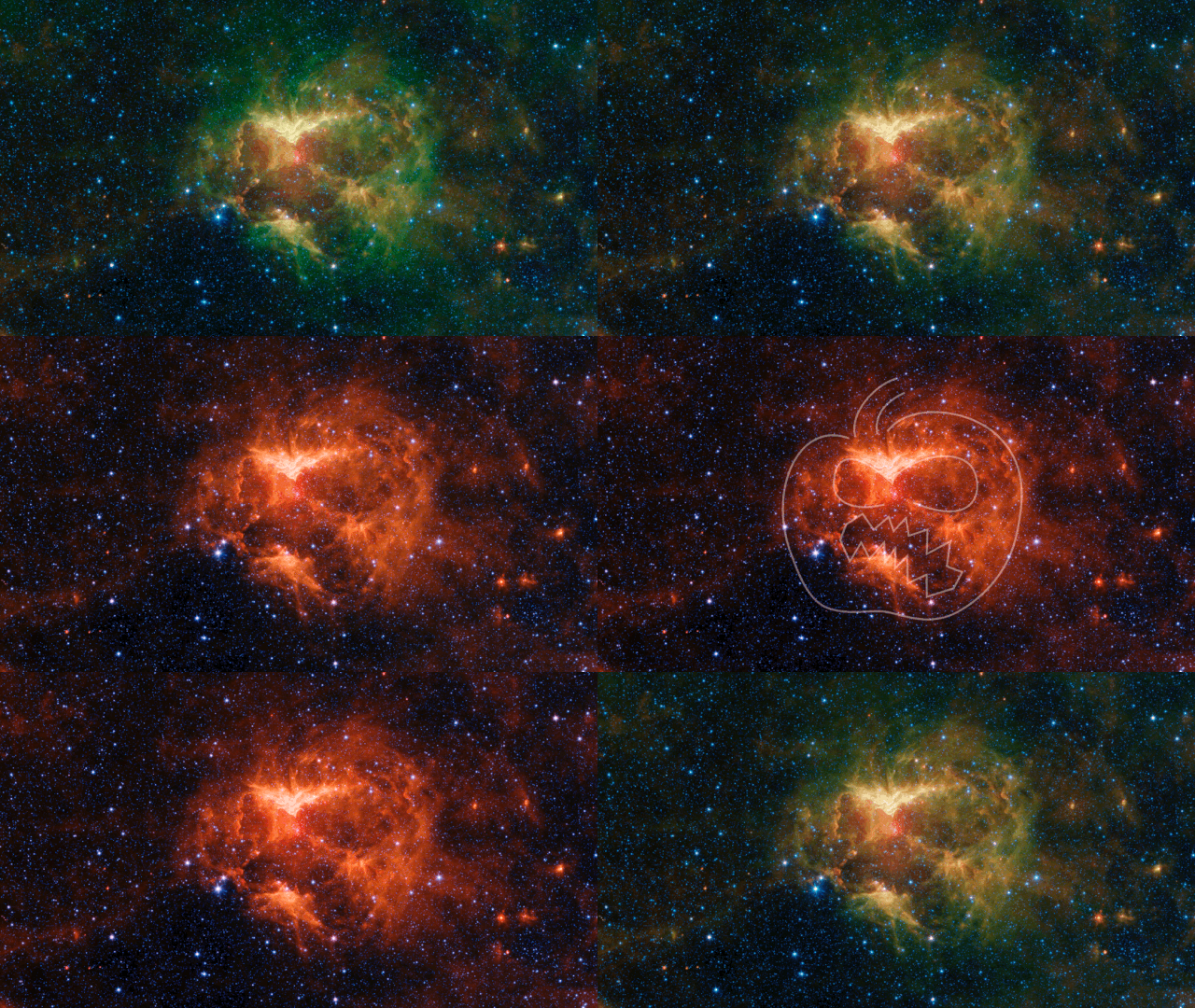
NASA's Spitzer Space Telescope has spotted a cosmic jack-o'-lantern.
Researchers uncovered the grimacing pumpkin while mapping star formation in the outer region of the Milky Way. An animation of the nebula outlines the hollowed-out pumpkin, which appears to be screaming into space.
The carved-out cloud of gas and dust is caused by the outflow of radiation and particles from a massive O-type star that is 15 to 20 times more massive than the sun, according to a statement from NASA.