Raise shields and charge phasers, because we're running down the best "Star Trek" spaceships from across the galaxy.
When Matt Jefferies started designing the original USS Enterprise, "Star Trek" creator Gene Roddenberry told him he didn't want to see rockets or jets propelling the ship. "I bought whatever I could find on 'Buck Rogers' and 'Flash Gordon' and pinned it up on the wall," Jefferies explained. "I said, 'That we will not do.'"
It's fair to say the artist came up with a truly brilliant solution, as the saucer/warp nacelle design of Kirk's Enterprise became a cultural icon. Its legacy survives 60 years later, with an updated version of that famous ship currently flying through "Strange New Worlds", and every other "Trek" spin-off featuring a descendant of that famous design. Starfleet crews have also faced off against some similarly iconic alien spacecraft along the way.
Now, 60 years after James T Kirk launched his original five-year-mission, we've looked back at some of the most memorable vessels ever to leave Spacedock (or its non-Federation equivalents).
We've limited ourselves to three Enterprises — Captain Archer's NX-01 did not make the cut — but you'll find plenty more of the best "Star Trek" spaceships below, whether friendly or hostile.

1. Galileo shuttlecraft

"Star Trek" famously got around the challenge of landing on a new planet every week by inventing the transporter beam. There are times, however, when only a shuttlecraft is up to the task, and the Galileo flew its first mission in "Star Trek"'s first season — it even gives its name to an episode, "The Galileo Seven".
It's essentially just a box with warp nacelles stuck to the bottom, but the design is so timeless that the shuttlecraft of "The Next Generation" era and beyond are essentially variations on the same theme. The Galileo may be small, but it's also perfectly formed.
2. USS Enterprise (Constitution Class, post-refit)

Matt Jefferies' Original Series Enterprise was — like the crew's uniforms — an instant design classic, but the NCC-1701 reached its peak when it got a top-to-bottom refit for "Star Trek: The Motion Picture".
Andrew Probert's update replaced the cylindrical nacelles with a squarer, sleeker look, and thoroughly modernized the saucer and stardrive sections. This iteration would ultimately be destroyed in "The Search for Spock", but the follow-up NCC-1701-A used the same blueprints. Arguably the most iconic Enterprise of them all.
3. USS Reliant (Miranda Class)

The script for "Star Trek II: The Wrath of Khan" necessitated Kirk's crew going head-to-head with another Starfleet vessel. A clone of the Enterprise would have made things confusing, while a complete design overhaul would have seemed incongruous.
The USS Reliant was the perfect halfway house, a design that kept things consistent with its trademark Federation saucer section, but shook things up by putting the warp nacelles under the primary hull. Less elegant than the Enterprise, perhaps, but still much more noteworthy than "The Search for Spock"'s USS Grissom and USS Excelsior.
4. HMS Bounty (Klingon Bird of Prey)

It was the Romulans who flew Birds of Prey in the Original Series, and they were all set to be the primary antagonists of "The Search for Spock" until Paramount executives pushed for the more famous Klingons. Luckily, Commander Kruge was allowed to hold on to the ship, because variants of this design went on to become a mainstay in later movies and into the "Next Generation" era.
There's a pleasing, "Star Wars"-like grubbiness to the hull, while the powerful weapons and movable wings make it look like an apex predator. The cloaking device is helpful, too, particularly when Kirk takes the rebranded "HMS Bounty" to the 20th century to pick up some whales in "The Voyage Home".
5. The whale probe

It's never entirely clear whether the whale probe is a vessel or a lifeform in its own right, but we're going to assume the former. What is obvious is that this vast probe possesses great power, enough to threaten human existence as it tries to make contact with humpback whales who — thanks to their extinction in the 21st century — have stopped phoning home.
It's the probe's design that's the masterstroke, however: a minimalist and surprisingly effective combination of giant log, energy beam and floating ball. The spacecraft's unknowability — along with its haunting cry — is what makes it so intimidating.
6. USS Enterprise-D (Galaxy Class)
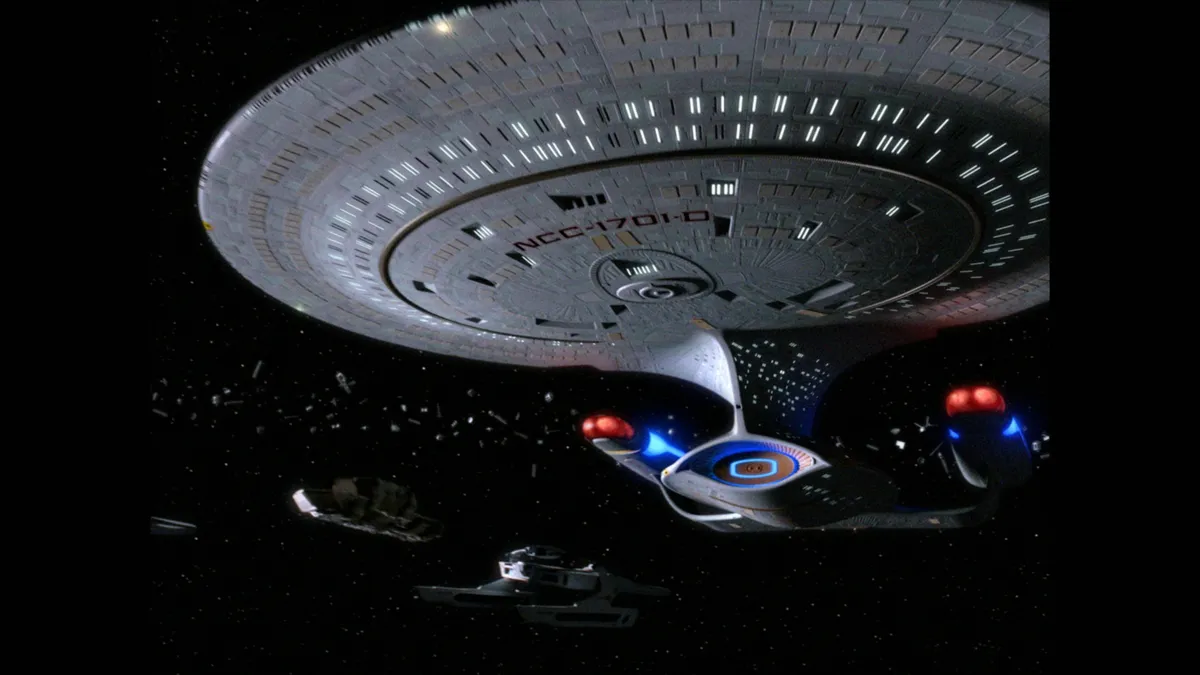
Probert also designed the flagship of "The Next Generation", albeit with a very different brief. Set decades after the voyages of Kirk and Spock in an even more enlightened future, the new show needed a friendlier home for its space explorers.
"I felt like it was an ambassador for Starfleet," said Probert. "It should look unthreatening, it should be very soft." That meant an oversized saucer section, a curvier secondary hull, and plenty of room for families.
It also has the rarely used capability to split into two sections — something that came in very handy in the brilliant episode "The Best of Both Worlds".
7. Romulan Warbird (D'Deridex Class)

Nobody had heard a peep from the Romulans in decades when they turned up in "The Next Generation" episode "The Neutral Zone".
It turned out they'd gone back to the starship drawing board in a big way, replacing the veteran Bird of Prey with a creepy, green design light years away from the shiny white exteriors beloved of the Federation.
The front of the hull is reminiscent of "Battlestar Galactica"'s OG Cylon helmets (Probert worked on both), while their decloaking maneuver is disconcertingly ghostly.
8. Borg Cube

It may look like what happens when other ships get crushed at a scrapyard, but the standard-issue Borg Cube is one of the most intimidating sights in the "Star Trek" universe.
Lacking a front or back — or, indeed, any distinguishable features — the design's uniformity is a cover for seemingly limitless power. Frustratingly impervious to most forms of attack, capable of self-repair, and surprisingly speedy (largely thanks to their ability to negotiate transwarp conduits), Borg Cubes are something you never want to see on your viewscreen.
9. Cardassian Galor Class

Cardassian designs had a major role in "Deep Space Nine", seeing as they built the original Terok Nor station.
Their most significant contribution to "Star Trek" aesthetics, however, may just be their military cruiser, an elaborate design inspired by the emblem of the Cardassian Union (Not the last time a Trek ship would be designed around a logo, as "Starfleet Academy"'s USS Athena also looks a lot like the combadges worn within the faculty).
The Galor Class isn't much to look at in profile, but from above there's a definite invertebrate vibe to the silhouette, even if the ship's back-to-front styling makes it look like it's perpetually in reverse gear.
10. USS Defiant (Defiant Class)

"Deep Space Nine"'s space station setting ensured it was more static than its predecessors, with the crew's occasional away missions undertaken on Runabouts.
The onset of the Dominion War ensured Sisko and co were given something with a little more punch, a "tough little ship" built for battle, supplied with special "ablative armor" and — thanks to a unique deal with the Romulans — its own cloaking device.
Color scheme aside, it's a complete break from Starfleet norms, the design owing as much to the Millennium Falcon as the USS Enterprise. So iconic that — following the destruction of the original USS Defiant — the replacement USS Sao Paulo took its name.
11. USS Voyager (Intrepid Class)

Unlike the Enterprises, Voyager was never designed to be the flagship of the Federation. This was always a more midtable vessel, equipped with some state-of-the-art technologies but only headline-worthy thanks to its extended jaunt across the Delta Quadrant.
Still, this nimble ship is one of the most good-looking in the fleet, with saucer and drive sections that feel like an organic whole, and — in a cool innovation — nacelles that move before a jump to warp.
It also, in season 2 "Voyager" episode "The 37s", became "Star Trek"'s first lead ship to intentionally land on the surface of a planet.
12. USS Enterprise-E (Sovereign Class)

After the Enterprise-D's saucer section crash-landed on the surface of Veridian III in "Generations", Picard and the "TNG" crew needed a new home.
The new-look USS Enterprise-E is more divisive than its predecessors, though it was a result of designer John Eaves' efforts to create a ship that looked better at multiple angles than the notoriously hard-to-shoot Enterprise-D model. In canon, the design reflected the Federation's shift to a more warlike stance after tussles with the Borg and the Dominion.
This was a more functional ship, crafted for battle rather than comfort, with a flatter, more streamlined profile, and — controversially — an elongated saucer section.
13. The Phoenix

AKA where it all began. The Phoenix is the ship warp pioneer Zefram Cochrane used to break the lightspeed barrier, attract the attention of some passing Vulcans, and usher in an era of (give-or-take) galactic peace.
The irony that it's constructed from a World War III nuclear missile is noted, though it's the optional extras that make the Phoenix so memorable — it's like a pair of extendable warp nacelles have been added to a modern-day rocket. There's also a built-in sound system.
The Phoenix is so important to the 'history' of spaceflight in canon that it featured alongside Apollo and the International Space Station in "Star Trek: Enterprise"'s opening credits.
14. Species 8472 Bioship

"Babylon 5"'s computer-driven VFX meant the show featured organic designs from its early days, but with "Star Trek"'s space scenes still dominated by model work, the debut of Species 8472 in the 1997 "Voyager" episode "Scorpion" brought a whole new breed of starship to the franchise.
These squid-like vessels (created in "fluidic space", but similarly adept in a vacuum) were more than a match for the Borg and could join forces to fire a single energy blast of Death Star-esque proportions.