Astronomers investigating mysterious flashes of X-rays believe that these blasts could stem from collisions between neutron stars, the events that forge elements like gold, silver, and platinum.
The event designated EP250704a, was first seen on July 4, 2025, as a blast of gamma rays lasting half a second followed by a bright X-ray emission lasting 10 minutes. After receiving an alert from the joint European-Chinese Einstein probe that witnessed the blast, a team of astronomers started to hunt for its cause by studying the aftermath of the explosion using the European Southern Observatory's Very Large Telescope (VLT), the Very Large Array (VLA), and other telescopes.
According to astronomer Niccolò Passaleva who led the observations of the X-ray flash with the VLT, this cosmic outburst was unlike any scientists had seen before. "This is the longest-lasting prompt X-ray flash ever observed from a neutron star merger," Passaleva said in a statement. "It is an opportunity to have a front-row seat to the most extreme forces of the universe and discover more of its secrets."
Neutron stars are created when massive stars die in supernova explosions, cramming one or two the mass of the sun into a width akin to a city on Earth and creating material so dense that a single teaspoon of neutron star matter brought to Earth would weigh 10 million tons. When these extreme dead stars slam together, they create environments so turbulent and violent they are capable of forging elements so heavy that even the hearts of stars can't do it. Elements like the gold on your finger.
These collision and merger events, marked by flashes of light called kilonovas, have long been associated with flashes of high-energy gamma-rays that disappear within two seconds, but new research suggests some neutron star mergers could reveal themselves via blasts of X-rays lasting minutes.
In particular, scientists have wondered if neutron star mergers could be the cause of hundreds of X-ray flashes in distant galaxies discovered by the Einstein probe since its launch in 2024. While some of these have been linked to the supernova-explosive death of massive stars that can create a neutron star or a black hole, others have defied explanation. EP250704a is one such X-ray flash.
"When I saw the X-ray data from this new event, I realized something was up," team member Eleonora Troja, part of the Einstein Probe European collaboration, said in the statement.
The team believes that there is something special in the neutron star merger mix that results in these X-ray bursts.

Merging with a magnetar
All neutron stars are created the same way from the collapsing core of a massive star, but not all neutron stars are equal.
Just as an ice skater pulls in their arms to increase the speed of a spin, the rapid reduction in radius of a collapsing stellar core can "spin up" the rotation of a neutron star to 'over 700 times per second. This collapse can have another consequence too.
It turns out that magnetic fields get stronger when magnetic field lines are pushed closer together. That means the collapse of a stellar core with an already powerful magnetic field can create a neutron star with the strongest magnetic field in the universe. Those neutron stars have a special name: magnetars.
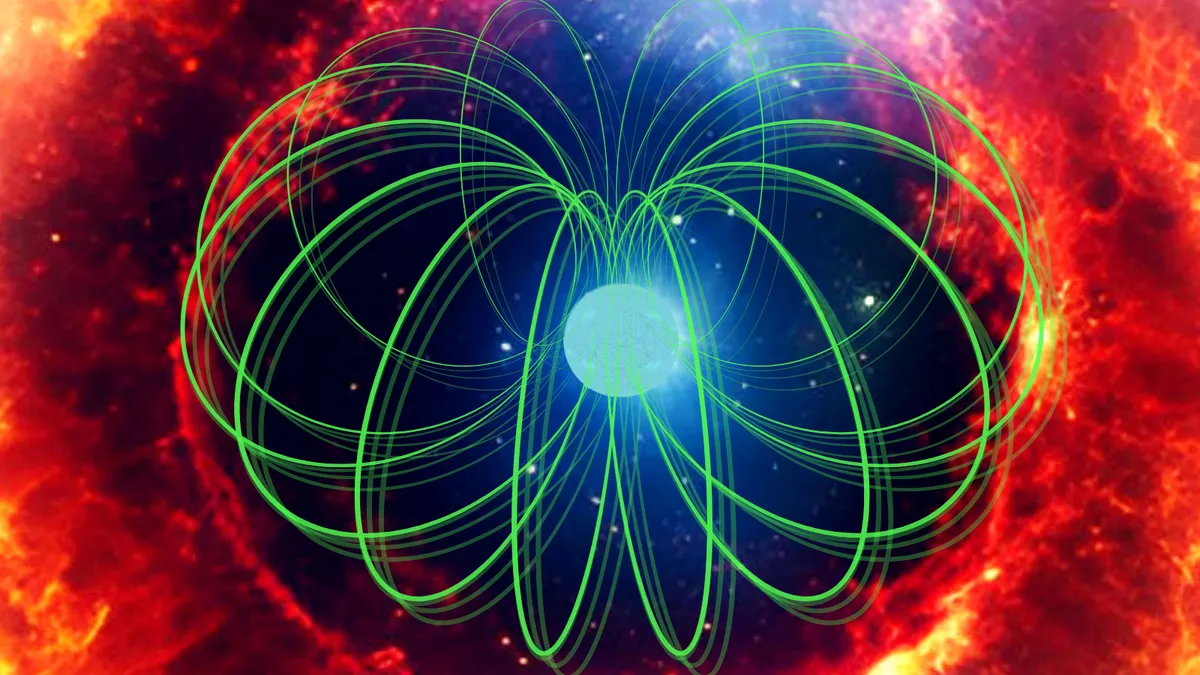
The team behind this research thinks that the neutron star merger in question involved at least one magnetar.
"If the remnant of the collision is a magnetar, it could keep bursting for longer," Troja said. "Magnetars are rapidly spinning neutron stars with huge magnetic fields. When they dump their magnetic power into the surroundings, they can make any explosion brighter and longer-lasting."

The researchers ruled out a supernova as the cause of the X-ray burst and were also able to determine that the light from this collision has been travelling to Earth for 6 billion years.
Discovering more of these extreme X-ray flashes could help astronomers determine how often magnetars are formed through these neutron star mergers, Passaleva said in the statement.
The team's research was published in the journal Science Bulletin.