




For as long as humans have watched the night sky, we have wondered about the moon, pondering everything from its alien appearance to its influence over phenomena on Earth such as ocean tides, climate stability, and even the natural rhythms of many organisms.
Among the many questions we have about Earth's lone natural satellite, one remains preeminent: what are the moon's origins, and how long has it orbited Earth?
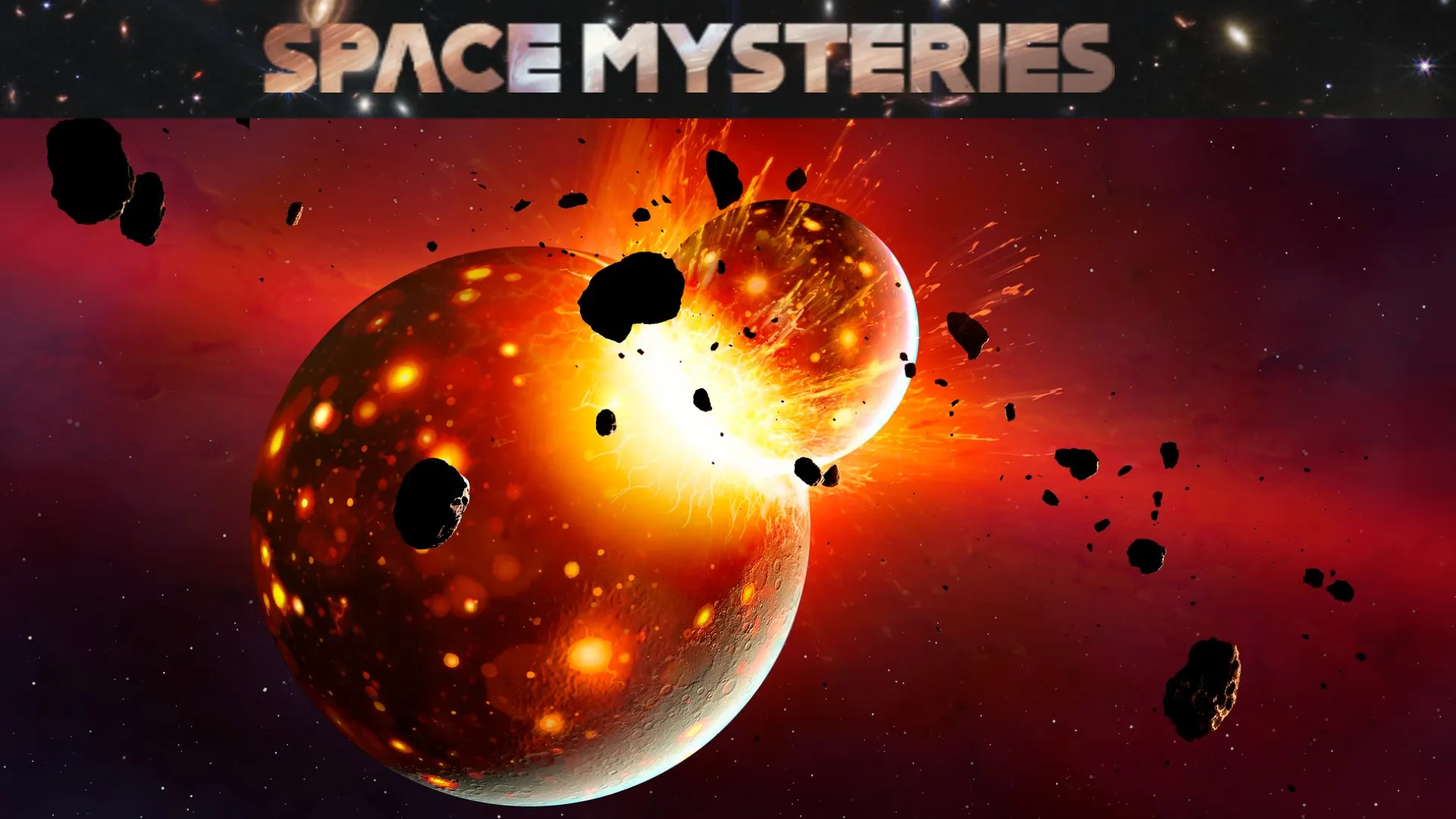
Today, the leading theory among astronomers is that deep in our planet's past — perhaps within roughly the first 100 million years of solar system history — Earth collided with a planet-sized object, creating the moon within a period that may have been as short as just a few hours. Known as the giant-impact hypothesis, this proposed event involves a hypothetical Mars-sized protoplanet astronomers call Theia. The material ejected into orbit by the powerful impact in question would have accumulated afterward, forming the moon that we observe today.
What do we know?
Birth of a lunar origin hypothesis
The evolution of this striking solution to one of the moon's most enduring mysteries goes back to 1946, when geologist Reginald Aldworth Daly was among the first to suggest that an impact event might explain the formation of the moon.
Before Daly, scientists had been leaning toward theories that involved Earth's rapid spin billions of years ago, when each day may have at one time lasted as little as 2 or 3 hours. Decades later in the 1970s, researchers William Hartmann and Donald Davis developed their own models involving collisions of large bodies left over from planetary formation, which could collide with younger planets.
Building on such ideas, other researchers went on to propose similar scenarios between the early Earth and a Mars-sized object. Early in the following decade, the concept eventually claimed its place as the leading lunar-formation process during a landmark conference held in Kona, Hawaii, in 1984.

Evidence of a planetary-scale collision
The popularity of the giant-impact hypothesis can be attributed to the multiple lines of evidence supporting the impact scenario. For instance, researchers have long recognized the similar stable-isotope ratios between both moon rocks and those from Earth, strongly suggesting a link between their origins.
Additionally, the unusually high angular momentum (or spin) of the Earth-moon system, when compared to observations of other rocky planets, also could be explained as one of the effects of a massive collision.
Further clues can be found in the moon's composition, which reveals a relatively small iron core and lower density. This is significant to astronomers, since a hypothetical giant impact would have seen the suspected Theia protoplanet's metallic core merging with the young Earth's interior — meanwhile, lighter mantle and crust material from both worlds would have become dislodged and blasted into orbit, eventually helping form the moon.
Another important piece of evidence involves the relative depletion of volatile substances (a chemical that easily turns into gas or vapor at room temperatures) in lunar material, which again suggests that it might have been lost during an extremely energetic event, an idea further supported by evidence that the early moon once possessed a substantial magma ocean.

What remains unknown?
New research expands on the Theia hypothesis
Still, several significant questions remain, including what precise conditions led to the impact, and how the resulting planetary material evolved into the moon as it appears today.
Recently, a new study by Adeene Denton of Southwest Research Institute and colleagues at the University of Arizona's Lunar and Planetary Laboratory put a new spin on the Theia hypothesis, suggesting that the suspected ancient impact may have been significantly influenced by the heat and physical strength of the two colliding bodies.
The team's findings challenge some long-held views about the giant-impact hypothesis, while lending new support to others. For instance, the team's simulations revealed that while some impacts lead to the creation of a disk of debris that later coalesces into a moon, under other conditions, simulations support the idea that the moon could have been formed in a remarkably short period of time — perhaps within around five hours.
However, one of the primary issues with determining the exact conditions of the giant-impact hypothesis involves the ongoing debate over the moon's age.
"There is a large controversy regarding the age of the moon," said Dr. Erik Asphaug, a planetary science professor at the University of Arizona's Lunar and Planetary Laboratory and one of the new study's co-authors.
In an email to Space, Asphaug explained some of the issues arising from this, since current estimates place the timing of the moon's formation anywhere from around 40 to 120 million years after the formation of the solar system. Therein lies part of the issue, according to Asphaug, who says this timing could have significant implications for models of the Theia impact.
If it had been an earlier collision, Asphaug says this would have involved a hotter Theia due to the greater degree of radiogenic heating; by contrast, a later impact would have meant a cooler and stronger Theia.
"I don't think we know enough yet to say the moon (and by corollary, the Earth) formed this way or that way," Asphaug told Space. "But knowing how temperature affects the result opens up a new dimension for viewing the problem, and that is always helpful because it shifts our frame of reference, like getting out of the car to have a walk around."
A lunar enigma in time and space
For researchers like Asphaug, understanding the moon's formation requires looking at it as more than just an event in space, but also as one in time. Doing so allows comparisons between three different metrics: isotopic decay, temperature-dependent material strength, and the geological record of debris striking other planets — a process through which he believes tighter constraints could be placed on precisely when the moon-forming impact might have occurred.
Adeene Denton, the study's lead author, also emphasized the introduction of the time component her team's research brings to the table, telling Space in an email that the outcome of the moon-forming impact could have depended significantly on the timing of the collision.
"Before, scientists have generally assumed that the outcome of the collision will be the same regardless of when it takes place," Denton wrote. "But now we know that temperature's effect on material properties, which is dictated by how old and/or cold the proto-Earth and Theia might be, alters things substantially."
By connecting impact simulations to data related to the moon's geochemical record, as well as models of early solar system formation, Denton thinks her team's work could help scientists better constrain precisely how and when the moon formed.
The mystery continues
For now, in terms of which possible scenario — an earlier or later collision event — emerges as being the most likely, Denton says it's still difficult to say.
"It depends on which scenarios for solar system formation you favor," Denton told Space.
"I am generally in favor of an earlier formation of the moon, consistent with a rapid planet-building phase in our solar system," Denton said, "but we can't neglect the possibility that the moon formed late."
While much work remains to be done, Denton and Asphaug believe their findings help significantly advance present efforts to resolve some of the questions about the giant-impact hypothesis — a few of which have lingered now for many years.
For Asphaug, however, such lingering questions may simply be part of the scientific process.
"Science has a way of wandering around for a long time until finally it all comes to focus," Asphaug said.
"I believe that will happen, in part thanks to this work, in the coming decade."
