



Static Fire Test Sets Stage for Next Falcon 9 Launch and Landing Attempt
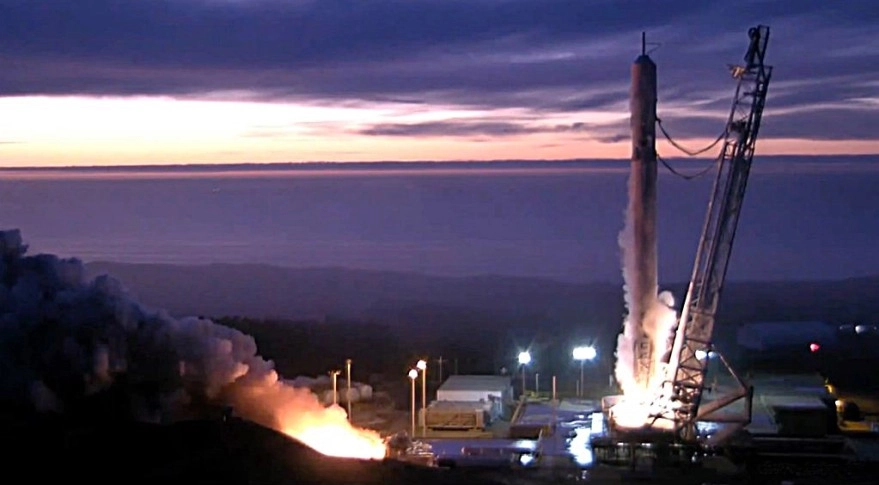
WASHINGTON — SpaceX performed a successful static fire test of its Falcon 9 rocket late Jan. 11, clearing the way for the launch of an ocean science satellite, and another first stage landing attempt, this weekend.
SpaceX carried out the static fire test, a standard part of the company's pre-launch preparations, at 8:35 p.m. Eastern at Space Launch Complex 4 at Vandenberg Air Force Base in California. Preliminary data from the seven-second test "looks good," the company said in a tweet.
A successful test will allow preparations to continue for the Jan. 17 launch of Jason-3, a joint U.S.-French mission to measure ocean surface conditions. The spacecraft, already encapsulated within its payload fairing, will be installed on the rocket as soon as Jan. 12 according to NASA, which procured the launch. [SpaceX Lands Orbital Rocket Successfully in Historic First]
Jason-3 is the fourth in a series of such spacecraft, dating back to the TOPEX/Poseidon launched in 1992. The spacecraft carries instruments provided by the French space agency CNES and the Jet Propulsion Laboratory to measure sea level, wave heights and wind speeds at sea level, as well as water vapor content in the atmosphere. Those data will be used to support both weather forecasting and climate monitoring.
SpaceX also plans to use the launch to attempt another landing of the rocket's first stage. While the company successfully landed a Falcon 9 first stage at Cape Canaveral after the Dec. 21 launch of 11 Orbcomm satellites, SpaceX plans to attempt a landing on a ship in the Pacific Ocean, similar to unsuccessful landing attempts in January and April of 2015.
The decision to land the stage on a ship, rather than on land, is driven at least in part by performance considerations. "Aiming to launch this weekend and (hopefully) land on our droneship. Ship landings needed for high velocity missions," SpaceX Chief Executive Elon Musk tweeted late Jan. 11, after the static fire test.
Musk, in a posting on the SpaceX website prior to the Dec. 21 launch, explained that the Falcon 9 first stage could accelerate 125 tons — the approximate mass of the second stage plus satellite payload — to 5,000 kilometers per hour for missions where the first stage returns to land, but 8,000 kilometers per hour for missions where the first stage lands at sea. The difference, which accounts for the additional propellant needed for the first stage to turn around to return to land, translates into improved payload capacity for missions where the first stage lands at sea.
SpaceX has not disclosed additional details about its Jan. 17 landing attempt. The company did file an application with the Federal Communications Commission Dec. 28 for special temporary authority to perform communications for an "experimental offshore recovery operation, following launch from Vandenberg AFB." That application listed coordinates for a boat and barge in the Pacific about 280 kilometers downrange from the launch site.
The launch will be the first for SpaceX from Vandenberg since the inaugural launch of the Falcon 9 v1.1 rocket in September 2013 carrying the Cassiope satellite. The Jason-3 launch is the last planned launch of the Falcon 9 v1.1, with future launches using an upgraded version of the vehicle first flown on the Orbcomm launch in December.
This story was provided by SpaceNews, dedicated to covering all aspects of the space industry.
