


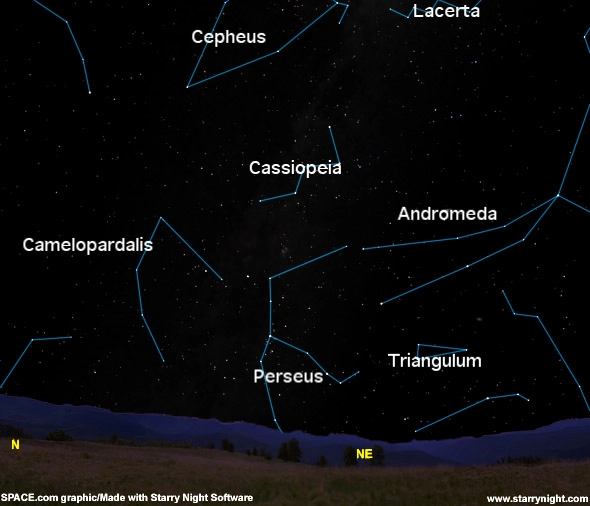
The annual Perseid meteor shower dazzled skywatchers around the globe overnight as it sent a meteor a minute racing overhead during peak hours at some locations. Viewers also reported several very bright shooting stars.
While the event continues for the next several days, the peak activity occurred Wednesday night and Thursday morning.
Larry Caracciolo watched from about 3,500 feet up on Mt. Hood in Oregon.
"The shower seemed to peak between midnight to 1 a.m. local Thursday morning, characterized by lots of bright meteors with luminescent trails," Caracciolo told SPACE.com. "Meteor colors were predominantly red, orange, and blue." Haze cut into the viewing after 1 a.m., he said.
In Germany, Lou Burgess saw about 60 meteors in a one-hour span before dawn Thursday.
"We had a great show last night," Burgess said via e-mail.
Daniel van Os counted 318 meteors in 310 minutes from The Netherlands. He said there seemed to be many that were very bright.
Seasoned meteor observer Marco Langbroek, also of The Netherlands, reported a "peculiar number of bright meteors" during a break in sometimes cloudy conditions. "Very odd," he reported to a meteor-observing bulletin board called Meteorobs.
Several hundred people turned out at the George Observatory Fort Bend County, Texas, to scan the sky. Barbara Wilson reported to Meteorobs a tally of 71 Perseid meteors counted during a two-and-a-half hour stretch. The pace picked up just before clouds blotted out the show, she said.
The Perseids begin in late July and run for about a month, with a sharp peak that generally comes Aug. 11-12. Skywatchers can still expect to see a dozen or so shooting stars each hour Thursday night and Friday morning, with a handful of stragglers into the weekend. Other meteors not associated with the Perseids are also visible this time of year.
Early morning hours are generally the best time to look for meteors, because that is when the side of Earth an observer stands on is facing the space into which the planet plunges on its orbital trip around the Sun. Meteors are scooped up in the predawn hours much like bugs hitting a car's front bumper. During evening hours, meteors must catch up to the planet, so fewer are evident.
The Perseids are the result of stream of debris in space laid down by comet Swift-Tuttle, which orbits the Sun every 130 years and spends most of its time in the far reaches of the solar system. On each pass inward, bits of dust -- mostly the size of sand grains but sometimes as big as marbles -- boil from the comet's surface. When Earth passes through the debris each August, the bits are vaporized in the atmosphere.
The Perseids are said to extend from July 17 to Aug. 24, though the bulk of the activity is concentrated in the days surrounding the peak. The next major meteor shower will be the Leonids in November.
- Viewer's Guide to the Perseids
- Top 10 Perseid Facts
- How Meteor Showers Work
