
• TechMediaNetwork
  • LiveScience
  • SPACE.com
  • Newsarama
  • TopTenREVIEWS
advertisement


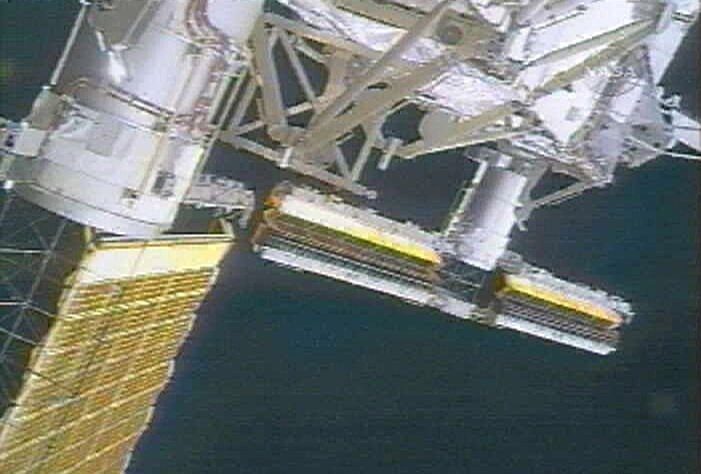
The International Space Station's last set of U.S. solar arrays are slightly deployed in this predawn view from exterior cameras caught on March 20, 2009. The arrays were to be fully extended later that day. Credit: NASA TV.


Mike Tyrrell took these still shots from video he made of three passes of the International Space Station with its new solar panels. The video was shot in March, 2009 from a telescope in a home-built observatory at the back of his garage in Northwich, about 20 miles southwest of Manchester, England. © Mike Tyrrell. Used with permission.


Backdropped by the blackness of space and the thin line of Earth's atmosphere, the ISS with its new solar wings (far right) is seen from shuttle Discovery as the two spacecraft begin their relative separation on March 25, 2009. Credit: NASA.

NASA: Expect 'Spectacular' Views of Space Station This Weekend
By SPACE.com Staff

posted: 30 June 2009
06:21 pm ET

Untitled Document

Over the 4th of July weekend, Americans will have "spectacular views" of the International Space Station as it makes several passes over the country, NASA said Tuesday.

The space station orbits Earth every 90 minutes in a constantly changing pattern. It is brighter than any stars in the sky right now, typically visible near dawn and just after dusk, weather permitting.

It will be almost directly over head during some passes this weekend, according to a NASA statement.

The trick is knowing when and where to look. SPACE.com's Satellite Spotting Guide has full details.

Telescopes are not useful, because the station moves across the sky too quickly, appearing much like other satellites but brighter, sometimes seeming like an airplane on approach to landing. Binoculars, however, can prove useful and might allow a glimpse of some of the station's structure.

The orbiting outpost is visible because it reflects sunlight. It is 357 feet long, about the length of a football field including the end zones, and 45 feet tall. Its reflective solar arrays are 240 feet wide, a wingspan greater than that of a jumbo jet, and have a total surface area of more than 38,000 square feet.

An international crew of six astronauts, including American flight engineer Michael Barratt, is aboard the complex conducting research and continuing its assembly. Other crew members are from Russia, Europe, Canada and Japan.

In March, skywatcher Mike Tyrrell captured videos of the space station with its new solar wings -- which make it brighter than ever -- from his home-built observatory at the back of his garage near Manchester, England.

 

StarMax 90mm EQ Compact "Mak"
$319.95
Explore More


Site Map | News | SpaceFlight | Science | Technology | Entertainment | SpaceViews | NightSky | Ad Astra | SETI | Hot Topics
Image Galleries | Videos | Reader Favorites | Image of the Day | Amazing Images | Wallpapers | Games | Community | Reviews
about us | FREE Email Newsletter | message boards | register at SPACE.com | contact us | advertise with us | terms & conditions | privacy statement
DMCA/Copyright
  What is This?