


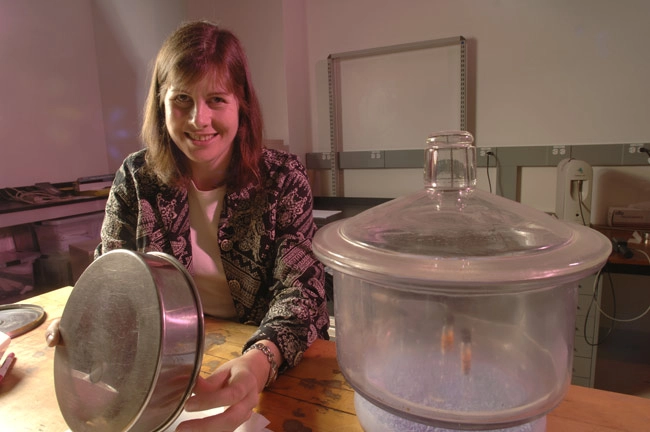
What isMars made of? Dust and many kinds of rock, for sure. But Dr. Janice Bishop, whois both a chemist and planetary scientist, is trying to learn more about the redplanet's makeup by studying the spectral behavior of other materials that mightbe found there. Her group is analyzing pure minerals, rocks from potential Marsanalogue field sites, and meteorites that are rocks from Mars. Spectroscopy is ameans of identifying compounds by the specific wavelengths of light theyreflect, and her expertise in this hi-tech "fingerprinting" schemehas led to her participation in the research programs of many of today'srobotic Mars explorers. These include NASA's new Mars Reconnaissance Orbiter,the highly successful and peripatetic ExplorationRovers, and Europe's Mars Express.
Janice'smost recent publication appeared in Science August 8, 2008: "PhyllosilicateDiversity and Past Aqueous Activity Revealed at Mawrth Vallis, Mars." She'sthe first author for a study that analyzed data from CRISM (Compact ReconnaissanceImaging Spectrometer) on board the Mars Reconnaissance Orbiter. They found evidenceof past activity of water on Mars in the clay mineral signatures recorded by CRISM.
Janice has alsomade investigations into how particles of iron oxide(also known as rust) might have been critically important in life's early days,before an ozone layer could protect biology from the searing ultraviolet rays ofthe sun. Small iron oxide particles could have operated as "sunshades"for these ancient microbes, letting infrared and visible light through (so photosynthesiscould occur), while blocking the damaging ultraviolet. There was a time, billionsof years ago, when living in the rust belt was a good thing. In addition, experimentswith iron oxides in Janice's lab are geared toward understanding the magnetic propertiesof the martiandust. For more information on Janice'sresearch, please visit our website.
Experience a Mars-like Expedition — Only Better!
Would you liketo help investigate solfataric alteration on volcanic islands? Join Janice for aweek in the spectacular wilds of Iceland or the splendid landscapes of Santorinior Hawaii, investigating an analogue site for Mars. You'll get to experience sulfurvents up close and personal, while participating in sample collection and in situspectral measurements.
Some locationsare a bit remote and require a hike with a heavy backpack. The scenery, however,is almost always breathtaking.
SETI Institute's Adopt a Scientist Program
Anyone can adopt a SETI Institute scientistand become part of the adventure!
Each of ourscientists offers a compelling journey of discovery. When you adopt a scientist,you help lead the way towards answering profound questions regarding our place inthe universe. You can form a one-on-one relationship and participate in the processof groundbreaking science with any number of our institute's scientists. In aneffort to ensure that this vital research continues to prosper, our Adopt a ScientistProgram invites you to make a direct contribution to the field.
There are manylevels of commitment starting as low as $1,000, and payment plans are available.
For more informationon the Adopt a Scientist programplease visit our website, email KarenRandall at or call Karen at 650-960-4537.