


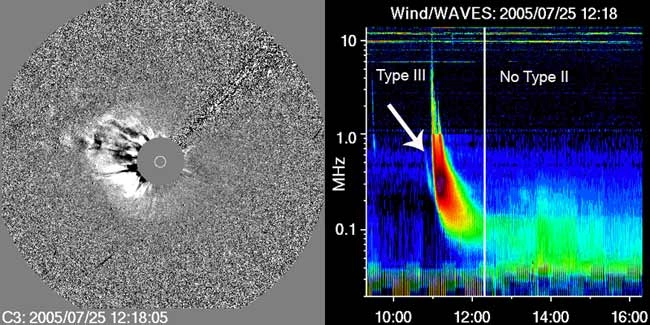
HONOLULU -- Speedysolar storms carrying a billion tons of charged gas through space let out athunderous scream before they unleash satellite-stopping radiation storms thatslam into Earth?s magnetic field.
A team ofastronomers presented this finding here today at a meeting of the AmericanAstronomical Society, one that could give astronauts and engineers forewarningof a type of coronalmass ejection (CME) capable of showering Earth, spacecraft and spacetravelers with damaging radiation.
Coronalmass ejections are violent solar eruptions thatcarry massive amounts of electrically charged gas called plasma from the Sun?satmosphere. Once unleashed, these plasma clouds race away from the Sun at up to a million miles per hour.
Dependingon the orientation of the associated magnetic fields, Earth-ward eruptions cangenerate magnetic storms that can flick a giant circuit breaker of sorts onEarth, causing widespread power outages.?
Radioshowers
Somecoronal mass ejections also bring intense radiation storms that can disablesatellites or cause cancer in unprotected astronauts.
Here?s howthese radiation ?snowstorms? form: As a CME plows through space it bumps intothe charged particles constantly blown from the Sun called the solar wind,resulting in a shock wave. If the shock is powerful enough, it acceleratesparticles in the solar wind to high speeds capable of triggering radiationstorms.
"SomeCMEs produce radiation storms, and some don't, or at least the level ofradiation is significantly lower," said lead researcher NatchimuthukGopalswamy of NASA's Goddard Space Flight Center in Greenbelt, Md.
Forinstance, the Solarand Heliospheric Observatory (SOHO) has observed more than 10,000 CMEs overthe past 10 years, Gopalswamy said, and only about 1 to 2 percent of themproduce these particle storms.
"Thetrick is to identify the ones that can produce dangerous radiation, so we canwarn astronauts and satellite operators,? Gopalswamy said.
Radioscreams
Gopalswamyand his team may have found a way to do just that. Like the calm before a storm(but louder), they found that CMEs with shocks capable of unleashing radiostorms are preceded by ?screams? in radio waves as they barrel through the solarwind.
Theyanalyzed nearly 500 large coronal mass ejections, finding that while theso-called radio-loud CMEs (those that were preceded by ?screams?) led toradiation storms, none of the more than 150 radio-quiet CMEs were followed bysuch storms.
Since radiowaves travel at the speed of light, the screams could give forewarning of animpending radio, or radiation, storm.?
"Wecan use a CME's radio noise to give warning that it is generating a radiationstorm that will hit us soon," Gopalswamy said. "This will giveastronauts and satellite operators anywhere between a few tens of minutes to acouple hours to prepare, depending on how fast the particles are moving."
The teamalso noticed that most of the radio-loud CMEs came from the Sun?s equator, aplace known as an active region for solar flares, while most of the radio-quietCMEs sprouted from the Sun?s edges.
Images:Solar Storms
Mysteriesof the Sun
Top10 Sun Images from SOHO
