


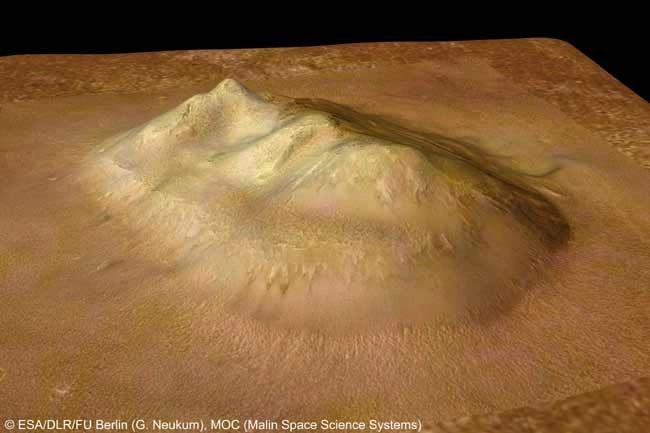
NASA started it all back in 1976 with an image of an interesting mountain on Mars and a caption that described it as appearing to have eyes and nostrils.
Thirty years later, the Face on Mars still inspires myths and conspiracy theories.
New images from the European Space Agency's Mars Express orbiter will confirm for many that the features are natural, while no doubt offering tantalizing "clues" to others of an ancient intelligent civilization at work.
The spacecraft's High Resolution Stereo Camera provides data the researchers turn into colorized perspective views, which simulate the scene as though you were flying high over the region in an aircraft. The data was obtained in July and the images released today. [Images 1, 2]
"They not only provide a completely fresh and detailed view of an area so famous to fans of space myths all around the world, but also provide an impressive close-up over an area of great interest for planetary geologists, and show once more the high capability of the Mars Express camera," said Agustin Chicarro, ESA Mars Express project scientist.
The feature known as the Face, along another skull-like feature and pyramid-looking hills in the vicinity, are in an area called Cydonia in the Arabia Terra region. It is a transition zone between the southern highlands and the northern plains, and it contains wide valleys and ancient remnant mounds, called massifs, of many shapes and sizes.


The massif that became the infamous "Face" was first seen in a photo taken on 25 July 1976 by NASA's Viking 1 Orbiter. NASA scientists thought it looked like a human head, and although they knew it was just an illusion, the agency's Jet Propulsion Laboratory issued this caption:
"The speckled appearance of the image is due to missing data, called bit errors, caused by problems in transmission of the photographic data from Mars to Earth. Bit errors comprise part of one of the 'eyes' and 'nostrils' on the eroded rock that resembles a human face near the center of the image. Shadows in the rock formation give the illusion of a nose and mouth. Planetary geologists attribute the origin of the formation to purely natural processes." [Read the full caption.]
A strong myth developed, holding that the Face was an artificial structure built by some ancient civilization. Surrounding pyramids-also just interesting-looking massifs-fueled the myth. Last year, a study helped explain why: People see faces that aren't there-on Mars or in clouds-because we have "over-learned" to recognize the human face.
Other photographs of the Face taken more recently show that from different angles, it does not look much like a face.
ESA scientists are interested in the geology of the region. Landslides and broad debris aprons show how the heavily eroded surface has changed over time, helping them piece together the real Martian past.
- Images: A Tour of Mars
- Face on Mars: Why People See What's Not There
- Top 10 Alien Encounters Debunked
- Life's Little Mysteries
