





Ever since the Cassini spacecraft began taking pictures of Saturn and its moons last February, scientists have had plenty of work on their plates. Last week several new images and data from the mission were published in the journal Science.
Among the findings is the detection of molecular oxygen around Saturn's A ring. ( The ring system begins from the inside out in this order: D, C, B, A, F, G, E.)
Molecular oxygen forms when two oxygen atoms bond together. It is rarely seen beyond Earth, where it is created continuously as a byproduct of photosynthesis in plants.
On Saturn, where there is no plant life, molecular oxygen must be formed in a different way -- through a chemical reaction between the Sun's radiation and the icy particles that comprise Saturn's rings, scientists said.
Scientists studying radiation in the rings of Saturn also found evidence of oxygen. Doug Hamilton of the University of Maryland said the main radiation belts in the rings are comprised mostly of oxygen and water.
"That is most likely the result of the bombardment of the planet's rings and icy moons by the radiation trapped in Saturn's magnetic field," Hamilton said.
Molecular oxygen has also been found above the icy Galilean moons of Jupiter.
Working in coordination with Hamilton's group, a group of scientists at the Applied Physics Laboratory at Johns Hopkins University found an unexpected radiation belt in the D ring. And they learned that the radiation belts of Saturn are more intense on the night-side of the planet.
Invisible moon?
Images of the narrow Keeler gap in Saturn's A ring offer circumstantial evidence of an unseen moon.
The Keeler gap is narrow, only 26 miles (42 kilometers) wide. Several faint discontinuities, or spikes, in the outer edge of the gap have been discovered and are similar to spikes seen in the core of the inner F ring, which is home to the moon Prometheus.
Based on the similarity to the features caused by Prometheus in the F ring, it is likely that the newly discovered features are the product of the passage of a yet-unseen moonlet on an eccentric orbit within the Keeler gap. The tiny moon would have a diameter of only a few miles. It was first reported last November.
New ring phenomena
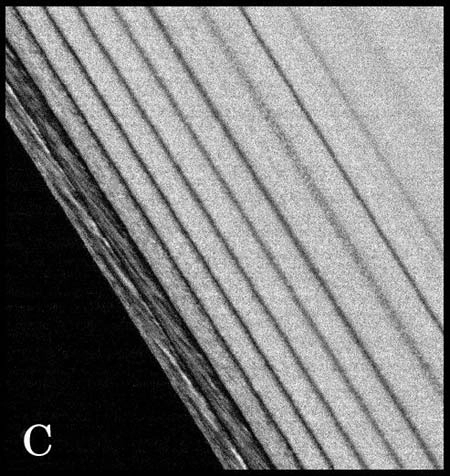
An assortment of new ring phenomena was observed on the dark side of Saturn's rings immediately after Cassini entered orbit. The new ring variations may be evidence of the clumping and aggregation of ring particles, most likely caused by gravitational effects of Saturn or other bodies.
Closer looks at gravitational disturbances in the rings could lead to the discovery of new ring-bound moons.
As the particles comprising the rings orbit Saturn they pass through what are called Pan wakes, wavy features seen in the outer edges of the A ring. They are the result of the tiny moon's gravitational pull on the particles in this ring.
As the particles orbit through the Pan wakes, they are forced closer together than normal and create a ropy appearance. Similar ropy features seen in other regions of the rings could be evidence of hidden moons.
New rings
Also, several new faint rings have been spotted in new images from Cassini. Many of these are in various gaps between other, larger rings and may indicate the presence of tiny moons, either coincident with the ring or close by. [NASA has a summary here.]
One ring, which was reported earlier, lies in the same orbit as the small moon Atlas.
Porous moons
Other new data from the inner rings has yielded more reliable approximations of the masses of two of Saturn's ring-bound moons, Atlas and Pan.
The research implies the moons are very porous - similar to moons orbiting just outside Saturn's rings. The low densities suggest that all the inner moons and satellites were smaller bits and pieces that were gravitationally pulled together; basically orbiting rubble piles.
Trojan moon
Late last year it was reported that researchers had found a new moon orbiting Saturn, but recent findings suggest that it is instead a "Trojan moon."
Trojan moons are companions to larger moons. In this case, the 3-mile-wide (5-kilometer) Polydeuces orbits Saturn in lockstep with the larger moon Dione.
More to come
The deluge of images and data from Cassini will continue for the next three-plus years. Early in March, the orbiter will swing past Enceladus, whose surface is relatively young - 100 million years or so - and has many interesting features.
The ice that coats it is especially clean, and gives the moon the highest albedo, a measure of light reflectivity, of any body in the solar system. Enceladus has an albedo greater than 90 percent, whereas the Earth and its moon have albedos of 38 percent and 12 percent, respectively.